 MichelangeloItalian, 1475–1564
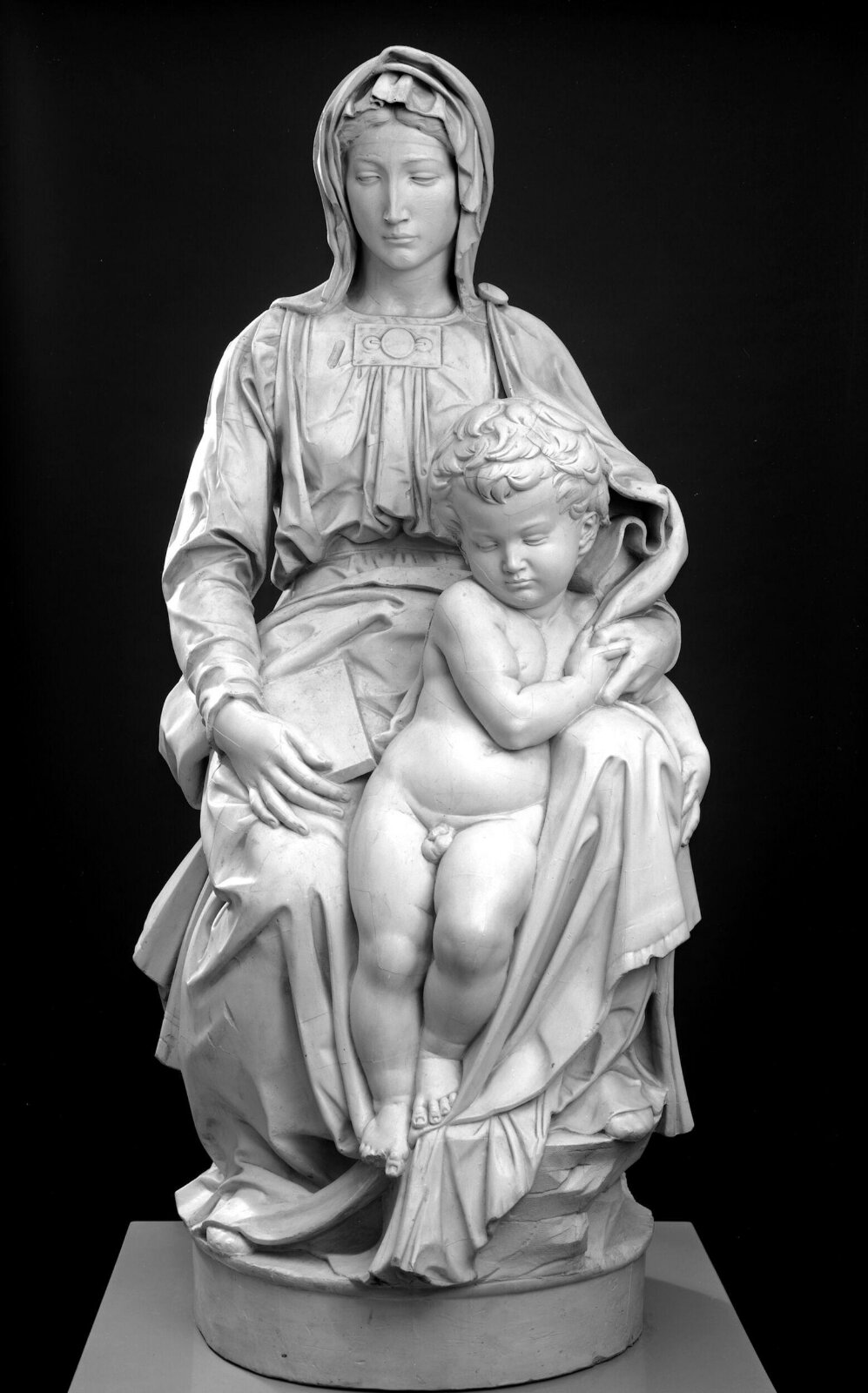
Bruges Madonna
May one see it?
Yes, receiving visitors

Victoria and Albert Museum
RoomCast Courts, Room 46b, The Weston Cast CourtLondon, United Kingdom
On public display.
- Checked
- 7 days ago
- In this state since
- Sep 25, 2026
- Source
- The museum's own collection data
About the sculpture
This is a plaster cast after Michelangelo's marble original, 1504-06, in the Church of Notre-dame, Bruges, Belgium. The maker of this cast is unknown and this is probably made in Bruges, late 1871. This cast was acquired from the Belgian government in 1872 through the international exchange scheme initiated by Henry Cole. The agreement facilitated exchange between museums across Europe of reproductions of objects in their respective countries. The document concluding this agreement, the International Convention, was signed by the fifteen crowned princes of Europe in 1867 at the Paris exhibition. With the aid of this agreement, the South Kensington Museum was able to amass a collection of casts unrivaled in its international scope and diversity.
Read on
The cast of the Bruges Madonna is today displayed alongside other casts of sculpture of Michelangelo in the east Cast Court, devoted entirely to reproductions of Italian works of art. It is probable that the surface of this cast was left unfinished to illustrate the complex network of piece molds required to make such a reproduction. Since they were first opened in 1873, the two magnificent Cast Court galleries at the V&A have displayed reproductions of some of the most significant monuments of medieval and Renaissance Europe. In these galleries one can view plaster casts of sculptures from Renaissance Italy, notably some of the masterpieces produced by Donatello, Luca della Robbia and Michelangelo.
The sculptures are faithful copies of the originals. They were made in the 19th century, when the vogue for replicated works of art was at its height. Museum visitors at that time generally had little opportunity to travel abroad, and illustrated art books were costly. These superb casts could afford people a rare glimpse of the original sculptures, even if they could not visit Florence or Rome. Artists and designers then and now could likewise sketch and learn from them. The painted surfaces of these reproductions often mirror the original stone or bronze, and the casts seem convincingly monumental. But they are made of plaster, a relatively fragile material.
The original sculpture was purchased by Jean and Alexandre Mouscron, cloth merchants of Bruges with establishments in Rome and Florence. They shipped the Madonna to Bruges in 1506. There it was installed on an altar in the church of Notre Dame, and framed by a tabernacle of black and white marble designed by Jan de Heere of Ghent and his son Lucas and completed by 1571.
Victoria and Albert Museum
Particulars
- Accession number
- REPRO.1872-62
What it shows
In the catalog
Sources
- Victoria and Albert Museum: the museum's own open data · fetched 7 days ago
- Image: Victoria and Albert Museum — © Victoria and Albert Museum, London
Meanwhile, in the life of Michelangelo
The whole life1501–1505 · Workplace
Florence
1504
A contest with Leonardo: “The Battle of Cascina”
Michelangelo was commissioned to paint the fresco “The Battle of Cascina” for the Hall of the Five Hundred in the Palazzo Vecchio, in a competition with Leonardo da Vinci decreed by the Signoria.
8 June 1504
The “David” is unveiled in the Piazza della Signoria
The statue Michelangelo had worked on since 1501 was unveiled in the Piazza della Signoria. Many citizens were shocked by the boldness of showing the biblical hero entirely nude, yet the “David” became the embodiment of the pride of Florentines then fighting the republic's enemies.
1505
Julius II commissions his tomb
Pope Julius II summoned Michelangelo to Rome and commissioned him to design a huge mausoleum in the middle of St Peter's, a structure with a chapel inside adorned with dozens of statues. He spent eight months in Carrara choosing the marble, while Rome overwhelmed him with the Colosseum, the Pantheon and the forums.
1505–1506 · Workplace
Rome
17 April 1506
A quarrel with the pope and a secret flight from Rome
Both the artist and Julius II had hot tempers and soon quarrelled; Michelangelo left Rome in secret for Florence and stayed there until the Florentine government pressed him to return to the pope.