 Nicholas RoerichRussian, 1874–1947
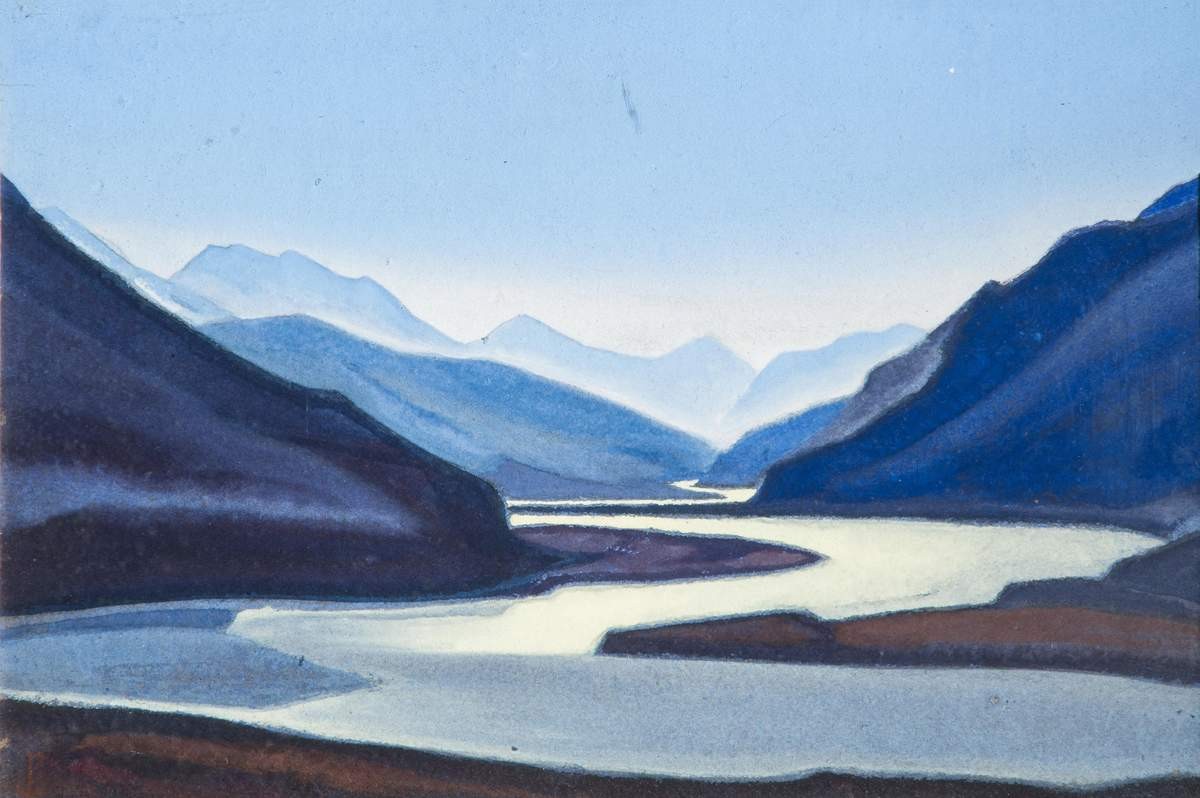
Брамапутра
Can I see it?
Unknown
Where is “Брамапутра” now? Collection: State Russian Museum, Saint Petersburg. Unknown.

Saint Petersburg, Russia
The owner is known; whether it is on view today is not.
- In this state since
- Source
- The museum
About the painting
Museum text in Russian
По впечатлениям от увиденного художник создает множество пейзажей. Казалось бы, он использует один сюжет — горы, в которых иногда встречаются монастырские строения или селения. Но его горные пейзажи не повторяют один другой. « Каждая гамма красок, — как писал Рерих, — создает какое-то могущественное настроение ». Светящиеся тонкими переливами красок, то спокойные, то драматически насыщенные изображения гор, складываясь в единый поток, передают эмоции, полученные их автором в пути. Что-то вечное, незыблемое и таинственное запечатлено Рерихом в этих пейзажах. В них нет экзотики, как и однообразия. Сам Рерих писал в своем дневнике, что горы напоминают ему « дух человеческий, когда он, преодолевая все трудности, восходит к этим вершинам …» 19. Евгения Петрова. Николай Рерих. В поисках Шамбалы // Николай Рерих. В поисках Шамбалы. СПБ. 2020. С. 10.
State Russian Museum
Details
- Accession number
- Ж-7209
What it shows
In the catalog
Sources
- State Russian Museum
- Image: State Russian Museum — © State Russian Museum
In the life of Nicholas Roerich
The whole life1925–1928
The Central Asian expedition
After Indonesia, Ceylon and Madras in early 1925, the main stage of the expedition begins — through Kashmir, Ladakh, Xinjiang, the USSR (with a visit to Moscow), Siberia, the Altai and Mongolia into Tibet, across unexplored parts of the Trans-Himalaya. Until 1928 archaeological and ethnographic studies are carried out, rare manuscripts are found, about five hundred paintings are made and the “Himalayas” series is begun.
March 1928
Out of Tibet: five dead
Between the summer of 1927 and June 1928 the expedition is thought to be lost, since contact with it has ceased. Living in tents in sub-zero conditions on meagre rations, five members of the party die; in March 1928 the expedition is allowed to leave Tibet and treks south to India, where the Roerichs found a research centre.
12 July 1928
The Urusvati Himalayan Research Institute
On 12 July 1928 the Himalayan Research Institute is founded in New York, and then Roerich creates the “Urusvati” institute in the Kullu valley — the name means “Light of the Morning Star” — where the last period of his life will be spent. His elder son Yuri becomes director; laboratories are at work, research on the languages and written sources of the East is carried out, and from 1931 a yearbook is published.
November 1929
The Master Building opens in New York
In November 1929 the Master Building opens — a 29-storey Art Deco skyscraper whose construction Louis Horch had been directing since 1925 while Roerich was in Asia. Its first two floors house the Roerich Museum, with more than a thousand of his canvases, and the Master Institute of United Arts; the upper floors are an apartment hotel. With the opening, Roerich's popularity in the United States reaches its peak.
28 April – 30 May 1934
The Manchurian expedition: from Seattle to Harbin
On 28 April 1934 Roerich and his elder son set out from Seattle for Yokohama: Henry Wallace, the US Secretary of Agriculture, who had befriended him in 1930, sends him to Manchuria and northern China to collect seeds of plants that protect the fertile layer of soil. In Japan he is received at the highest government level, and on 30 May the scientific part of the expedition begins in Harbin.
13 December 1947
Died