 Edward HopperAmerican, 1882–1967
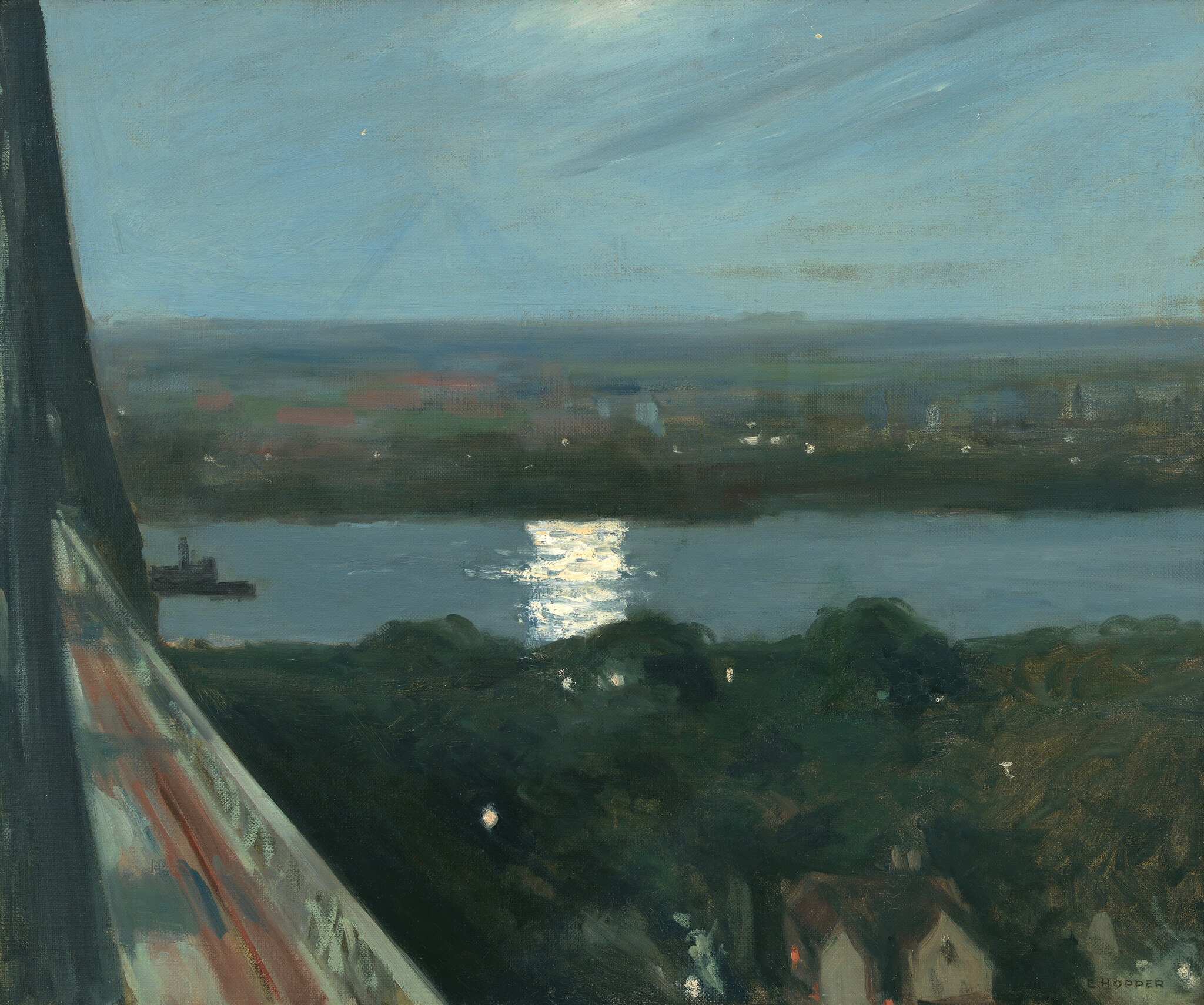
Blackwell's Island
May one see it?
Not receiving at present

New York, United States
It belongs to the collection, but is not on display at present.
- Checked
- Source
- The museum
Particulars
- Accession number
- 70.1188
In the catalog
Sources
- Whitney Museum of American Art
- Image: Whitney Museum of American Art — © the artist or rights holder
Meanwhile, in the life of Edward Hopper
The whole life22 July 1882 – 1910 · Residence
Edward Hopper Birthplace and Boyhood Home
1906–1910
Three trips to Europe, centred on Paris
Ostensibly to study art, Hopper makes three trips to Europe, each centred on Paris, with visits to London, Berlin and Amsterdam: in fact he mostly works alone, drawing street and café scenes and going to the theatre and opera, little affected by the new currents. He is highly impressed by Rembrandt, particularly the Night Watch, and later claims few European influences other than Rembrandt, Goya and the French engraver Charles Meryon, whose moody Paris scenes he imitated.
1910
A studio in New York and a return to illustration
Returning from his last European trip, Hopper rents a studio in New York and struggles to define his own style; to support himself he reluctantly returns to illustration and, as a freelancer, knocks on the doors of magazine and agency offices. His fellow illustrator Walter Tittle sees him sitting for days before his easel in helpless unhappiness.
1912
Gloucester: his first outdoor paintings in America
Seeking inspiration, Hopper travels to Gloucester, Massachusetts, and makes his first outdoor paintings in America; among them is “Squam Light”, the first of many lighthouse paintings to come.
1913
His first sale: “Sailing” at the Armory Show
At the Armory Show in New York Hopper sells his first painting, “Sailing” (1911), painted over an earlier self-portrait, to the businessman Thomas F. Vietor for $250. The thirty-one-year-old hopes his first sale will lead to others in short order, but his career will not catch on for many more years.
1913
His father's death, and the move to 3 Washington Square North
In September 1913 his father, Garret Henry Hopper, a dry-goods merchant who had retired at forty-nine, dies; shortly afterwards Hopper moves to an apartment at 3 Washington Square North in Greenwich Village, Manhattan, where he will live for the rest of his life.