 Georgia O'KeeffeAmerican, 1887–1986
Summer Days
May one see it?
Yes, receiving visitors

Whitney Museum of American Art
New York, United States
On public display.
- Checked
- 7 days ago
- Source
- The museum's own collection data
About the painting
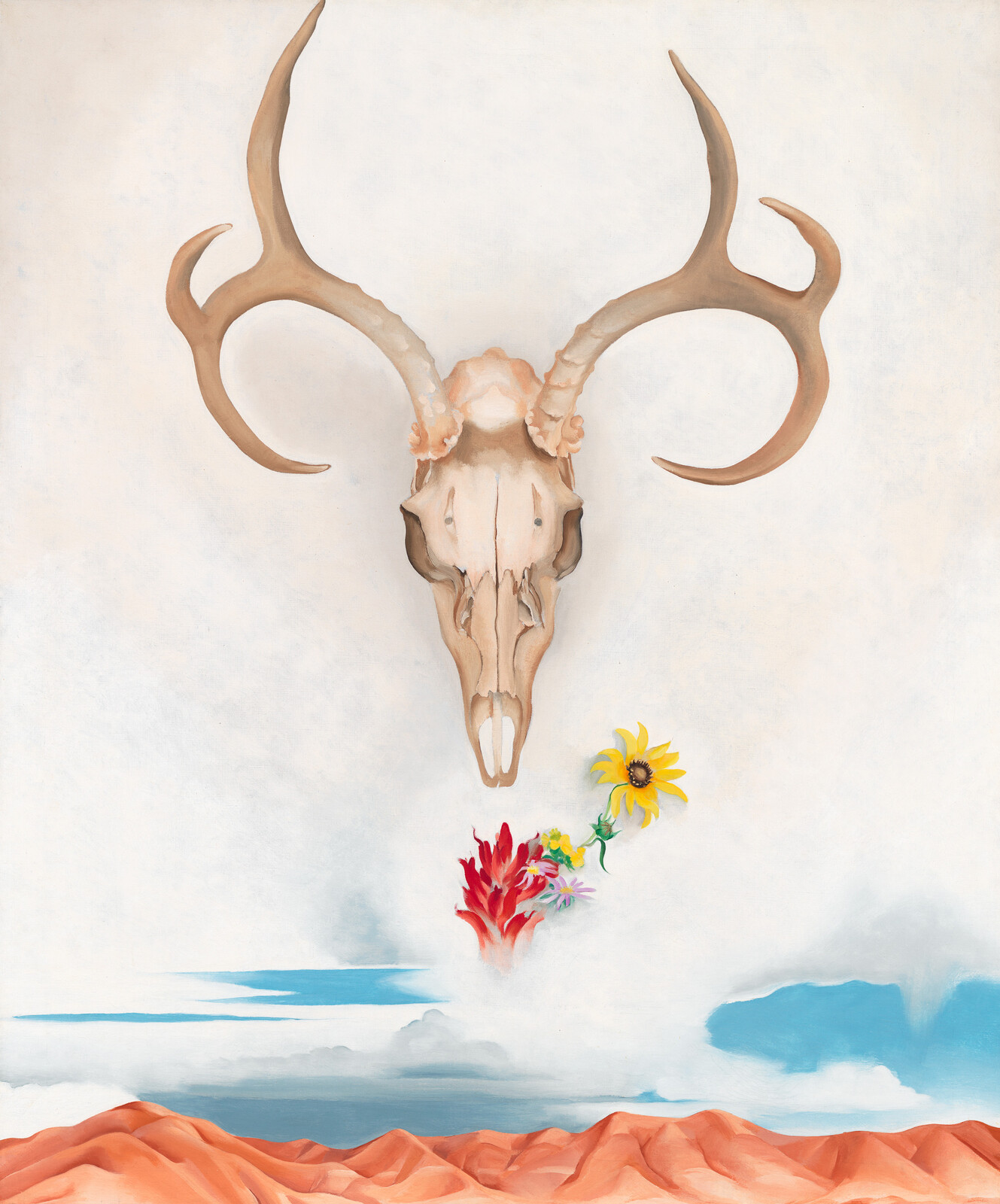
Summer Days is a 1936 oil painting by the American 20th-century artist Georgia O'Keeffe. It depicts a buck deer skull with large antlers juxtaposed with a vibrant assortment of wildflowers hovering below. The skull and flowers are suspended over a mountainous desert landscape occupying the lower part of the composition. Summer Days is among several landscape paintings featuring animal skulls and inspired by New Mexico desert O'Keeffe completed between 1934 and 1936.
Read on
The juxtaposition of skull and landscape imagery in Summer Days has prompted various interpretations. While some art historians and critics see them as commonplace desert elements, others emphasize the painting's transcendental or mystical potential. O'Keeffe, who never assigned any specific symbolic meaning to her use of skeletal motifs, associated the inclusion of bones in her artwork with the raw, alive essence of the desert, and later defined Summer Days as simply a "portrayal of summertime".
The work was first exhibited at Alfred Stieglitz's New York gallery space called An American Place in 1937 and remained with O'Keeffe for numerous years, later featuring on the cover of her monographic book published in 1976 by Viking Press. The Museum of Fine Arts, Santa Fe attempted to acquire the painting in 1980, but financial disagreements within the museum led to its return to O'Keeffe. Summer Days was eventually purchased by the American fashion designer Calvin Klein in 1983, who later donated it to the Whitney Museum of American Art in 1994. It has been described as one of O'Keeffe's most recognized paintings.
Particulars
- Accession number
- 94.171
Sources
- Whitney Museum of American Art: the museum's own open data · fetched 7 days ago
- Image: Whitney Museum of American Art — © the artist or rights holder
Meanwhile, in the life of Georgia O'Keeffe
The whole life1929–1983 · Workplace
New Mexico
1932–1934
Nervous breakdown and two months in hospital
A nervous breakdown, largely brought on by Stieglitz’s affair with Dorothy Norman, kept O’Keeffe from working from late 1932, and in 1933 she spent two months in hospital; in 1933 and 1934 she recuperated in Bermuda. She began painting again in January 1934.
August 1934
Moves to Ghost Ranch
From August 1934 she lived at Ghost Ranch, north of Abiquiú; the varicoloured cliffs around the ranch inspired some of her most famous landscapes. In 1940 she moved into a house on the ranch property.
1937
Stieglitz gives up photography
When Stieglitz retired from photography in 1937 he had made more than 350 portraits of O’Keeffe and more than 200 nude photographs of her.
1938
Advertising commission from the Hawaiian Pineapple Company
The agency N. W. Ayer & Son asked her for two paintings for the Hawaiian Pineapple Company (now Dole) to use in advertising. The offer came when she was 51 and her career seemed to be stalling: critics found her New Mexico focus limited and called her desert images a kind of mass production.