ART WIKI32,963 on view
MapCollectionArtistsMuseumsExhibitionsJournal
Sign in

ART WIKI

Where the masterpiece hangs, and when they let you in.

Collections: Art Institute of Chicago, Getty Villa, Harvard Art Museums, Hirshhorn Museum and Sculpture Garden, J. Paul Getty Museum, Minneapolis Institute of Art, Musée du Louvre, National Gallery of Art, National Museum of Asian Art, National Portrait Gallery (Smithsonian), Pushkin State Museum of Fine Arts, Rijksmuseum, Smithsonian American Art Museum, SMK — National Gallery of Denmark, State Hermitage Museum, State Russian Museum, The Cleveland Museum of Art, The Metropolitan Museum of Art, The Museum of Modern Art, Tretyakov Gallery, Victoria and Albert Museum, Whitney Museum of American Art, State Catalogue of the Museum Fund of Russia (274 museums), Europeana (19 museums), Wikidata (6 museums), Paris Musées (12 museums), and Joconde, the French Ministry of Culture's museum database (495 museums). Images belong to their rights holders.

Sections

  • Map
  • Search
  • Collection
  • Masterpieces
  • On view now
  • Artists

More

  • Museums & galleries
  • Exhibitions
  • Journal
  • Where the data comes from
  • Privacy & cookies
HomeMapBrowse
  1. Collection/
  2. J. Paul Getty Museum/
  3. Bathsheba After the Bath
Bathsheba After the Bath, Jan Steen, about 1670–1675
Jan Havicksz. Steen, portraitJan Havicksz. SteenDutch, 1626–1679

Bathsheba After the Bath

about 1670–1675 · Painting · 57.5 × 44.5 cm

May one see it?

Yes, receiving visitors

JPG
J. Paul Getty Museum

Los Angeles, United States

RoomMuseum East Pavilion, Gallery E204

On public display.

Checked
2 days ago
In this state since
Oct 5, 2026
Source
The museum
On the mapMuseum page

About the painting

Bathsheba stares brazenly out at the viewer while a maidservant trims her toenails. King David, who saw her beauty and desired her, sent her a summons to appear at his palace. Although she was married, Bathsheba was forced to comply. A popular subject, artists often portrayed Bathsheba as distraught about her dilemma. Here, Jan Steen depicted her as a temptress, rather than the innocent victim of the king's passion. In this moralizing painting, Steen commented on the foolishness of human behavior. Bathsheba's robe is casually arranged to reveal her breast and bare legs. The shoe in the right foreground symbolizes lasciviousness; the fountain on the left probably alludes to female fecundity. She is so lost in her thoughts that she holds King David's note loosely in her right hand and pays no attention to the small dog or to the old woman grasping her shoulder.

JPGJ. Paul Getty Museum

Particulars

about 1670–1675
16261679
Accession number
89.PB.27

In the catalog

PaintingsOilDutch paintingBaroque17th centuryDutch

Sources

  • J. Paul Getty Museum
  • Image: J. Paul Getty Museum — Open Content

Meanwhile, in the life of Jan Havicksz. Steen

The whole life
  1. 1660–1670

    Haarlem: his most productive period

    From 1660 to 1670 Steen lived in Haarlem, and this was the most productive period of his life.

  2. 1669–1670

    The deaths of his wife, mother and father

    By 1669 Steen's finances had improved, but in the spring his wife died, later that year his mother, and a year later his father.

  3. 1670

    Returns to Leiden, to his parents' house

    After his father's death Steen returned to Leiden and lived for the rest of his life in the house he inherited from his parents.

  4. 1671

    Elected head of the Leiden Guild of St Luke

    In 1671 Steen was elected princeps — head — of the local Guild of St Luke.

  5. 1672

    Opens the tavern “De Vrede” (“Peace”)

    Steen opened the tavern “De Vrede” (“Peace”); his debts mounted again, the art market was declining, and according to Houbraken he often spent his time drinking.

  6. 1672

    The “Year of Disaster”: the art market collapses

    In 1672, known in the Netherlands as the “Year of Disaster”, the art market collapsed.

More by Jan Havicksz. Steen

All works
Adolf and Catharina Croeser, Known as ‘The Burgomaster of Delft and his Daughter’, Jan Havicksz. Steen, 1655

Adolf and Catharina Croeser, Known as ‘The Burgomaster of Delft and his Daughter’

1655 · Rijksmuseum

De zieke vrouw, Jan Havicksz. Steen, c. 1663 - c. 1666

De zieke vrouw

c. 1663 - c. 1666 · Rijksmuseum

Self-portrait, Jan Havicksz. Steen, c. 1670

Self-portrait

c. 1670 · Rijksmuseum

Merry Company on a Terrace, Jan Steen, ca. 1670

Merry Company on a Terrace

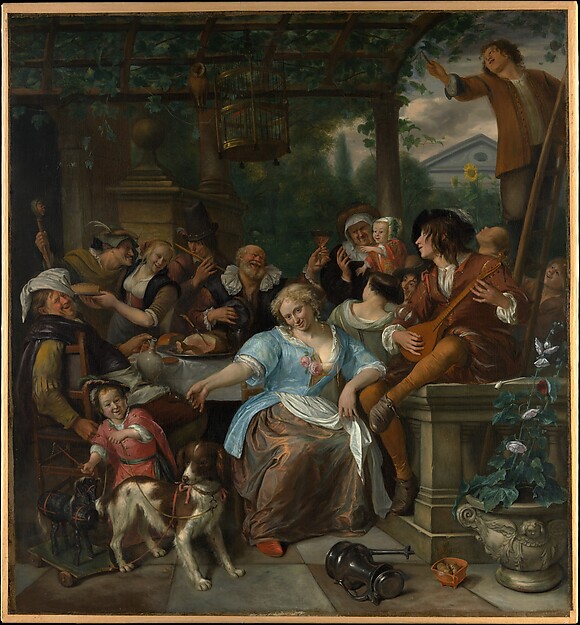
ca. 1670 · The Metropolitan Museum of Art

Smoker, Jan Havicksz. Steen, 1650

Smoker

1650 · State Hermitage Museum

Esther before Ahasuerus, Jan Havicksz. Steen, 1660s

Esther before Ahasuerus

1660s · State Hermitage Museum

Idlers, Jan Havicksz. Steen, 1660s

Idlers

1660s · State Hermitage Museum

The Lovesick Maiden, Jan Steen, ca. 1660

The Lovesick Maiden

ca. 1660 · The Metropolitan Museum of Art

In the same room · Museum East Pavilion, Gallery E204, J. Paul Getty Museum

Museum page
The Drawing Lesson, Jan Steen, about 1665

Jan Havicksz. Steen

The Drawing Lesson, about 1665

The Satyr and the Peasant Family, Jan Steen, about 1660–1662

Jan Havicksz. Steen

The Satyr and the Peasant Family, about 1660–1662

Two Watermills and an Open Sluice, Jacob van Ruisdael, 1653

Jacob Isaacksz. van Ruisdael

Two Watermills and an Open Sluice, 1653

Bridge with a Sluice, Jacob van Ruisdael, about 1648–1649

Jacob Isaacksz. van Ruisdael

Bridge with a Sluice, about 1648–1649

A Woman Preparing Bread and Butter for a Boy, Pieter de Hooch, about 1660–1663

Pieter de Hooch

A Woman Preparing Bread and Butter for a Boy, about 1660–1663

The Music Lesson, Gerard ter Borch, about 1668

Gerard ter Borch

The Music Lesson, about 1668

Horse Stable, Gerard ter Borch, about 1654

Gerard ter Borch

Horse Stable, about 1654

A Maid Milking a Cow in a Barn, Gerard ter Borch, about 1652–1654

Gerard ter Borch

A Maid Milking a Cow in a Barn, about 1652–1654