 Jean-Honoré FragonardFrench, 1732–1806
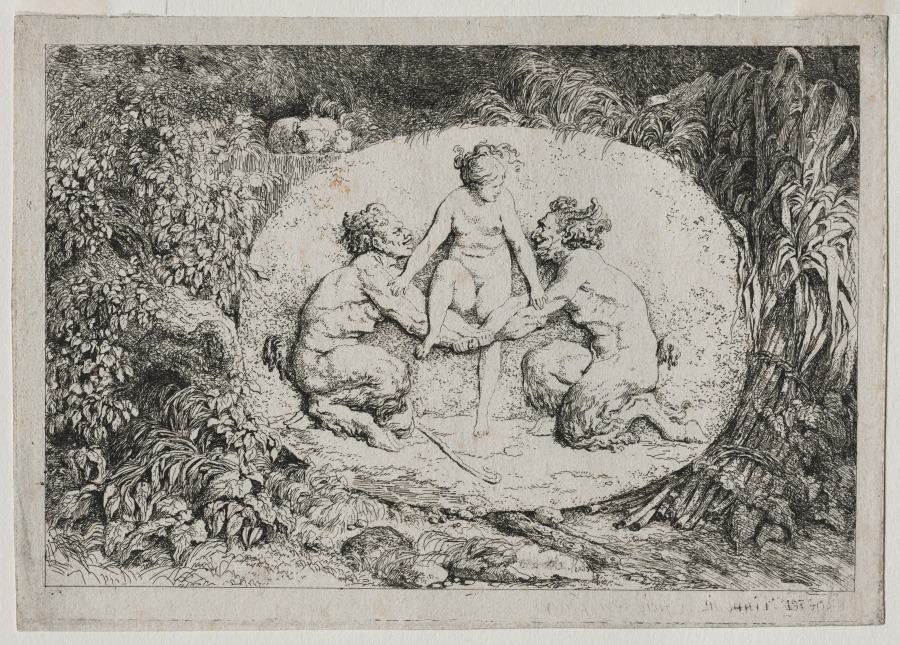
Bacchanales
Can I see it?
Not on view at present
Where is “Bacchanales” now? Collection: The Cleveland Museum of Art, Cleveland. Not on view at present. Checked September 29, 2026.

Cleveland, United States
It belongs to the collection, but is not on display at present.
- Checked
- In this state since
- Source
- The museum
About the work
Jean-Honoré Fragonard made these four etchings shortly after returning to Paris from Italy, where he studied antique subjects and sculpture. He may have also looked at other sources for inspiration, such as Jacques François Joseph Saly’s suite of vase designs. Though the prints feature the followers of Bacchus, the wine god does not make an appearance. Instead, Fragonard highlighted the playfully erotic frolics, conflicts, and even family life of a group of bacchants, conceiving them as low-relief sculptures on stone fragments within abundant foliage. Fragonard’s creations helped to popularize revelries in nature in French art, architecture, and garden design during the later 1700s.
The Cleveland Museum of Art
Details
- Accession number
- 2012.64
In the catalog
Sources
- The Cleveland Museum of Art
- Image: The Cleveland Museum of Art — Museum open access
In the life of Jean-Honoré Fragonard
The whole lifec. 1761
Studio in the Louvre
On his return to Paris he received a studio in the Louvre palace, where he lived, and was put in charge of the decoration of the Galerie d'Apollon.
April 1761
Return to France via Venice and southern Italy
Having lived in Rome until April 1761, he left the Eternal City with his patron the Abbé de Saint-Non and Hubert Robert: he visited Florence, Bologna and Venice, where he studied Tiepolo, made a journey to southern Italy, and returned to France.
1765
"Coresus and Callirhoe" at the Salon: admission to the Academy
He exhibited at the Paris Salon the painting "Coresus and Callirhoe" (now in the Louvre), for which the Royal Academy of Painting and Sculpture admitted him as a member. Diderot devoted a lavish panegyric to it, and the king bought the painting and ordered it reproduced at the Gobelins manufactory.
second half of the 1760s
Abandoning history painting for "gallant scenes"
Despairing of attaining the position of first painter in the classical genre, he abandoned it for erotic genre scenes, which enjoyed the greatest success at the court of Louis XV. He soon became a fashionable artist — a master of pastoral landscapes, female portraits and small-format "cabinet pictures."