 Gordon ParksAmerican, 1912–2006
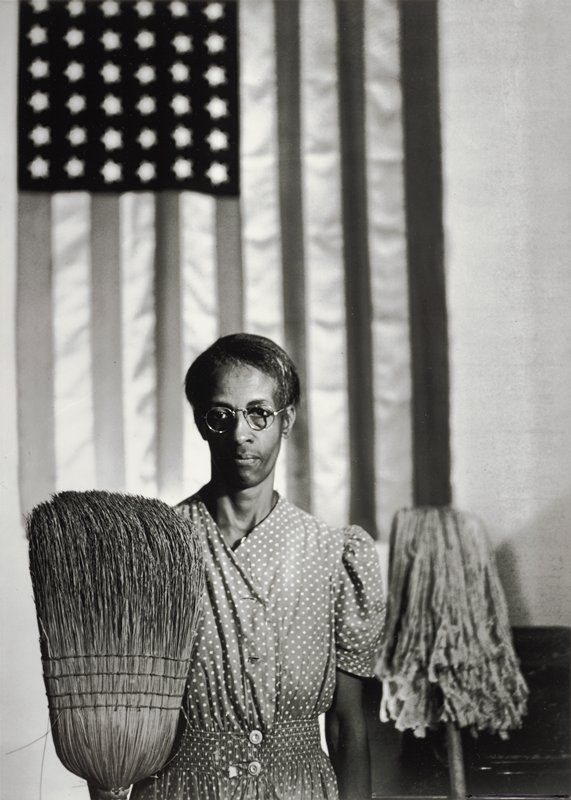
American Gothic, Washington, D.C.
Can I see it?
Not on view at present
Where is “American Gothic, Washington, D.C.” now? Collection: Minneapolis Institute of Art, Minneapolis. Not on view at present. Checked September 29, 2026.

Minneapolis, United States
It belongs to the collection, but is not on display at present.
- Checked
- In this state since
- Source
- The museum
About the work
African American photographer Gordon Parks spent his youth in Minnesota and later became prominent in documentary journalism from the 1940s through 1970s, focusing on issues of civil rights and poverty. A year-long fellowship with the Information Division of the Farm Security Administration in 1942 supported his work documenting black lives in Washington, D.C. He later said of this photograph, a portrait of government cleaning woman Ella Watson:
Read on
“I had experienced a kind of bigotry and discrimination here that I never expected to experience. . . . At first, I asked [Ella Watson] about her life, what it was like, and [it was] so disastrous that I felt that I must photograph this woman in a way that would make me feel or make the public feel about what Washington, D.C., was in 1942. So I put her before the American flag with a broom in one hand and a mop in another. And I said, ‘American Gothic’—that’s how I felt at the moment.”
Minneapolis Institute of Art
Details
- Accession number
- 2007.35.169
In the catalog
Sources
- Minneapolis Institute of Art
- Image: Minneapolis Institute of Art — © The Gordon Parks Foundation
In the life of Gordon Parks
The whole lifec. 1940 (aged 28)
Buys his first camera and teaches himself to shoot
Struck by magazine photographs of migrant workers, at twenty-eight he buys a Voigtländer Brillant for $12.50 at a Seattle pawnshop and teaches himself photography. The clerks who develop his first roll of film applaud his work and urge him to seek a fashion assignment at Frank Murphy’s women’s clothing store in St. Paul.
1940
Moves to Chicago on Marva Louis’s advice
His photographs for the St. Paul store catch the eye of Marva Louis, wife of heavyweight boxing champion Joe Louis, who encourages Parks and his wife Sally Alvis to move to Chicago. There he opens a portrait business and specialises in photographs of society women.
1940
Daughter born: Toni Parks
1941
Exhibition of photographs of Chicago’s Black ghetto
While chronicling the South Side Black ghetto of Chicago, he sees an exhibition of these photographs win him a photography fellowship with the Farm Security Administration (FSA); other accounts link his invitation to the FSA to the Rosenwald Fellowship of 1942.
1942
Receives the Rosenwald Fellowship
The Julius Rosenwald Fellowship, $200 a month with the choice of employer, rewards his work in Chicago, especially his capturing of the myriad experiences of African Americans across the city. It contributes to his being asked to join the FSA, which under Roy Stryker was chronicling the nation’s social conditions.
c. 1942
Stryker calls the picture an indictment of America
Seeing the photograph, Stryker says it is an indictment of America that could get all of his photographers fired, and urges Parks to keep working with Watson, which leads to a series of pictures of her daily life. Parks later says his first image was overdone and not subtle.