ART WIKI33,040 on view
MapCollectionArtistsMuseumsExhibitionsJournal
Sign in

ART WIKI

Where the masterpiece hangs, and when they let you in.

Collections: Art Institute of Chicago, Getty Villa, Harvard Art Museums, Hirshhorn Museum and Sculpture Garden, J. Paul Getty Museum, Minneapolis Institute of Art, Musée du Louvre, National Gallery of Art, National Museum of Asian Art, National Portrait Gallery (Smithsonian), Pushkin State Museum of Fine Arts, Rijksmuseum, Smithsonian American Art Museum, SMK — National Gallery of Denmark, State Hermitage Museum, State Russian Museum, The Cleveland Museum of Art, The Metropolitan Museum of Art, The Museum of Modern Art, Tretyakov Gallery, Victoria and Albert Museum, Whitney Museum of American Art, State Catalogue of the Museum Fund of Russia (274 museums), Europeana (19 museums), Wikidata (6 museums), Paris Musées (12 museums), and Joconde, the French Ministry of Culture's museum database (495 museums). Images belong to their rights holders.

Sections

  • Map
  • Search
  • Collection
  • Masterpieces
  • On view now
  • Artists

More

  • Museums & galleries
  • Exhibitions
  • Journal
  • Where the data comes from
  • Privacy & cookies
HomeMapBrowse
  1. Collection/
  2. Rijksmuseum/
  3. A Satyr
A Satyr, Jacques Jordaens, c. 1630 - c. 1635
Jacques Jordaens, portraitJacques JordaensFlemish, 1593–1678

A Satyr

c. 1630 - c. 1635 · Painting

May one see it?

Unknown

Rijksmuseum

Amsterdam, Netherlands

The owner is known; whether it is on view today is not.

Source
The museum
On the mapMuseum page

About the painting

In Greek mythology, satyrs – half-men and half-goats – were said to live in the woods and mountains. In

17th-century literature, they dwelt in the pastoral paradise of Arcadia, where one could lead a carefree life. The satyr here is presented as a shepherd of goats and sheep. He looks up from playing his flute to smile at the viewer.

Rijksmuseum

Particulars

c. 1630 - c. 1635
15931678
Accession number
SK-A-198

What it shows

SheepSatyr(s) (in general)Flute, aulos, tibia

In the catalog

PaintingsOilFlemish paintingBaroque17th century

Sources

  • Rijksmuseum
  • Image: Rijksmuseum — public domain

Meanwhile, in the life of Jacques Jordaens

The whole life
  1. 1621–1667

    His workshop: fifteen pupils in the guild records

    Between 1621 and 1667 the guild registered fifteen pupils with Jordaens (the best known being Jan Boeckhorst), and six more are named in court documents; his son Jacob and his cousin Arnoldus also trained with him. His fame drew foreigners: after 1642 the Polish painter Aleksander Jan Tricius became his pupil, and in 1645 Queen Christina of Sweden meant to send her protégé Georg Waldau, but the threat of war in Flanders prevented it.

  2. 1629

    Daughter born: Anna Catharina Jordaens

  3. 1633–1634

    Inherits his birth house, “Het Paradijs”

    When his parents' estate was divided among Jacob, his brother Izaak and his sisters Anna, Magdalena and Elisabeth, he received the house where he was born, “Het Paradijs” (“Paradise”). In 1634 he bought two more houses on the Verversrui.

  4. 1635

    Decorations for the entry of Cardinal-Infante Ferdinand

    For the Joyous Entry into Antwerp of the new governor of the Habsburg Netherlands, designed by Rubens, Jordaens painted decorative pictures after Rubens's designs and, with Cornelis de Vos, completed the triumphal Arch of Philip on the Huidenvetterstraat. The arch was temporary and has not survived.

  5. c. 1635 – 1645

    Publishes prints after his own designs

    Like Rubens and van Dyck, Jordaens realised that prints spread an artist's fame and on his own initiative issued 14 engravings under privilege (cum privilegio), cut by Marinus Robyn van der Goes, Schelte a Bolswert, Paulus Pontius and other Antwerp engravers. Beneath each image stood his name as inventor and a short explanation in Latin verse.

  6. 1637–1638

    Paintings for Philip IV's hunting lodge

    In 1636 Rubens received a commission for a mythological series after Ovid's Metamorphoses for the Torre de la Parada near Madrid and enlisted Antwerp painters. Jordaens painted “Apollo and Pan” (1637, after a sketch by Rubens) and “Vertumnus and Pomona” (1638).

More by Jacques Jordaens

All works
Portrait of Catherine Behaghel, Jacques Jordaens, 1635

Portrait of Catherine Behaghel

1635 · Rijksmuseum

Portrait of Magdalena de Cuyper, Jacques Jordaens, c. 1635 - c. 1636

Portrait of Magdalena de Cuyper

c. 1635 - c. 1636 · Rijksmuseum

Portrait of Rogier Le Witer, Jacques Jordaens, 1635

Portrait of Rogier Le Witer

1635 · Rijksmuseum

Self-Portrait with Parents, Brothers and Sisters, Jacques Jordaens, 1615

Self-Portrait with Parents, Brothers and Sisters

1615 · State Hermitage Museum

Sts Paul and Barnabas in Lystra, Jacques Jordaens, c. 1616

Sts Paul and Barnabas in Lystra

c. 1616 · State Hermitage Museum

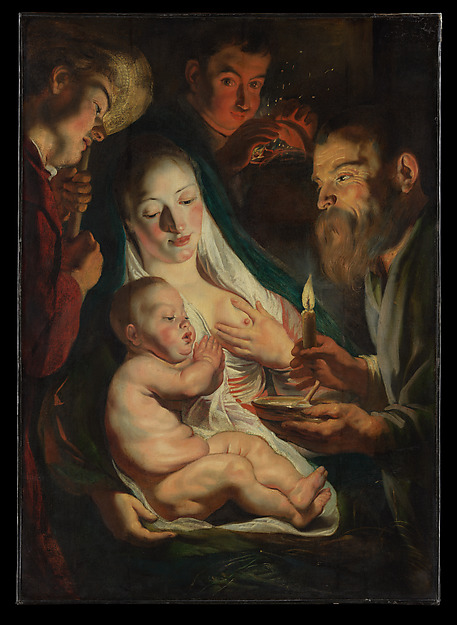
The Holy Family with Shepherds, Jacob Jordaens, 1616

The Holy Family with Shepherds

1616 · The Metropolitan Museum of Art

Madonna and Child in the Garland of Flowers, Jacques Jordaens, c. 1618

Madonna and Child in the Garland of Flowers

c. 1618 · State Hermitage Museum

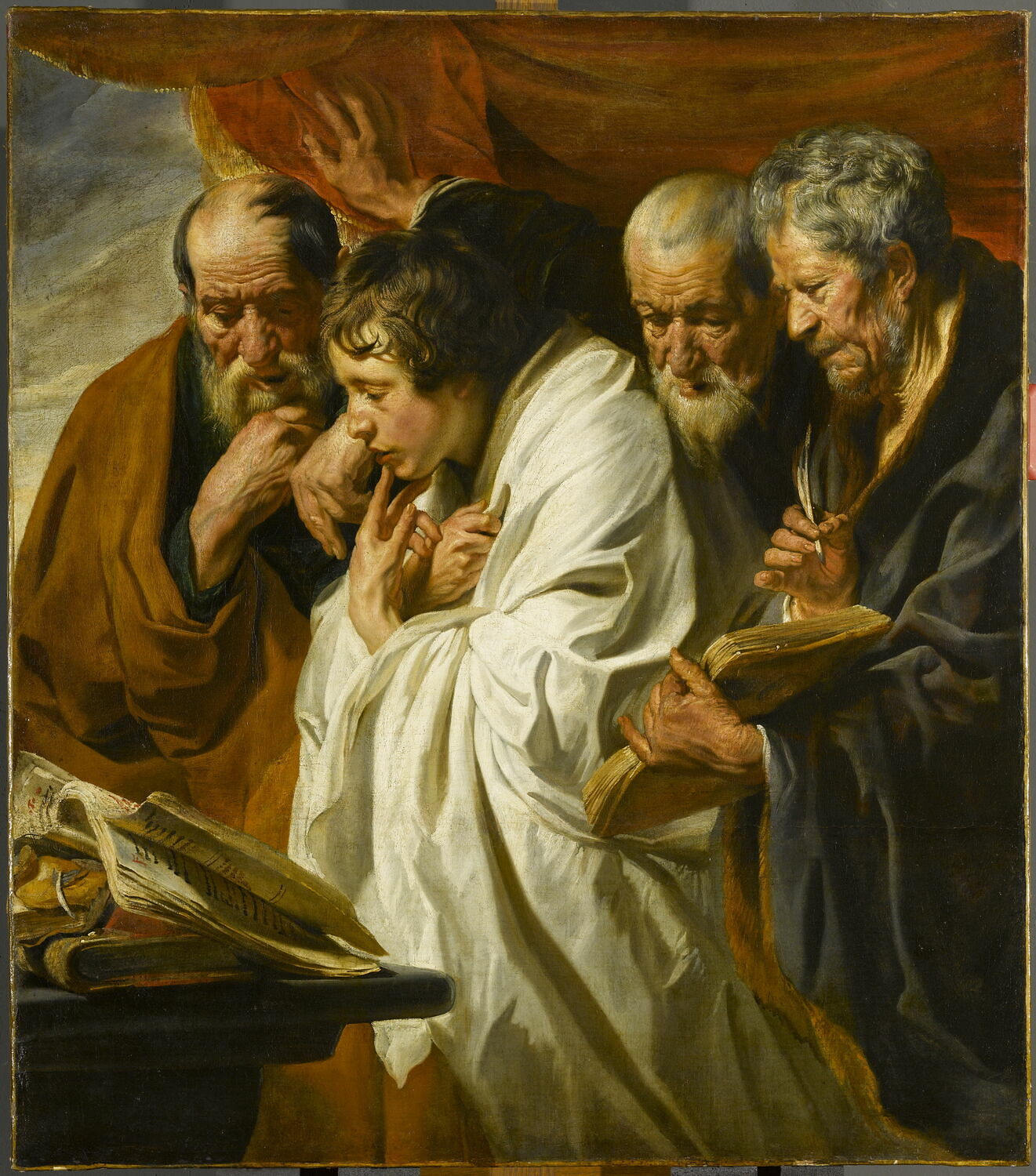
Les Quatre évangélistes, Jordaens, Jacob, 1e tiers du XVIIe siècle (1625 - 1630)

Les Quatre évangélistes

first third of the 17th century (1625–1630) · Musée du Louvre

Neighbors at Rijksmuseum

Museum page
Self-portrait, Vincent van Gogh, 1887

Vincent van Gogh

Self-portrait, 1887

La Corniche near Monaco, Claude Monet, 1884

Claude Monet

La Corniche bij Monaco, 1884

De Nachtwacht, Rembrandt van Rijn, 1642

Rembrandt van Rijn

The Night Watch, 1642

Portrait of a Woman, Probably Maria Trip (1619-1683), Rembrandt van Rijn, 1639

Rembrandt van Rijn

Portrait of Maria Trip, 1639

Landscape with a Stone Bridge, Rembrandt van Rijn, c. 1638

Rembrandt van Rijn

The Stone Bridge, c. 1638

Man in Oriental Dress, Rembrandt van Rijn, 1635

Rembrandt van Rijn

Man in Oriental Dress, 1635

Portrait of Haesje Jacobsdr van Cleyburg, Rembrandt van Rijn, 1634

Rembrandt van Rijn

Portrait of Haesje Jacobsdr van Cleyburg, 1634

Jonge vrouw in gefantaseerde kleding, Rembrandt van Rijn, 1633

Rembrandt van Rijn

Jonge vrouw in gefantaseerde kleding, 1633

On the same theme · Sheep

All works on the theme
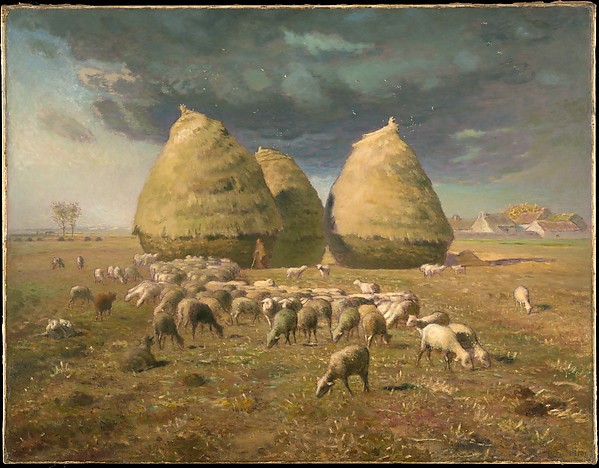
Haystacks: Autumn, Jean-François Millet, ca. 1874

Jean François Millet

Haystacks: Autumn, ca. 1874

The Metropolitan Museum of Art

Landscape with a Hay Barn and a Flock of Sheep, Rembrandt van Rijn, 1652

Rembrandt van Rijn

Landscape with a Hay Barn and a Flock of Sheep, 1652

Not on view · National Gallery of Art

Christ Driving the Money Changers from the Temple, Rembrandt van Rijn, 1635

Rembrandt van Rijn

Christ Driving the Money Changers from the Temple, 1635

Not on view · National Gallery of Art

Landscape with a Hay Barn and a Flock of Sheep, Rembrandt van Rijn, 1652

Rembrandt van Rijn

Landscape with a Hay Barn and a Flock of Sheep, 1652

Not on view · National Gallery of Art

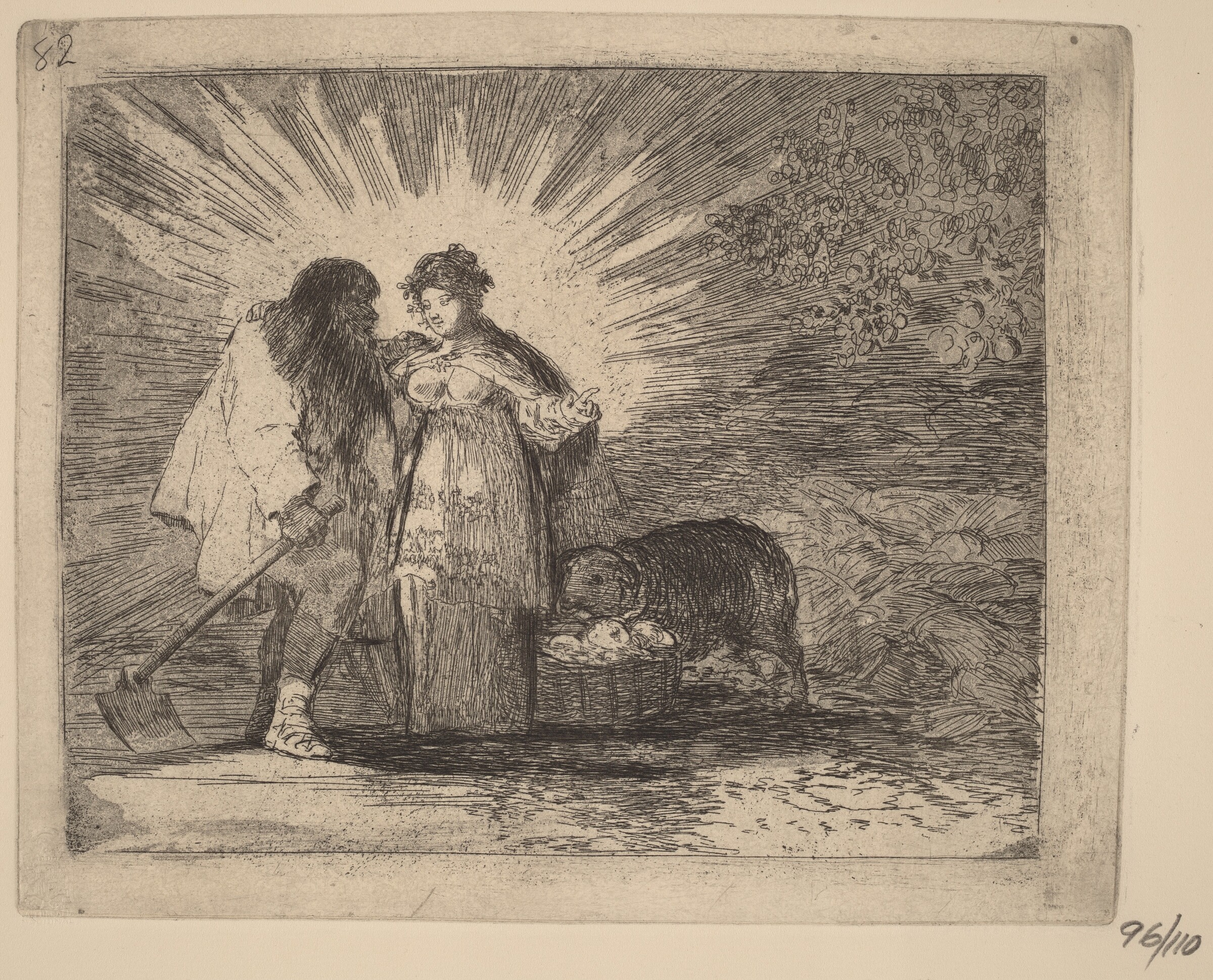
Esto es lo verdadero (This Is the Truth), Francisco Goya, 1810/1820

Francisco de Goya

Esto es lo verdadero (This Is the Truth), 1810/1820

Not on view · National Gallery of Art

The Wolf Turned Shepherd, Marc Chagall, 1927/1930

Marc Chagall

The Wolf Turned Shepherd, 1927/1930

Not on view · National Gallery of Art

The Horse Wishing to be Revenged on the Stag, Marc Chagall, 1927/1930

Marc Chagall

The Horse Wishing to be Revenged on the Stag, 1927/1930

Not on view · National Gallery of Art

The Shepherd and His Flock, Marc Chagall, 1927/1930

Marc Chagall

The Shepherd and His Flock, 1927/1930

Not on view · National Gallery of Art