 Wenceslaus HollarCzech, English, 1607–1677
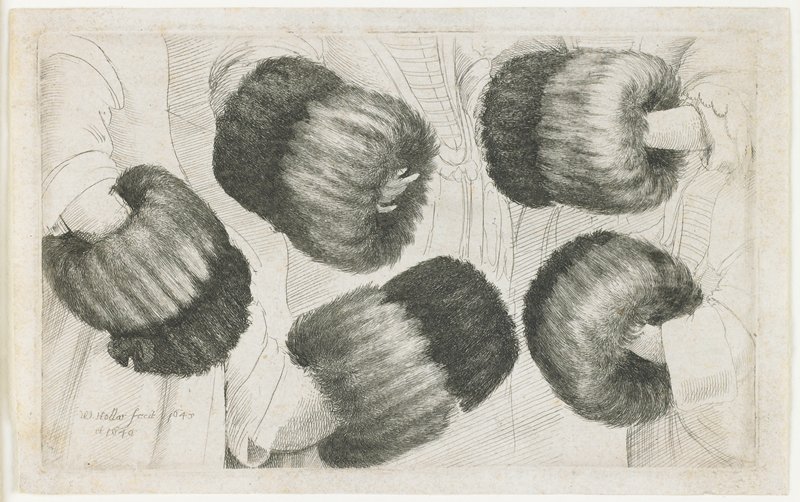
A Muff in Five Views
Can I see it?
Not on view at present
Where is “A Muff in Five Views” now? Collection: Minneapolis Institute of Art, Minneapolis. Not on view at present. Checked September 29, 2026.

Minneapolis, United States
It belongs to the collection, but is not on display at present.
- Checked
- In this state since
- Source
- The museum
About the work
Wenceslaus Hollar was almost obsessive in his handling of the etching needle, here creating an astonishing illusion of fur. His series of muffs helped establish the genre of still life, but the prints go beyond mere virtuosity. A Group of Muffs suggests the life of its absent owner and her social milieu; in the absence of context, we are invited to attach our own stories to the landscapelike arrangement.
Minneapolis Institute of Art
Details
- Accession number
- P.235
In the catalog
Sources
- Minneapolis Institute of Art
- Image: Minneapolis Institute of Art — public domain
In the life of Wenceslaus Hollar
The whole life1643–1644
Endures the siege of Basing House with fellow royalist artists
With other royalist artists, notably Inigo Jones and the engraver William Faithorne, he stands the long siege of Basing House; some hundred plates by his hand are dated 1643 and 1644. The Civil War, despite his productivity, adversely affected his income.
1645
Captured by parliamentary forces, he escapes
Hollar joins the Royalist Regiment and is captured by parliamentary forces in 1645 during the siege of Basing House; after a short time he manages to escape.
1646
After Arundel’s death he works for authors and publishers
After the earl’s death in Padua in 1646, Hollar earns his living by working for various authors and publishers, which becomes his primary means of distribution.
1646
Meets Arundel again in Antwerp
In Antwerp in 1646 Hollar again meets the Earl of Arundel, in whose household he had lived for many years.
1646–1652
Works in Antwerp during the Civil Wars
During the unrest of the Civil Wars he works in Antwerp, where he produces many of his most renowned works: Dutch cityscapes, seascapes, depictions of nature, his “muffs” and “shells”.
![Bride, from "Dance of Death", Wenceslaus Hollar, [1651] late 18th century printing](https://images.metmuseum.org/CRDImages/dp/web-large/DP822840.jpg)