 Anthony van DyckFlemish, 1599–1641
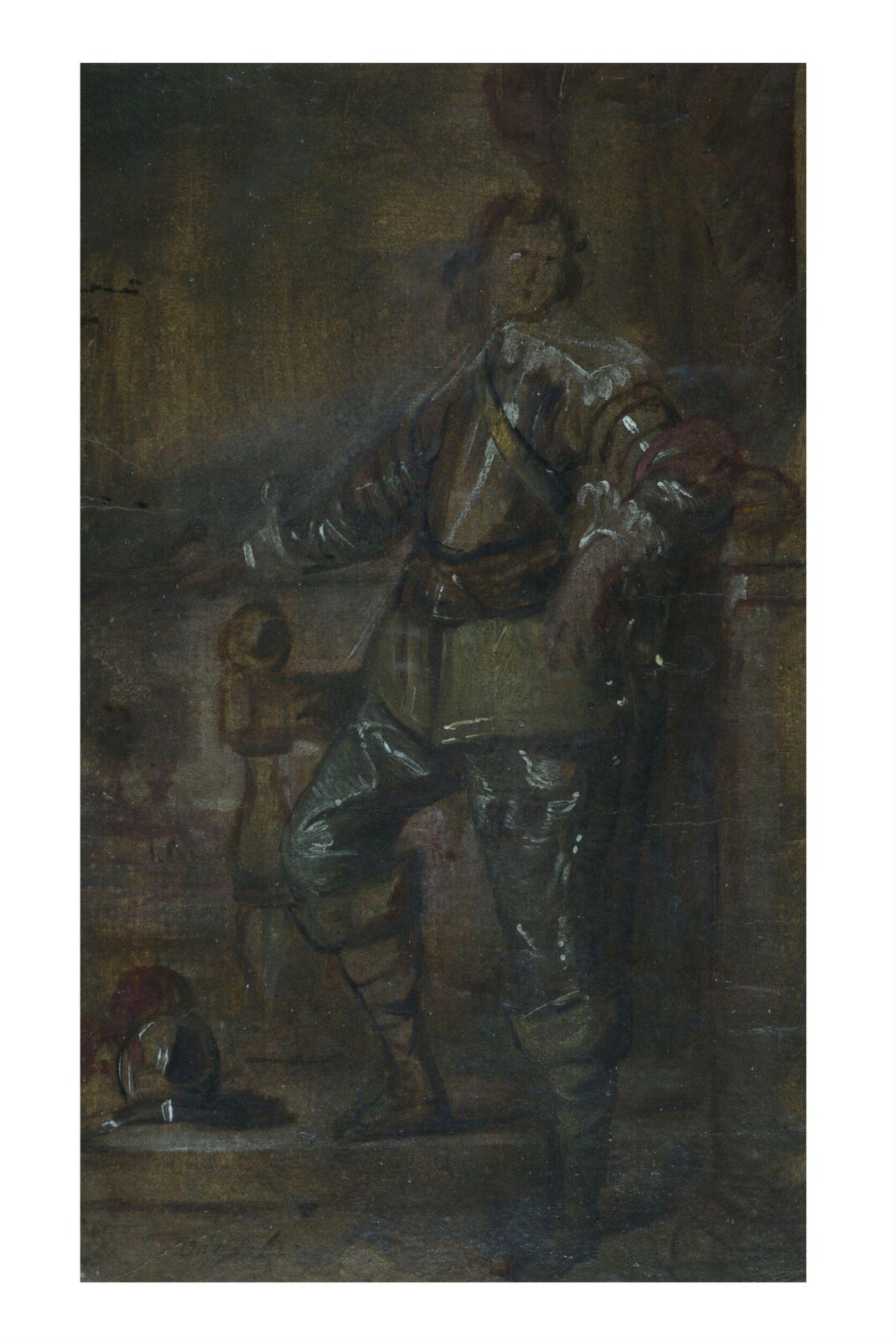
A Man in Half Armour
Can I see it?
Not on view at present
Where is “A Man in Half Armour” now? Collection: Victoria and Albert Museum, London. Not on view at present. Checked September 25, 2026.

London, United Kingdom
It belongs to the collection, but is not on display at present.
- Checked
- In this state since
- Source
- The museum
About the painting
A man in half armour and wearing a sheathed sword, standing at a balustrade with left arm akimbo and right arm outstretched, his red plumed helmet at his feet and a red scarf tied at his right elbow. Sir Anthony van Dyck (b. 1599, Antwerp, d. 1641, London) was a Flemish painter and one of the most important and prolific portraitists of the 17th century. He spent two years in the workshop of Peter Paul Rubens in Antwerp and from 1620-1627 traveled in Italy, where he was in great demand as a portraitist and where he developed his maturing style. He toned down the Flemish robustness of his early work to concentrate on a more dignified, elegant manner. In his portraits of Italian aristocrats he painted idealized figures with proud, erect stances, slender figures, and the famous expressive “van Dyck” hands.
Read on
Influenced by the Venetian painters Titian, Paolo Veronese, and Giovanni Bellini, he adopted their rich, jewel-like colours. In 1632 he moved to London and became court painter to King Charles I, who knighted him shortly after his arrival. Van Dyck painted most of the English aristocracy and his style became lighter and more luminous, with thinner paint and more sparkling highlights in gold and silver. He set a new style for Flemish art and founded the English school of painting; the portraitists Sir Joshua Reynolds and Thomas Gainsborough of that school were his artistic heirs. Dyce.11 appears to be an oil sketch for a portrait or history painting by van Dyck or in his manner and may represent only a section of a larger composition. The arm akimbo stance and 3/4 turn are favourite motifs in van Dyck and similar half-length portraits of men in armour dating to the 1620s are found for example in musuems in Vienna and Dresden e.
Victoria and Albert Museum
Details
- Accession number
- DYCE.11
What it shows
In the catalog
Sources
- Victoria and Albert Museum
- Image: Victoria and Albert Museum — © Victoria and Albert Museum, London
In the life of Anthony van Dyck
The whole life22 March 1599
Born
from 1617
Beginning of Work with Rubens
From 1617 Van Dyck collaborated for a long period with Peter Paul Rubens, whose pupil he became, giving up his independent workshop; Rubens spoke of him as his best pupil.
20 November 1621
Departure for Italy, Arrival in Genoa
In 1621 Van Dyck decided to go to Italy; Rubens supplied him with funds and letters of introduction. On 20 November 1621 he arrived in Genoa and remained in Italy for six years, where his fame as a portraitist was consolidated.
5 July 1632
Principal Painter to King Charles I
On 5 July 1632 Charles I officially appointed Van Dyck principal painter to the king, guaranteeing an annual income of two hundred pounds sterling; the king gave him a large house with a garden on the banks of the Thames.
27 February 1640
Married: Mary Ruthven
9 December 1641
Died