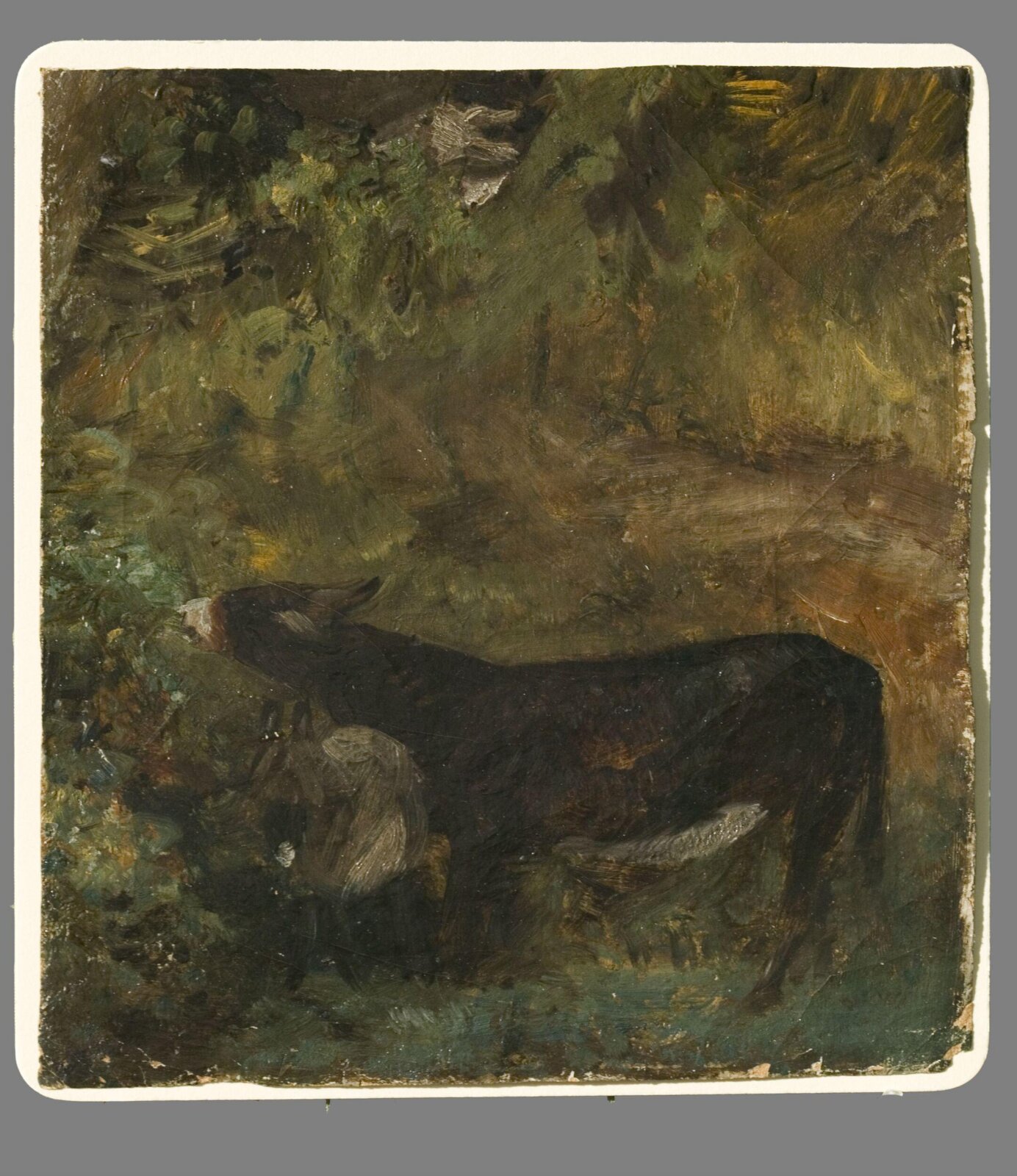
 John ConstableBritish, 1776–1837
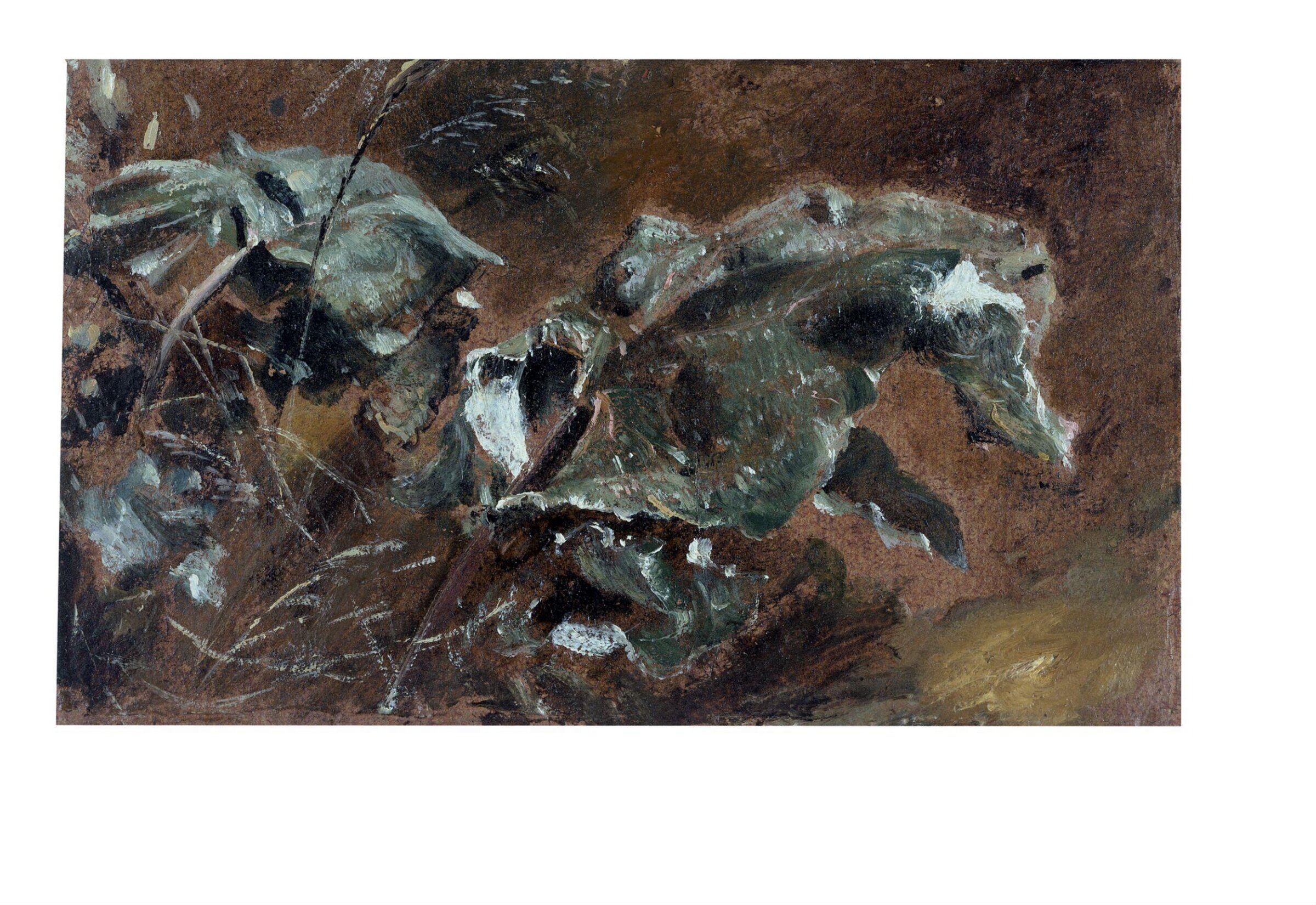
A Donkey with a Foal: Study for <i>The Cornfield</i>
Can I see it?
Yes, on view now
Where is “A Donkey with a Foal: Study for <i>The Cornfield</i>” now? Victoria and Albert Museum, Paintings, Room 88, The Edwin and Susan Davies Galleries, London. Yes, on view now. Checked September 25, 2026.

London, United Kingdom
RoomPaintings, Room 88, The Edwin and Susan Davies Galleries
Closed· opens tomorrow at 10:00 AM
On public display.
- Checked
- In this state since
- Source
- The museum
About the painting
Farm animals appear in many of Constable's landscapes. He once mentioned 'painting in the field from a donkey that I wanted to introduce in a little picture'. The donkey and foal in this study reappear in The Cornfield of 1826, one of Constable's most famous works. It is now in the National Gallery, London.
Victoria and Albert Museum
Details
- Accession number
- 790-1888
What it shows
In the catalog
Sources
- Victoria and Albert Museum
- Image: Victoria and Albert Museum — © Victoria and Albert Museum, London
In the life of John Constable
The whole life1824
The Paris Salon: a gold medal
The Anglo-French dealer John Arrowsmith bought The Hay Wain and other works, and in 1824 they were shown at the Paris Salon, where they caused a sensation. The Hay Wain was awarded a gold medal by Charles X.
1824
Delacroix repaints the background of “The Massacre at Chios”
After seeing Constable’s pictures at Arrowsmith’s gallery, Delacroix repainted the background of his Massacre at Chios, saying the paintings had done him a great deal of good. In his journal he noted that Constable’s meadow greens are a combination of many different shades.
1824–1828
The family in Brighton for Maria’s health
When Maria began to show symptoms of tuberculosis, Constable took lodgings for the family in Brighton in the hope that sea air would restore her health, dividing his time between Brighton and Charlotte Street in London. He was unsure at first that Brighton suited painting, and complained to Fisher that the beach was only Piccadilly by the sea.
1825
A quarrel with Arrowsmith: the French market is lost
In 1825 Constable quarrelled with Arrowsmith and lost his French outlet, perhaps partly from worry over his wife’s health, the uncongenial life at Brighton and the pressure of outstanding commissions. In a few years he had sold more than twenty pictures in France, more than he sold at home.
23 November 1828
The death of his wife Maria
After the birth of their seventh child the family returned to Hampstead, where Maria died of tuberculosis at the age of 41. “Hourly do I feel the loss of my departed Angel,” Constable wrote to his brother.
1828–1837
A widower with seven children
For the rest of his life Constable dressed in black and brought up his seven children alone; according to Leslie he was “a prey to melancholy and anxious thoughts”. Several of the children also painted, notably Lionel.



![Vallon à Helmingham [Helmingham Dell], Constable, John, 1e quart du XIXe siècle (peint à l'été 1823 (selon Beckett)) (1823)](https://collections.louvre.fr/media/cache/large/0000000021/0000065616/0000312650_OG.JPG)

![[Die Flucht nach Ägypten; The Flight into Egypt. Small; Fuite en Egypte], Rembrandt, 1633](https://diglib.hab.de/varia/haum/rembrandt-ab3-0063/max/000001.jpg)
![[Die Flucht nach Ägypten; The Flight into Egypt. Small; Fuite en Egypte], Rembrandt, 1633](https://diglib.hab.de/varia/haum/rembrandt-ab3-0064/max/000001.jpg)


