Frans HalsDutch, 1581–1666
Portrait of a Young Man Holding a Glove
Can I see it?
Yes, on view now
Where is “Portrait of a Young Man Holding a Glove” now? State Hermitage Museum, Room 249, Saint Petersburg. Yes, on view now. Checked August 29, 2026.

Saint Petersburg, Russia
Open now· until 9:00 PM
On public display.
- Checked
- In this state since
- Source
- The museum
About the painting
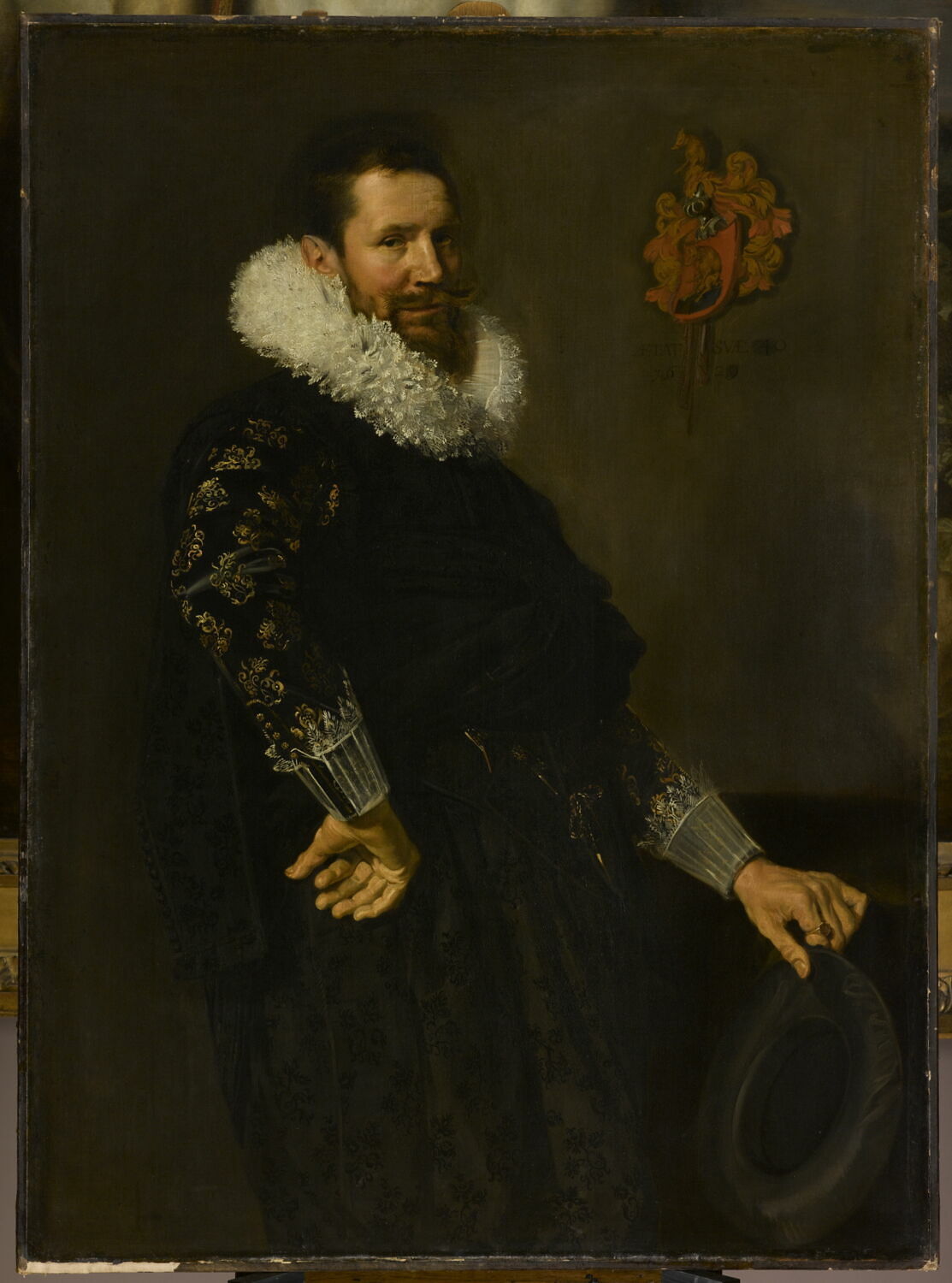
Portrait of a Man with a Glove or Portrait of a Man Holding a Glove is a 1640 oil-on-canvas painting by the Dutch artist Frans Hals. The subject of the painting is unknown but believed to be a physician, partially owing to the painting previously having been called Portrait of a Doctor. The portrait demonstrates Hals' "rapid spontaneous manner of painting". It was acquired in 1764 by the Hermitage Museum in Russia. It was previously owned by Frederick the Great, who sent it to Catherine the Great as part of a batch of paintings in lieu of paying off several debts to Russia.
Read on
The portrayed person is possibly Cornelis Schrevelius (1608–1664), a medical doctor in Haarlem between 1632 and 1641. After 1641 he was dean of the Latin school of Leiden where he succeeded his father. He was the son of Theodorus Schrevelius (1572–1649) dean of the Latin school of Haarlem and later of Leiden who was an acquaintance of Frans Hals and wrote about him in his history of Haarlem (1647/1648). Theodorus was portrayed by Frans Hals in 1617.
There are several portraits of Cornelis known. He was first portrayed in 1624 in a family portrait with his parents, brother and sister. Additional portraits dating from the 1650s and 1660s are known through engravings. In 1661 he was portrayed with his own family by Jacob Torenvliet.
This portrait by Hals was possibly in 1704 still in the possession of his son Theodorus (1639–1704) under the name "Quacksalver". The painting was used around 1685 by an English engraver for a commercial engraving "The mountback doctor and his merry Andrew". Probably the little flattering title gives his own opinion about his former profession while he was a famous Latinist and asked several times for a medical professorship at the University of Leiden which he refused.
Museum text in Russian
«Портрет молодого человека с перчаткой в руке» из коллекции Эрмитажа отличает быстрая спонтанная манера письма, позволявшая Франсу Халсу достигать необычайной точности в передаче мимики и жестов его героев. Молодой человек в черном костюме с белым воротником горделиво смотрит из-под полей черной шляпы. Его затянутая в перчатку правая рука положена на грудь, в левой он небрежно держит другую перчатку, что придает его элегантной позе особую непринужденность. Перчатки – аксессуар костюма, свидетельствующий о высоком социальном статусе заказчиков. Модель портрета не отождествлена, но по легенде, укоренившейся в литературе, изображенный, возможно, имел отношение к медицине. Живописный оригинал Ф. Халса вскоре после создания был гравирован Э. Ле Дэвисом в 1670 г.
Read on
В композиции гравюры рядом с молодым человеком изображен так называемый «Мулат», герой еще одной известной картины Халса (Музей изобразительных искусств, Лейпциг). Надпись на графическом листе гласит: «Доктор-шарлатан и его шут». Идея объединения в гравюре персонажей двух различных по времени написания картин, несомненно, принадлежит самому граверу. Но не исключено, что заказчик эрмитажного портрета действительно мог иметь отношение к медицине. В старой литературе это полотно нередко называли «портретом врача».
State Hermitage Museum
Details
- Accession number
- ГЭ-982
In the catalog
Sources
- State Hermitage Museum
- Image: State Hermitage Museum — Museum open access
In the life of Frans Hals
The whole life1617–1666 · Workplace
Haarlem
1646–1651
Pupil: Pieter Gerritsz van Roestraten
1652
Sells his belongings to pay the baker
Creditors take Hals to court several times, and in 1652 he sells his belongings to settle a debt with a baker; the inventory of the seized property lists only three mattresses and bolsters, an armoire, a table and five pictures — by himself, his sons, Van Mander and Maarten van Heemskerck.