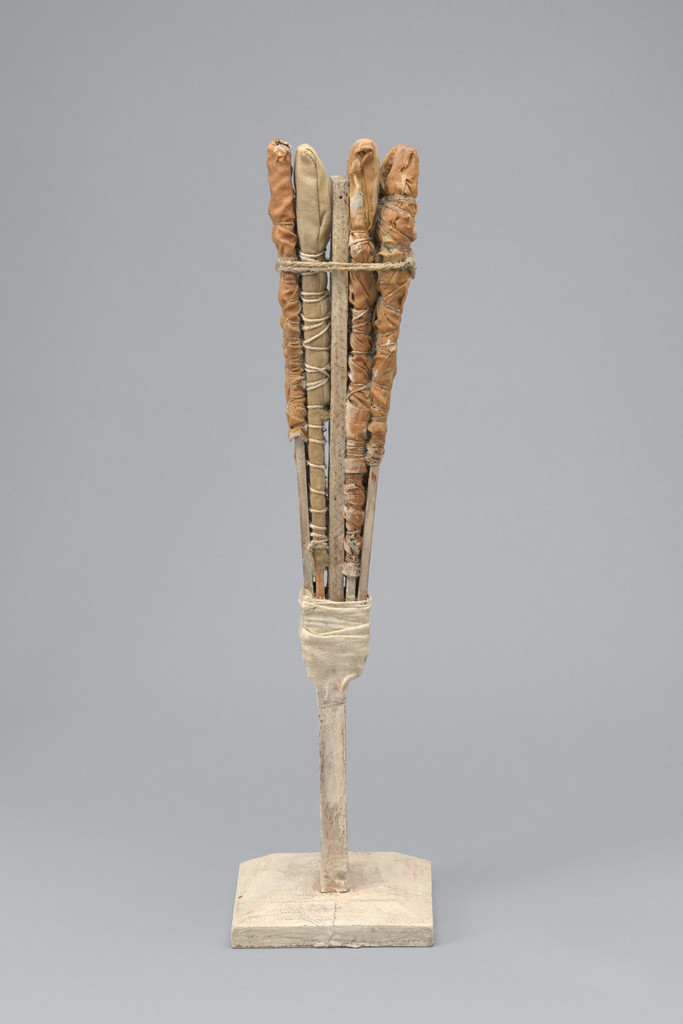
Untitled is among Cy Twombly’s best-known and earliest sculptures. Once painted stark white, it is now evocatively weathered. The work presents a fence-like array of wooden spoon handles and other shafts of wood that were wrapped together with bands of cloth and mounted on a miniature stepped platform. It can be variously read—either separately or simultaneously—as depicting a powerful “fetish” object, a set of mute panpipes, or an unidentified archaeological fragment.
Twombly made this assemblage in New York City after formative travels in both Italy and North Africa; fellow artist Robert Rauschenberg, who had traveled with him, kept the work in his personal collection for more than fivedecades.
On a tuition scholarship at the Art Students League of New York, Twombly meets Robert Rauschenberg, with whom he is briefly romantically involved. Rauschenberg encourages him to attend Black Mountain College.
1951
First solo exhibition at the Kootz Gallery
Robert Motherwell helps arrange Twombly’s first solo exhibition, which is organized by the Samuel M. Kootz Gallery in New York; his work at this time shows the influence of Franz Kline’s black-and-white gestural expressionism and of Paul Klee’s imagery.
1951–1952 · Ausbildung
Black Mountain College
1951–1952
Black Mountain: meeting Cage and Olson
At Black Mountain College near Asheville, Twombly studies with Franz Kline, Robert Motherwell and Ben Shahn and meets John Cage; the poet Charles Olson, the college’s rector, has a great influence on him.
1952
Travels to North Africa and Europe with Rauschenberg
A grant from the Virginia Museum of Fine Arts enables Twombly to travel to North Africa, Spain, Italy and France; Robert Rauschenberg accompanies him on the journey.