
 RaphaelItalien, 1483–1520
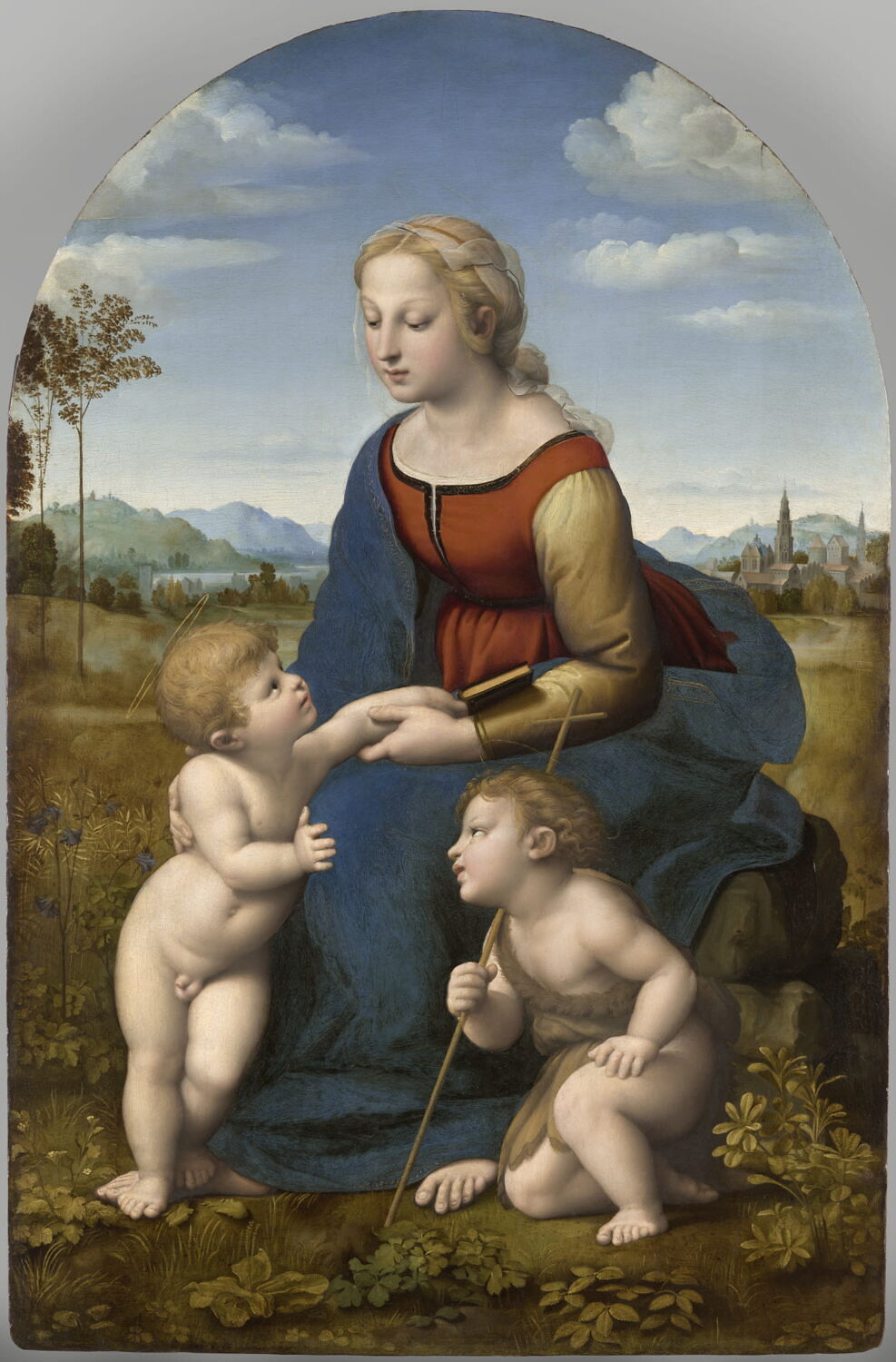
Madonna Alba, Szene: Maria mit Christuskind und Johannes dem Täufer, Tondo
Darf man es sehen?
Ja, es empfängt Besucher

Öffentlich ausgestellt. Wer dafür bürgt, steht unten.
- Geprüft
- vor 6 Tagen
- Unverändert seit
- 29. Sept. 2026
- Quelle
- Sammlungsdaten des Museums selbst
About the painting
The Alba Madonna is a tondo (circular) oil on wood transferred to canvas painting by the Italian High Renaissance artist Raphael, created c. 1510, depicting Mary, Jesus, and John the Baptist in a typical Italian countryside.
After a century and a half in Italy, it was in the collection of the Dukes of Alba in Spain until 1836, when it was sold to Nicholas I of Russia, and it became one of the highlights of the Imperial Hermitage Museum in Saint Petersburg. Clandestinely sold to Andrew W. Mellon by the government of the Soviet Union in 1931, it has been held by the National Gallery of Art in Washington, D.C., since 1937.
Angaben
- Inventarnummer
- 1937.1.24
What it shows
Im Katalog
Kommen und Gehen
Ausgestellt · Saal 20 · Westgebäude, Hauptgeschoss
National Gallery of Art · 29. Sept. 2026 — jetzt · Geprüft
Ausgestellt · Saal 20 · Westgebäude, Hauptgeschoss
National Gallery of Art · 29. Sept. 2026 — 29. Sept. 2026 · Geprüft
Ausgestellt · Saal 20 · Westgebäude, Hauptgeschoss
Eremitage · 28. Sept. 2026 — 29. Sept. 2026 · Geprüft
Ausgestellt · Saal 20 · Westgebäude, Hauptgeschoss
National Gallery of Art · 30. Aug. 2026 — 28. Sept. 2026 · Geprüft
Quellen
- Eremitage: the museum's own open data · abgerufen vor 6 Tagen
- Bild: National Gallery of Art — Museum open access
Derweil im Leben von Raphael
Das ganze Lebenc. 1504 – c. 1508 · Wirkungsort
Florence
1508
Moves to Rome at the invitation of Julius II
The new pope, Julius II, invited Raphael to Rome, perhaps at the suggestion of his architect Bramante, a distant relative of the artist. Unlike Michelangelo, kept waiting for months after his summons, Raphael was immediately commissioned to fresco what was to become the pope's private library, a far larger commission than any he had had before.
1508–1520 · Wirkungsort
Rome
c. 1510
Marcantonio Raimondi engraves his designs
Raphael made no prints himself, but his pupils and assistants, above all Marcantonio Raimondi, engraved his drawings; around 1510 came “The Judgement of Paris”. The prints were sold in street shops and bought by maiolica painters, jewellers and carvers.
1511
Under the spell of Michelangelo's ceiling
According to Vasari, Bramante let Raphael into the Sistine Chapel secretly, and while painting the Stanza he was clearly influenced by Michelangelo's ceiling, as in his portrait of Michelangelo himself as Heraclitus in “The School of Athens”. Michelangelo accused him of plagiarism and years later complained that “everything he knew about art he got from me”.



![Ginevra de' Benci [obverse], Leonardo da Vinci, c. 1474/1478](https://api.nga.gov/iiif/8f29e3c9-a289-4d53-abf0-31a66e9e98fa/full/!2400,2400/0/default.jpg)
![Wreath of Laurel, Palm, and Juniper with a Scroll inscribed Virtutem Forma Decorat [reverse], Leonardo da Vinci, c. 1474/1478](https://api.nga.gov/iiif/ff62e8d0-45c4-498f-ad36-6358de827e04/full/!2400,2400/0/default.jpg)


