 Claude MonetFrankreich, 1840–1926
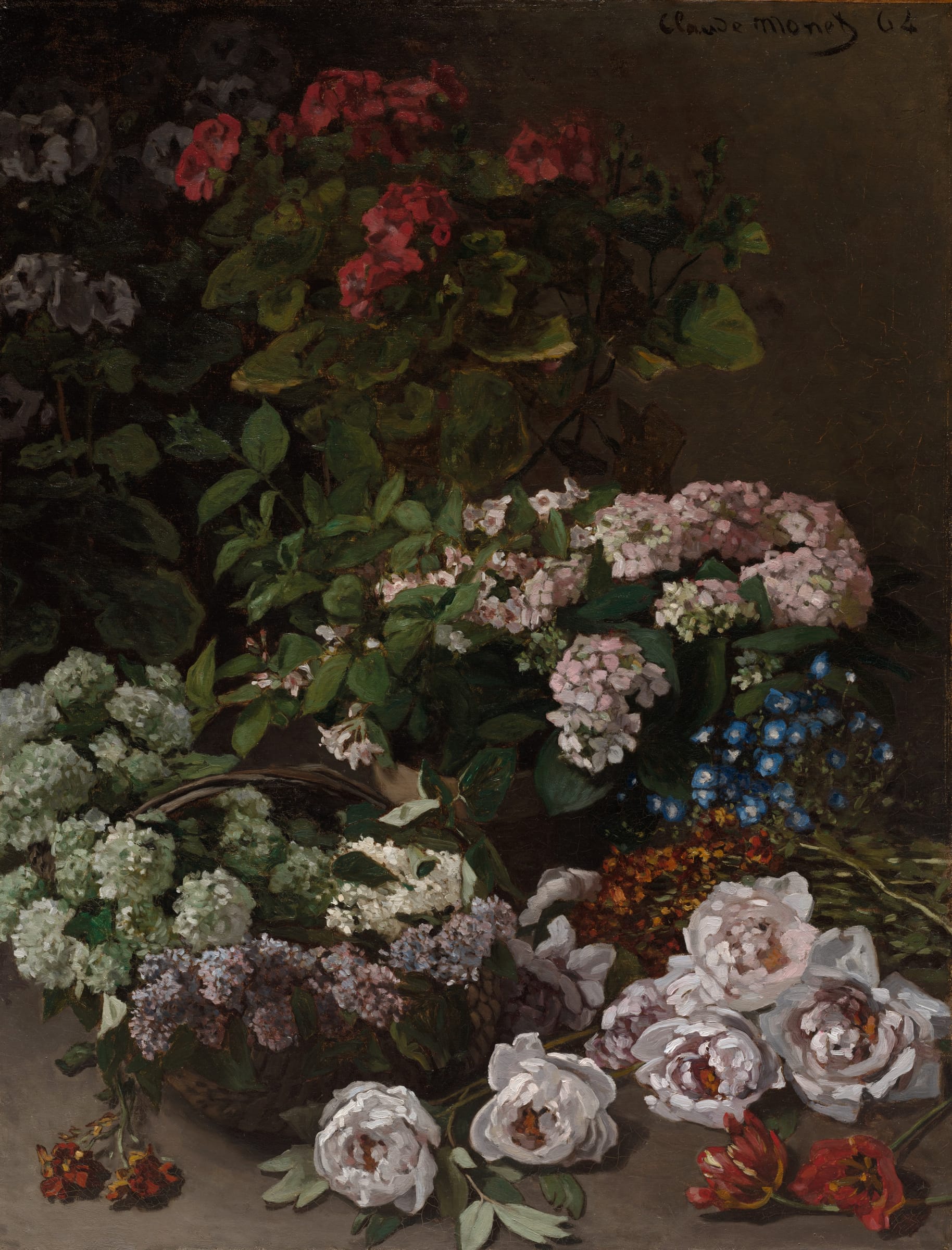
Spring Flowers
Darf man es sehen?
Empfängt derzeit nicht

Cleveland Museum of Art
Cleveland, Vereinigte Staaten
Es gehört zur Sammlung, ist derzeit aber nicht ausgestellt.
- Geprüft
- vorgestern
- Unverändert seit
- 16. Aug. 2026
- Quelle
- Sammlungsdaten des Museums selbst
About the painting
This early work reveal's Monet's fascination with capturing the transitory effects that became the primary focus of his later innovations. Painted with almost scientific accuracy, this still life has a freshness and immediacy derived partly from its composition. Isolated against a dark background, the fully mature peonies, potted hydrangeas, and basketed lilacs spill downward and outward from the geraniums at the rear. At the same time, Monet's energetic brushwork conveys the sparkling play of light on leaves and petals.
Cleveland Museum of Art
Angaben
- Inventarnummer
- 1953.155
Im Katalog
Quellen
- Cleveland Museum of Art: the museum's own open data · abgerufen vor 6 Tagen
- Bild: Cleveland Museum of Art — CC0 (Cleveland Museum of Art Open Access)
Derweil im Leben von Claude Monet
Das ganze LebenApril 1861 – November 1862
Military service in Algeria
Monet enlisted in the 1st Regiment of African Light Cavalry (Chasseurs d'Afrique) and arrived in Algeria in June 1861. In spring 1862 he contracted typhoid; his aunt bought him out of the army. The light and colors of North Africa, in his words, "contained the germ of my future researches."
summer 1862
Meeting Jongkind
While working near Cape La Hève in the summer of 1862, Monet met and befriended the Dutch painter Johan Jongkind, who alongside Boudin became an important mentor to him.
December 1862
Gleyre's studio: Renoir, Sisley, Bazille
Back in Paris, Monet entered the studio of Charles Gleyre, where he met Auguste Renoir, Alfred Sisley and Frédéric Bazille — the future core of the Impressionist group. Bazille became his closest friend.
1865
Salon debut
Monet made his Salon debut with the paintings "Cape La Hève at Low Tide" and "The Mouth of the Seine at Honfleur," which met with great approval.