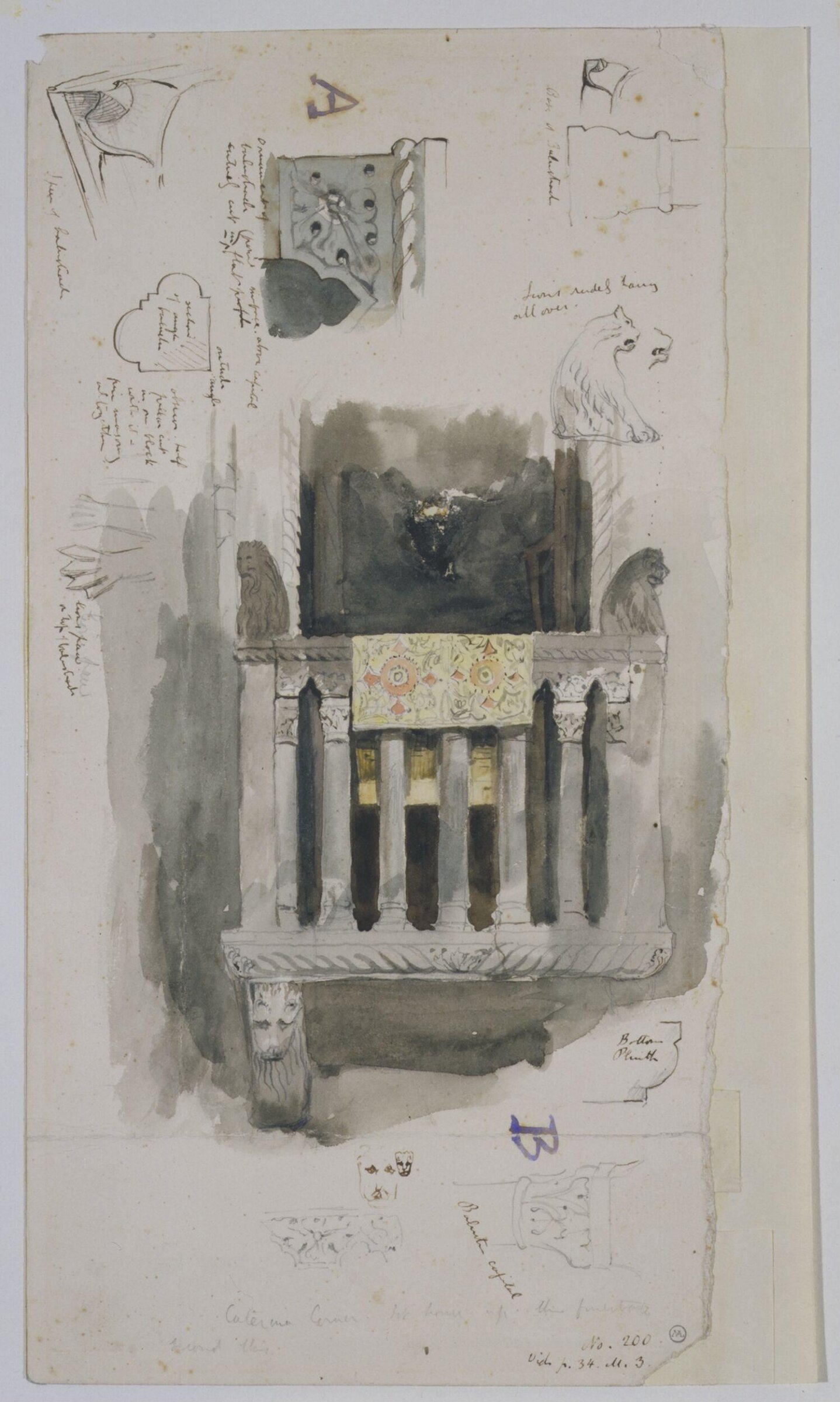
John RuskinEngland, 1819–1900
Mont Saleve
Kann ich es sehen?
Derzeit nicht ausgestellt
Wo ist „Mont Saleve“ heute? Sammlung: Art Institute of Chicago, Chicago. Derzeit nicht ausgestellt. Geprüft 29. September 2026.

Chicago, Vereinigte Staaten
Es gehört zur Sammlung, ist derzeit aber nicht ausgestellt.
- Geprüft
- Unverändert seit
- Quelle
- Das Museum
Angaben
- Inventarnummer
- 1982.454
Im Katalog
Quellen
- Art Institute of Chicago
- Bild: Art Institute of Chicago — CC0
Im Leben von John Ruskin
Das ganze Leben1834–1900 · Wirkungsort
Great Britain
September 1837 – December 1838
“The Poetry of Architecture” under the pen name Kata Phusin
Loudon's Architectural Magazine serialises his study of cottages, villas and other dwellings under the Greek pen name “Kata Phusin” (“According to Nature”). Following Wordsworth, Ruskin argues that buildings should be sympathetic to their surroundings and use local materials — themes that anticipate his later writing.
1837–1842
His first love, Adèle Domecq, becomes engaged to another
Ruskin is devastated to hear that his first love, Adèle Domecq, the second daughter of his father's business partner, has become engaged to a French nobleman.
1839
The Newdigate Prize and a meeting with Wordsworth
At the third attempt Ruskin wins the prestigious Newdigate Prize for poetry (Arthur Hugh Clough comes second) and at the ceremony meets William Wordsworth, who is receiving an honorary degree.
April 1840
Coughing blood and a long break from Oxford
While revising for his examinations Ruskin begins to cough blood; fears of consumption lead to a long break from Oxford, which he spends travelling with his parents.
late 1840 – autumn 1842
Italy with his parents: guided by George Richmond
For much of the period from late 1840 to autumn 1842 Ruskin is abroad with his parents, mainly in Italy, where George Richmond — introduced to the family by Joseph Severn, a friend of Keats — guides his study of Italian art. Back at Oxford in 1842 he sits for a pass degree and is awarded an unusual honorary double fourth-class degree in recognition of his achievements.