
 Jean-Antoine WatteauFrankreich, 1684–1721
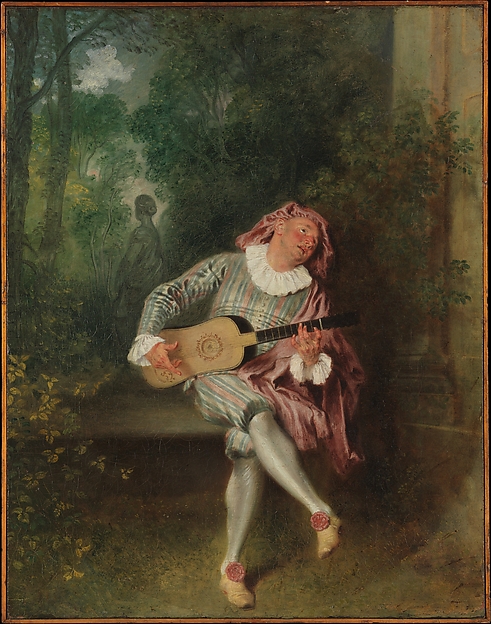
Mezzetin
Darf man es sehen?
Empfängt derzeit nicht

Washington, D.C., Vereinigte Staaten
Es gehört zur Sammlung, ist derzeit aber nicht ausgestellt.
- Geprüft
- Unverändert seit
- Quelle
- Das Museum
Angaben
- Inventarnummer
- 1963.12.1
Was es zeigt
Im Katalog
Quellen
- National Gallery of Art
- Bild: National Gallery of Art — Museum open access
Derweil im Leben von Jean-Antoine Watteau
Das ganze Leben1710s
Meets Edme-François Gersaint
At Sirois's house Watteau meets his son-in-law, the art dealer Edme-François Gersaint, who soon becomes a close friend.
1710s
Tuberculosis sets in
Watteau's fame grows steadily, yet he is as a rule dissatisfied with everything that comes from his brush; at the same time he develops a serious illness, tuberculosis.
1714
Moves into the banker Crozat's mansion
Through Sirois, Watteau finds a patron in the very wealthy banker and collector Pierre Crozat and, at his invitation, moves into Crozat's newly built Paris mansion. There he gains access to the celebrated collection and eagerly copies drawings by the great masters; next door lives the academician Charles de La Fosse, with whom he is on good terms.
c. 1717
Crozat recommends Watteau to Rosalba Carriera
Watteau's fame spreads beyond Paris: the banker Crozat writes to the celebrated portraitist Rosalba Carriera in Venice that among Paris painters he knows no one but Watteau who could produce a work worthy of being shown to her. Crozat's patronage and lucrative commissions help to launch the painter's European reputation.
28 August 1717
Elected to the Academy: a “fête galante”
By 1717 Watteau's “gallant scenes” have had such wide success that an exception is made for his reception piece, “Pilgrimage to Cythera”: in the minutes the words “pilgrimage to Cythera” are struck out and replaced by “fête galante”. Watteau is elected a full member of the Academy; the ceremony is attended by the First Painter to the King, Antoine Coypel, by Claude Gillot and by the Regent, the Duke of Orléans.
1718
Leaves Crozat's house
Watteau's independent character does not let him stay long in such luxurious but constraining circumstances, and in 1718 he leaves the house of his patron, who does not lose interest in his art. “Gilles” was probably one of the last works painted in the large studio put at his disposal in Crozat's mansion.



![Ginevra de' Benci [obverse], Leonardo da Vinci, c. 1474/1478](https://api.nga.gov/iiif/8f29e3c9-a289-4d53-abf0-31a66e9e98fa/full/!2400,2400/0/default.jpg)
![Wreath of Laurel, Palm, and Juniper with a Scroll inscribed Virtutem Forma Decorat [reverse], Leonardo da Vinci, c. 1474/1478](https://api.nga.gov/iiif/ff62e8d0-45c4-498f-ad36-6358de827e04/full/!2400,2400/0/default.jpg)


![The Watering Place (Horses Bathing) [L'abreuvoir (chevaux au bain)], Pablo Picasso, 1906](https://api.nga.gov/iiif/bbac782b-88ea-4477-97a5-4369aa47b98a/full/!2400,2400/0/default.jpg)
