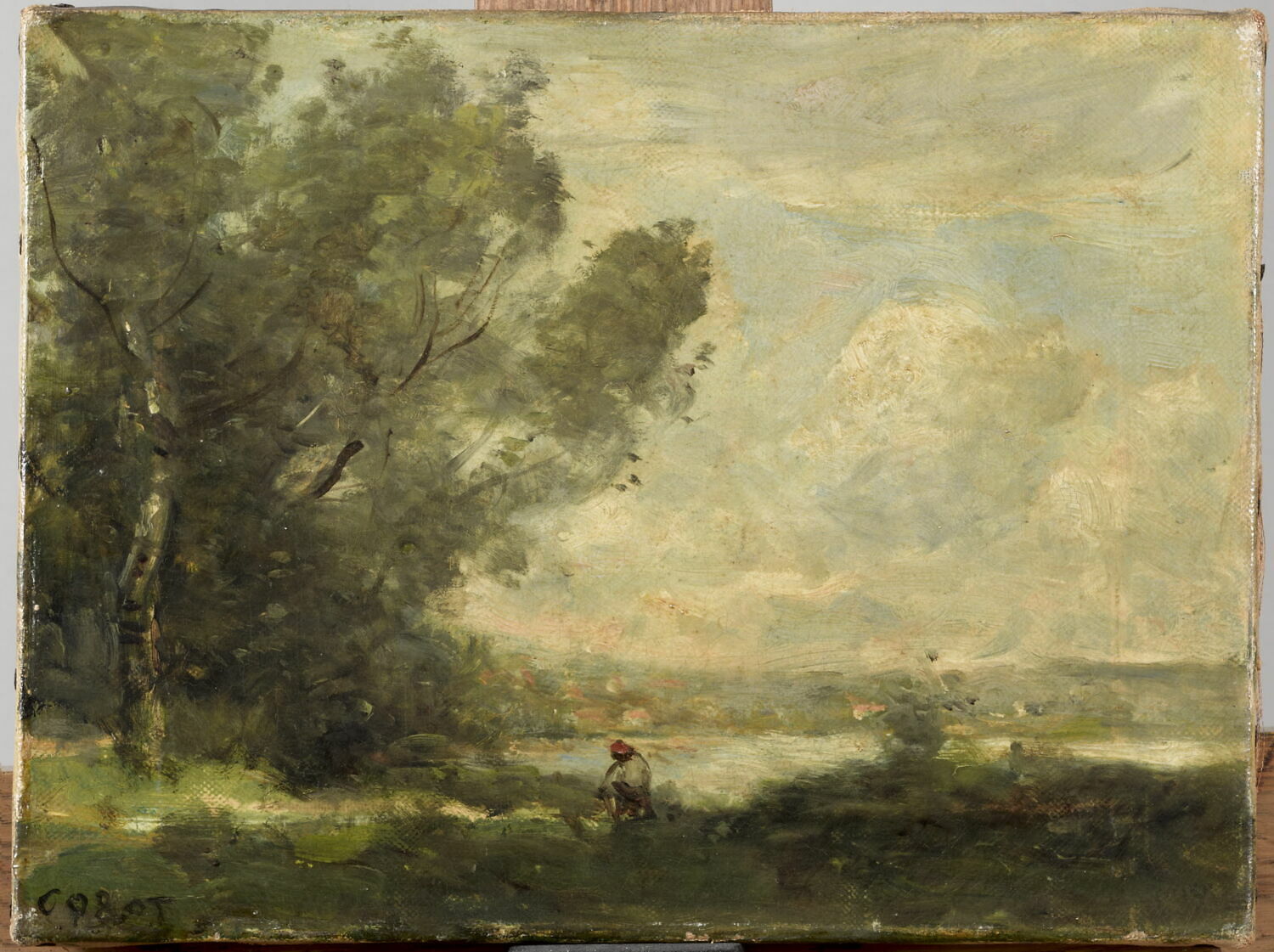
Landscape with Pollard Willows
Über das Gemälde
In den Worten des Museums — auf Niederländisch
Landschap met knotwilgen. Rechts een vrouw met een geit. In de verte een boerderij.
Rijksmuseum Amsterdam

Angaben
- Inventarnummer
- SK-A-2882
Derweil im Leben von Camille Corot
Das ganze Leben1845
Baudelaire proclaims Corot leader of modern landscape
Throughout the 1840s the Salon rejected many of Corot's works and the public bought few. But by 1845 Baudelaire led a charge proclaiming him the leader of the “modern school of landscape painting”, answering critics who found his colors pale: Corot, he said, was more a harmonist than a colorist.
1847
Delacroix takes note of Corot; Dutilleux becomes a friend
In 1847 Delacroix noted in his journal that Corot was a true artist. On Delacroix's recommendation the painter Constant Dutilleux bought a Corot painting and began a long and rewarding relationship with the artist, bringing him friendship and patrons.
1848
After the Revolution of 1848, a seat on the Salon jury
Corot's public treatment improved dramatically after the Revolution of 1848, when he was admitted to the Salon jury; that year he also received a second-class medal at the Salon. It brought him little state patronage, however.
1872
A house in Auvers for the blind Daumier
In 1872 Corot bought a house in Auvers as a gift for Honoré Daumier, who by then was blind, without resources and homeless.
25 January 1875
Ill with stomach cancer, he returns to Paris
Suffering from stomach cancer, Corot returned to Paris on 25 January 1875. He remained bedridden at No. 56 Rue du Faubourg-Poissonnière until his death.