Paul KleeDeutschland, 1879–1940
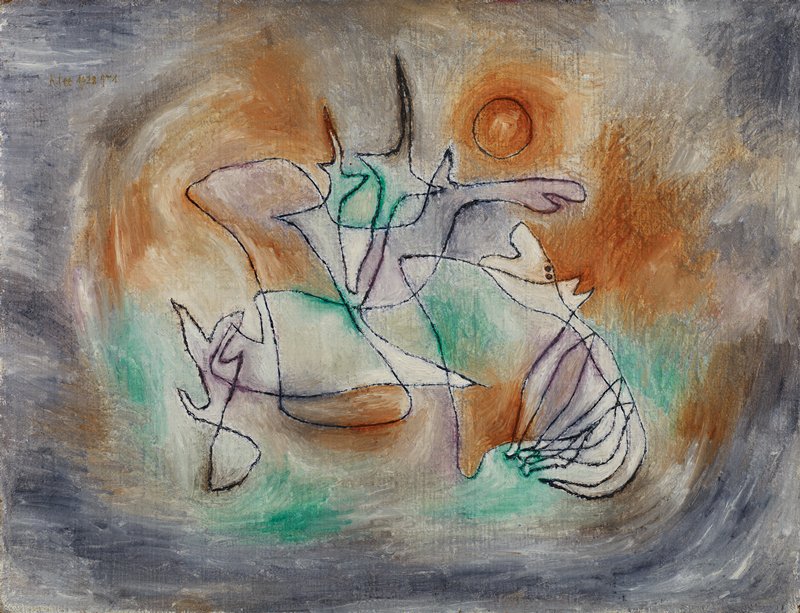
Comedian (INV 4)
Darf man es sehen?
Empfängt derzeit nicht

Art Institute of Chicago
Chicago, Vereinigte Staaten
Es gehört zur Sammlung, ist derzeit aber nicht ausgestellt.
- Geprüft
- Unverändert seit
- Quelle
- Das Museum
Angaben
- Inventarnummer
- 1970.237
Im Katalog
Quellen
- Art Institute of Chicago
- Bild: Art Institute of Chicago — © the artist or rights holder
Derweil im Leben von Paul Klee
Das ganze Leben22 October 1901 – 2 May 1902
First journey to Italy with Hermann Haller
With Hermann Haller, a fellow pupil at Knirr’s school and a future sculptor, Klee travelled from Milan and Genoa through Rome and Naples to Florence. Three impressions of the trip shaped his later work: the Renaissance architecture of Florence, the Naples Aquarium, which revealed the variety of natural forms, and the playful sensuality of the Gothic panels in Siena.
1902–1906
Four years at his parents’ house in Bern
Back from Italy, Klee lived for four years at his parents’ house, earning a living by giving music and painting lessons and writing reviews for a music magazine; he attended a course in anatomy for artists, and the Bern Music Society took him on as a violinist. In 1904, in Munich’s print room, he studied Aubrey Beardsley, William Blake, Goya — whose “Disasters of War” delighted him — and James Ensor.
May – June 1905
Paris with childhood friends: the Louvre and the Luxembourg
With his childhood friends, the budding painter Louis Moilliet and the writer Ernst Bloesch, Klee lived in Paris and studied classical art in the Louvre and the gallery of the Luxembourg Palace. He also became acquainted with Impressionism, but the work of Cézanne, Matisse and Derain was still unknown to him.
June 1906
First public appearance: the Munich Secession
The “Inventions” etching cycle is shown at the Munich Secession’s international art exhibition — Klee’s first appearance before the public.
September 1906
Marriage and a move to Munich’s Schwabing
Klee moves to Munich and marries the pianist Lily Stumpf; the couple settle in the suburb of Schwabing.