ART WIKI32.963 ausgestellt
KarteSammlungKünstlerMuseenAusstellungenJournal
Anmelden

ART WIKI

Wo das Meisterwerk hängt und wann man vorgelassen wird.

Sammlungen: Art Institute of Chicago, Cleveland Museum of Art, Eremitage, Getty Villa, Harvard Art Museums, Hirshhorn Museum and Sculpture Garden, J. Paul Getty Museum, Louvre, Metropolitan Museum of Art, Minneapolis Institute of Art, Museum of Modern Art, National Gallery of Art, National Museum of Asian Art, National Portrait Gallery, Puschkin-Museum, Rijksmuseum Amsterdam, Russisches Museum, Smithsonian American Art Museum, Statens Museum for Kunst, Tretjakow-Galerie, Victoria and Albert Museum, Whitney Museum of American Art, Staatskatalog des Museumsfonds Russlands (274 Museen), Europeana (19 Museen), Wikidata (6 Museen), Paris Musées (12 Museen) und Joconde, die Museumsdatenbank des französischen Kulturministeriums (495 Museen). Die Bilder gehören ihren Rechteinhabern.

Rubriken

  • Karte
  • Suche
  • Sammlung
  • Meisterwerke
  • Jetzt ausgestellt
  • Künstler

Mehr

  • Museen & Galerien
  • Ausstellungen
  • Journal
  • Woher die Daten stammen
  • Datenschutz & Cookies
StartseiteKarteKatalog
  1. Sammlung/
  2. J. Paul Getty Museum/
  3. Apollo Crowning Himself
Apollo Crowning Himself, Antonio Canova, 1781–1782

Apollo Crowning Himself

1781–1782 · Sculpture · 84.7 × 41.9 cm

Über die Skulptur

As Ovid told the story in his *Metamorphoses,* when the beautiful nymph Daphne finally escaped the pursuing Apollo by turning into a laurel tree, the Roman god of music and poetry pledged his unrequited love: "Although you cannot be my wife, you shall at least be my tree; I shall always wear you on my hair, on my quiver, O Laurel." In this marble, half-life-size statue inspired by this episode of the *Metamorphoses,* Apollo crowns himself with a laurel wreath. Nude except for sandals, his lyre hangs on the tree trunk that supports a piece of rumpled drapery. He stands in *contrapposto,* a balanced stance characterized by the opposition of straight and bent limbs, in a moment of reflection after the dramatic chase. Apollo's nudity, his broad, muscular chest, and his relaxed, balanced pose all recall famous antique representations of the god.

Weiterlesen

But while sculptor Antonio Canova clearly emulated several antiques, his *Apollo* is not a copy of an already existing statue. The commission for the marble was the result of a competition organized by Don Abbondio Rezzonico, nephew of the Venetian Pope Clement XIII. It is Canova's first fully classicizing work, carved in the Neoclassical style for which he soon became famous.

JPG

Derweil im Leben von Antonio Canova

Das ganze Leben
  1. 1775–1800

    Shows his statues by candlelight

    In the last quarter of the eighteenth century it became fashionable to view galleries at night by torchlight, and Canova seized on the fad: he displayed his works in his studio by candlelight and finished the statues by candlelight with special tools, softening the transitions between the parts of the nude. He then rubbed the marble with pumice, sometimes for weeks or months, and if need be with tripoli and lead.

  2. 1779 · Laufbahn

    the Venetian Academy, but not a teacher

    In 1779 Canova was elected a member of the Venice Academy of Fine Arts; he declined an offer to teach, but gave the Academy a terracotta statue of Apollo in gratitude.

  3. 1779–1780

    Leaves Venice for Rome

    Dreaming of living and working in Rome, “the capital of art”, Canova left Venice in October 1779 and, accompanied by the architect Giannantonio Selva and stopping in Bologna and Florence, reached Rome — on 4 November 1779 or, by other accounts, on 28 December 1780. He studied the antiquities and sketched the works of Michelangelo, but his first Roman works were received coolly.

  4. 22 January – 28 February 1780

    Naples: Sanmartino’s “Veiled Christ”

    From 22 January to 28 February 1780 he stayed in Naples as a guest of Contarina Barbarigo; he saw the Farnese collection and the Sansevero Chapel, where he so admired Giuseppe Sanmartino’s “Veiled Christ” that he tried to buy it, as well as the veiled figures by his fellow Venetian Antonio Corradini.

Mehr von Antonio Canova

Alle Werke

Im selben Saal · Museum West Pavilion, Gallery W101, J. Paul Getty Museum

Museumsseite
J. Paul Getty Museum

Angaben

1781–1782
17571822
Inventarnummer
95.SA.71

Quellen

  • J. Paul Getty Museum
  • Bild: J. Paul Getty Museum — Open Content
Antonio Canova, PorträtAntonio CanovaItalien, 1757–1822

Darf man es sehen?

Ja, es empfängt Besucher

JPG
J. Paul Getty Museum

Los Angeles, Vereinigte Staaten

SaalMuseum West Pavilion, Gallery W101

Öffentlich ausgestellt. Wer dafür bürgt, steht unten.

Geprüft
vorgestern
Unverändert seit
5. Okt. 2026
Quelle
Das Museum
Auf der KarteMuseumsseite
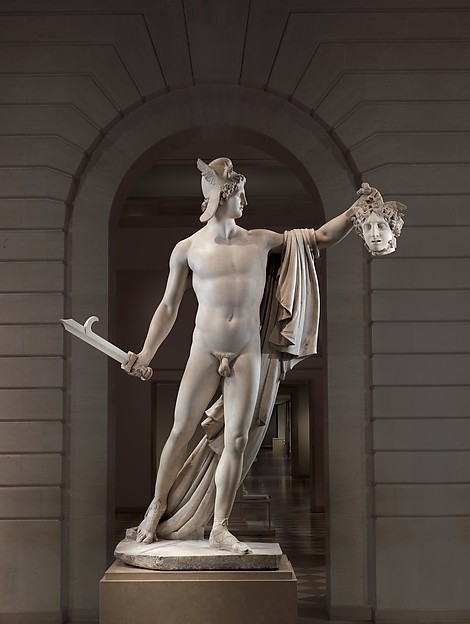
Perseus with the Head of Medusa, Antonio Canova, 1804–6

Perseus with the Head of Medusa

1804–6 · Metropolitan Museum of Art

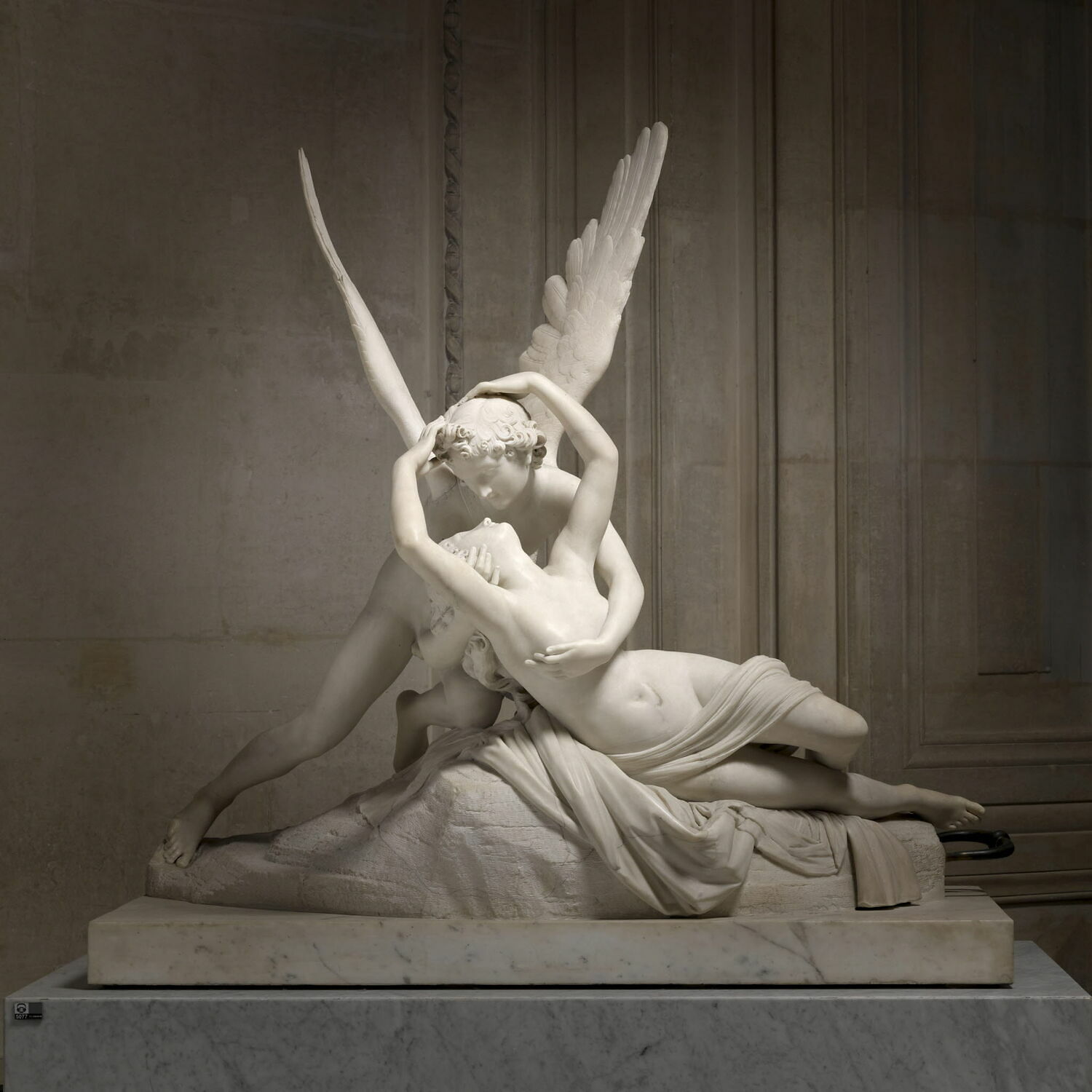
L'Amour et Psyché à demi couchée, Canova, Antonio, 1787 - 1793

L'Amour et Psyché à demi couchée

1787 - 1793 · Louvre

Cupid and Psyche, Antonio Canova, 1794

Cupid and Psyche

1794 · Metropolitan Museum of Art

Winged Victory, Antonio Canova, after the Antique, c. 1803/1806

Winged Victory

c. 1803/1806 · National Gallery of Art

Dancer with Finger on Chin, Antonio Canova, model 1809/1814, carved 1819/1823

Dancer with Finger on Chin

model 1809/1814, carved 1819/1823 · National Gallery of Art

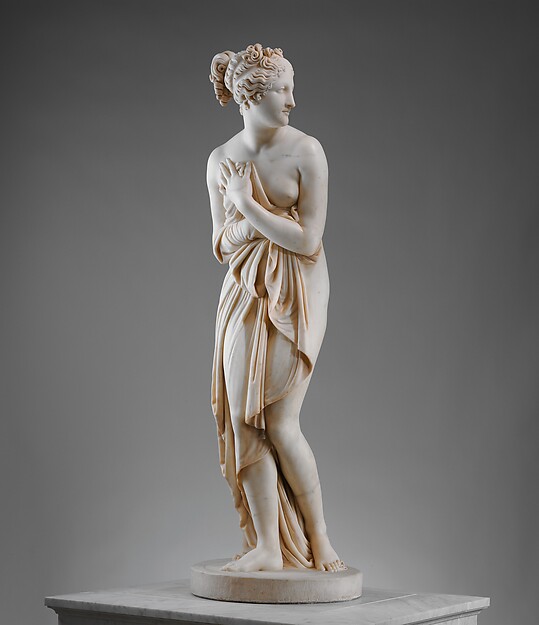
Venus Italica, Antonio Canova, probably ca. 1822–23, variant of marble first executed 1810

Venus Italica

probably ca. 1822–23, variant of marble first executed 1810 · Metropolitan Museum of Art

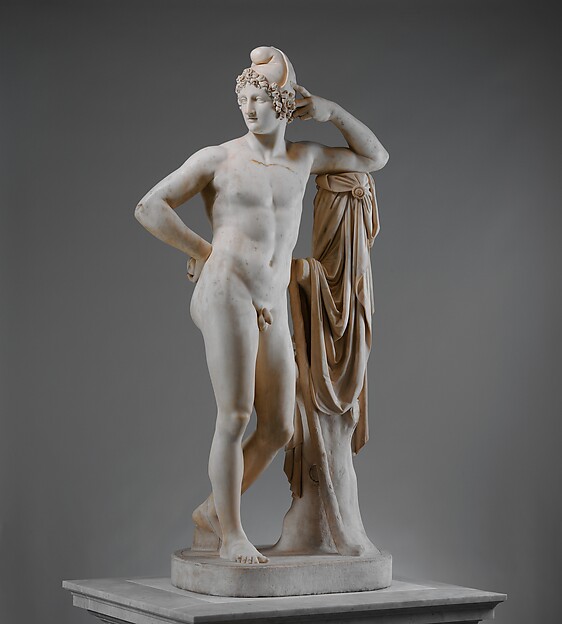
Paris, Antonio Canova, ca. 1822–23, original marble version completed November 1812

Paris

ca. 1822–23, original marble version completed November 1812 · Metropolitan Museum of Art

Naiad, Antonio Canova, model 1815/1817, carved 1820/1823

Naiad

model 1815/1817, carved 1820/1823 · National Gallery of Art

Allegorical Portrait of the van Risamburgh Family, Joseph Chinard, 1790

Joseph Chinard

Allegorical Portrait of the van Risamburgh Family, 1790

Venus, Joseph Nollekens, 1773

Joseph Nollekens

Venus, 1773

Bust of a Man (after the antique), Joseph Wilton, 1758

Joseph Wilton

Bust of a Man (after the antique), 1758

Bust of Pseudo-Seneca (after the antique), Joseph Wilton, 1755–1765

Joseph Wilton

Bust of Pseudo-Seneca (after the antique), 1755–1765

Sketch for a Fireplace Overmantel, Francesco Antonio Franzoni, about 1789

Francesco Antonio Franzoni

Sketch for a Fireplace Overmantel, about 1789

Venus Reclining on a Sea Monster with Cupid and a Putto, John Deare, 1787/1788–1790

John Deare

Venus Reclining on a Sea Monster with Cupid and a Putto, 1787/1788–1790

The Elements Paying Tribute to Friendship (Les Élements rendant homage a l'Amitié), Louis-Simon Boizot, about 1783

Louis-Simon Boizot

The Elements Paying Tribute to Friendship (Les Élements rendant homage a l'Amitié), about 1783

Juno, Joseph Nollekens, 1776

Joseph Nollekens

Juno, 1776

Im Katalog

SkulpturMarmorKlassizismus18. JahrhundertItalien