Caspar David FriedrichDeutschland, 1774–1840
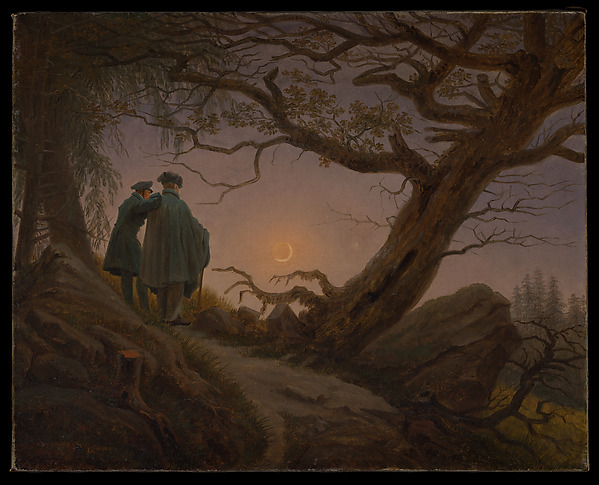
A Walk at Dusk
Darf man es sehen?
Ja, es empfängt Besucher
Öffentlich ausgestellt.
- Geprüft
- Unverändert seit
- Quelle
- Das Museum
Über das Gemälde
His head bowed, a man walks alone in the silvery, cold moonlit night while contemplating a megalithic tomb and its implicit message of death. It is winter, and all around him nature is dying. Leafless trees loom behind like specters, but a grove of verdant oaks rises through the mist in the background with the promise of life. The waxing moon, high in the sky, also acts as a counterbalance to death, symbolizing Christ and the promise of rebirth for the artist Caspar David Friedrich. Friedrich was part of the German Romantic movement; his deeply personal and introspective vision addressed Christian themes through analogies based on the cycles of nature. *A Walk at Dusk* was among a small group of works Friedrich completed before he suffered a debilitating stroke in 1835. The painting embodies both the melancholy he experienced during this period and the consolation he found in the Christian faith.
J. Paul Getty Museum
Angaben
- Inventarnummer
- 93.PA.14
Im Katalog
Quellen
- J. Paul Getty Museum
- Bild: J. Paul Getty Museum — Open Content
Derweil im Leben von Caspar David Friedrich
Das ganze Leben1825–1840
The fading of his fame
Over the last fifteen years of his life Friedrich’s reputation steadily declines: as the ideals of early Romanticism go out of fashion he comes to be seen as an eccentric and melancholy figure out of touch with the times, and his patrons gradually fall away. Towards the end he lives in relative poverty and spends long periods, often beginning before sunrise, walking alone through woods and fields.
1830
Aphorisms on art
Friedrich sets down a collection of aphorisms on aesthetics, the sum of his written commentary on art. The artist, he holds, must match natural observation with scrutiny of his own personality: close the bodily eye in order to see the picture first with the spiritual eye, and then bring to the light of day what was seen in the darkness.
1835
Money from the Russian royal family and a cure at Teplitz
Soon after his stroke the Russian royal family purchases a number of his earlier works, and the proceeds allow him to travel to Teplitz, in today’s Czech Republic, to recover.
June 1835
His first stroke
Friedrich’s first stroke leaves him with minor limb paralysis and greatly reduces his ability to paint: he can no longer work in oil and is limited to watercolour, sepia and reworking older compositions. His vision remains strong, but his hand has lost its full strength.