Can I see it?
Where to See Joan Miró: Hemingway’s Farm, a New World and Wartime Constellations
A painting once threatened with division into eight saleable pieces now opens a route through Miró’s changing world, from a Catalan farmyard to a sky crowded with signs.
2. november 2026 · 7 min. læsning · ART WIKI’s redaktion
A Paris dealer proposed cutting The Farm into eight pieces. Smaller pictures, Paul Rosenberg thought, might fit Parisian apartments and find buyers more easily. Miró was distressed: he regarded the canvas as a summation of his country life. Its crowded yard, animals, tools and buildings belonged together. What looked to a dealer like an awkwardly large object was, to its maker, an entire world.
That world survives intact in Washington’s National Gallery of Art. Our autumn 2026 check placed it in gallery EU-415-B. New York offers another beginning in The Birth of the World, recorded in MoMA’s gallery 517 on Floor 5. Between these two paintings lies an extraordinary change: the things that Miró once counted and described seem to have loosened from the ground and become a new language.
Washington: Hemingway brings the farm home
Ernest Hemingway bought The Farm as a birthday present for his first wife, Hadley. He and Miró were friends and sometimes sparring partners in a Paris boxing gym. The painting later lived in Hemingway’s homes in Key West and Cuba; Mary Hemingway gave it to the National Gallery in 1987. It had become a travelling image of attachment to a place.
The yard is busy, but almost everything has room to be itself. A watering can, a ladder and the creatures in the enclosure seem to have been granted individual introductions. The tree rises from a dark circle near the centre. Its leaves do not dissolve into an indistinct canopy; they hold their separate shapes. The painting makes looking feel like the work of someone unwilling to forget anything.
Try moving between the largest and smallest things. The farmhouse holds one side of the composition, yet a tiny animal or a scattered tool can compete for attention. That unusual equality is more revealing than a hunt for hidden symbols. Miró’s future vocabulary is already latent here: a world in which a little mark can have as much visual authority as a building.

New York: the hunter sheds his body
A pipe, a moustache and a triangular head are enough to introduce the protagonist of The Hunter (Catalan Landscape). MoMA identifies the thin figure as a stand-in for Miró. The Catalan countryside remains, but its inhabitants have become abbreviated. A heart floats near the hunter’s chest; anatomy no longer requires everything to remain in its usual place.
This painting was recorded as not on view in our autumn 2026 data, but it is a useful companion to save before visiting. The change from the farmyard is easier to understand when you place the two images side by side. Details have not simply been discarded. They have gained the mobility of signs: a few strokes can suggest a person, an action and an attitude without filling in the body between them.
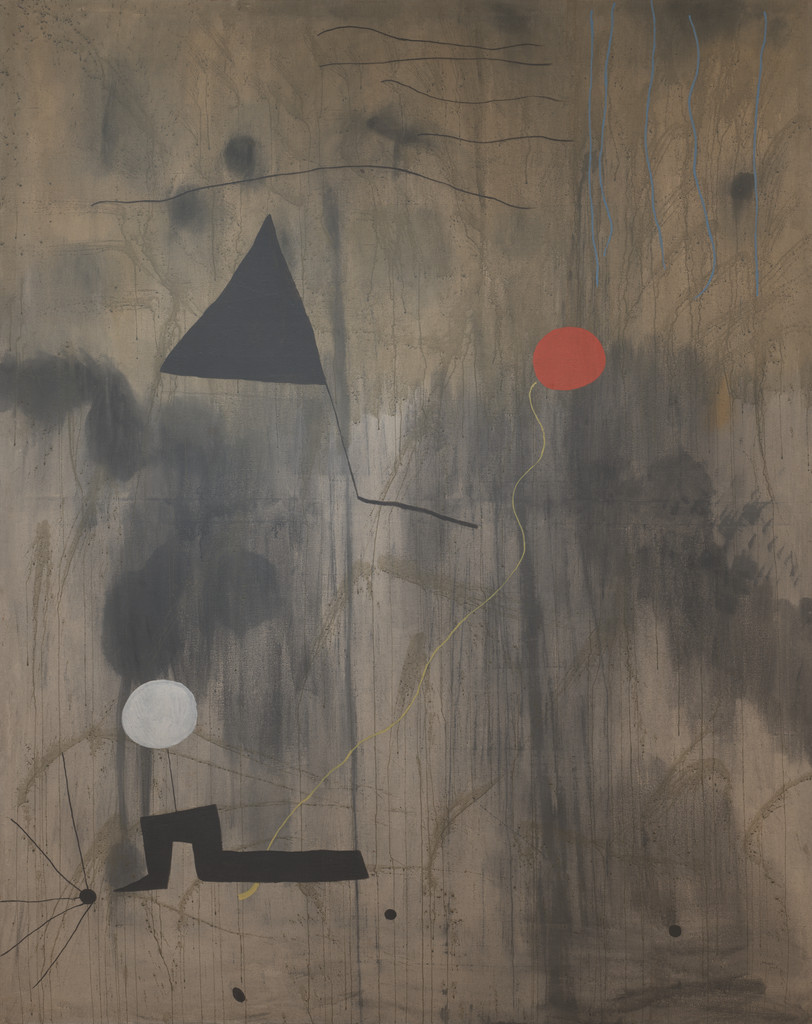
The scale changes again in The Birth of the World. More than two and a half metres high, the canvas gives a few dark shapes and a red circle an enormous field to inhabit. MoMA explains that Miró poured, brushed and flung paint over uneven preparation, allowing it to soak in differently across the surface. He then added forms developed in preparatory studies. Accident and planning operate in the same picture.
Knowing the method prevents the background from becoming mere empty space. Uneven patches, runs and stains provide conditions in which the signs can appear. Let your eye travel through that ground before deciding what any shape resembles. A mark may suggest a bird or an object, then seem to change its mind. The painting gives that uncertainty room rather than forcing it into a fixed scene.
Two words take flight
In Hirondelle Amour, language enters the blue field directly. The French words mean “swallow” and “love.” They do not form a sentence; their handwritten curves participate in the same movement as the surrounding shapes. Reading becomes one more way for the eye to move across the painting.
MoMA’s catalogue traces the canvas to a commission for woven hangings, although Miró developed it as an independent painting without accommodating the weaver’s practical needs. The museum owns it, and our autumn check recorded it as not on view. That origin makes its freedom particularly engaging: an image conceived in connection with another medium refused to organise itself around that medium’s restrictions.
Paris in wartime: the shoe grows threatening
Familiar objects returned with a different weight in Still Life with Old Shoe. In 1937, exiled in Paris during the Spanish Civil War, Miró worked from objects arranged before him: a shoe, bread, a bottle, an apple and a fork. MoMA’s curator Anne Umland describes this as a deliberate return to direct observation. The result makes ordinary things look almost dangerously alive.
The fork pierces the apple; the shoe swells towards us. Acidic colour and heavy black areas make the tabletop difficult to trust as a stable surface. There is no depicted battle, yet domestic space seems to have absorbed the pressure of events outside it. This MoMA painting was also not on view in our autumn records. Its absence from a visit need not mean its absence from your understanding of Miró’s apparent playfulness.
Chicago: a sky carried through war
The small Ciphers and Constellations, in Love with a Woman, in the Art Institute of Chicago, belongs to a series made in 1940–41. Miró began the Constellations in France, took the first sheets with him when he fled the German advance, and continued in Spain. The Chicago sheet was made in Palma in 1941. Its crowded network offers another way of holding a world together when the world outside is breaking apart.
Our autumn check recorded the Chicago work as not on view. For a first trip, choose Washington’s farmyard or MoMA’s great beginning, and confirm the individual painting before setting out. Keep one wartime image on your phone for comparison. Miró’s colour can be immediately pleasurable; giving that pleasure a history makes the visit last longer in the mind.
På forsiden: The Farm — Joan Miró. © the artist or rights holder
Mere at læse
Where to see an artist →Can I see it?
Where to See C. W. Eckersberg: Rome through Three Arches and a Ship Given in Thanks
His pictures seem to tell the exact truth about what stood before him. Look longer, and separate views, remembered ships and carefully arranged people begin to reveal his choices.
Can I see it?
Where to See Moretto da Brescia: A Restless Count and Altarpieces Far from Home
A man surrounded by expensive things seems unable to enjoy any of them. Follow his painter from London to Venice, Milan and Washington, where private unease gives way to public grief.
Can I see it?
Where to See Alexandre Cabanel: Venus, an Emperor and the Stories after the Applause
Napoleon III bought the goddess; Zola disliked her sugary flesh. Cabanel’s other paintings lead from that public triumph into abduction, bereavement and a paradise destroyed twice.