Can I see it?
Where to See C. W. Eckersberg: Rome through Three Arches and a Ship Given in Thanks
His pictures seem to tell the exact truth about what stood before him. Look longer, and separate views, remembered ships and carefully arranged people begin to reveal his choices.
2. november 2026 · 7 min. læsning · ART WIKI’s redaktion
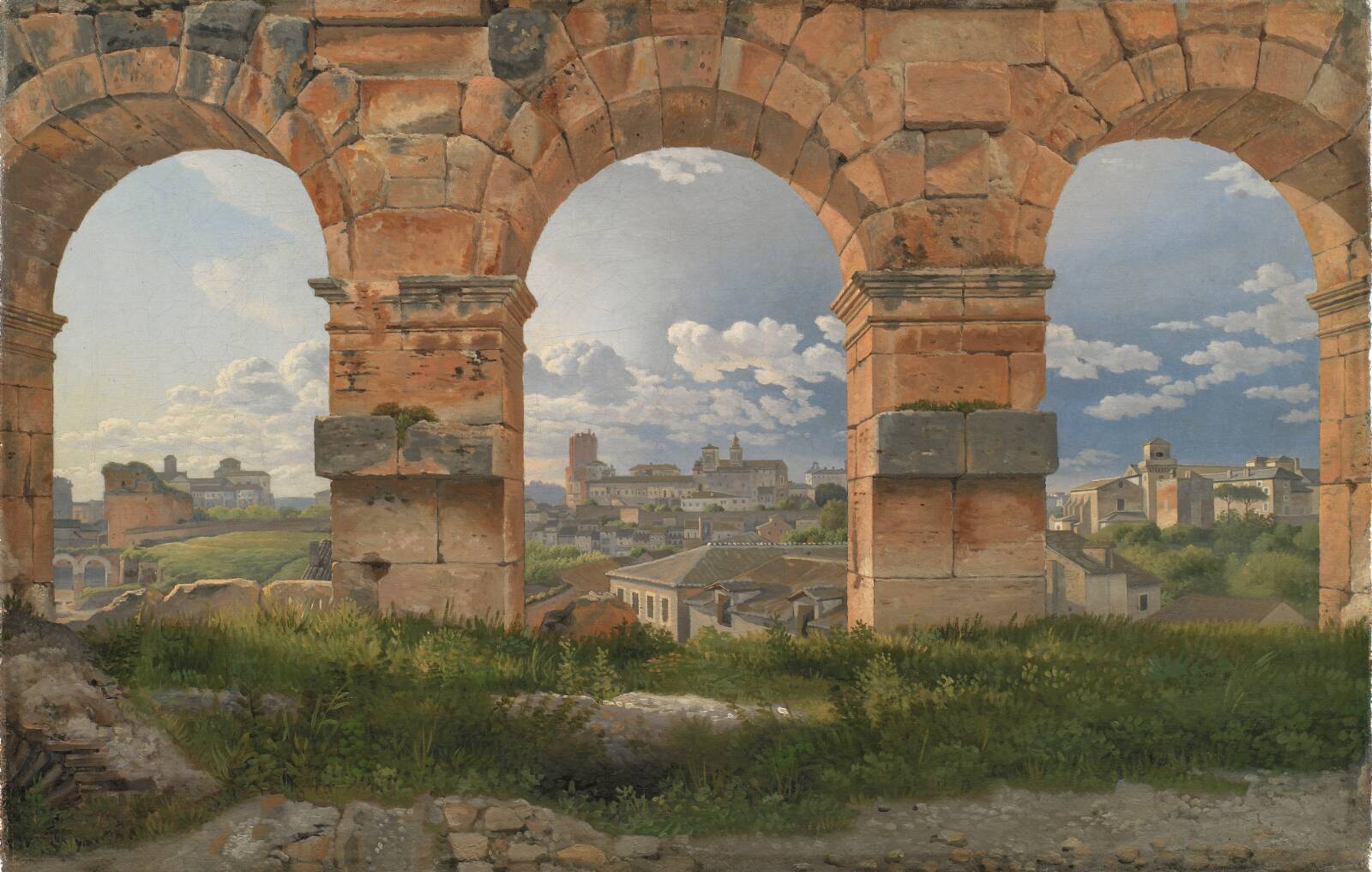
Three arches open onto Rome, each offering a little portion of the city. The stone is close enough to inspect; beyond it, buildings and vegetation recede into the light. Yet the apparent eyewitness account in A View through Three Arches of the Colosseum cannot be seen from a single position. Eckersberg joined views that a person standing there would have to take in separately.
That small liberty is a good introduction to Christoffer Wilhelm Eckersberg. His clarity comes from choosing and arranging as well as observing. Copenhagen’s SMK holds the heart of this route: on our autumn 2026 check, the Roman view, the Nathanson sisters and three further pictures discussed below were all in room 217C. Paris adds two works whose histories lead back to Denmark, including a ship given to the Louvre as an unusually specific thank-you.
Copenhagen: Rome from a low step
Eckersberg’s Marble Steps Leading to Santa Maria in Aracoeli chooses an unceremonious position below the church. Steps and walls do most of the talking. Sunlit surfaces meet shadowed ones; the eye climbs even though the painter stays low. The picture was made outdoors during his Roman years, with close attention to the changing light.
The Colosseum view gives us openings; the staircase gives us an ascent. In both, architecture decides how we enter the picture. Try comparing the bright distance beyond the arches with the solid planes of the steps. A famous city becomes something you experience by standing in one place and looking carefully at its edges, rather than by collecting a series of complete monuments.
Small size sharpens that experience. The Roman paintings were objects Eckersberg could carry away from Italy, and they make the act of selection palpable. In the Colosseum view, the arches interrupt the panorama instead of letting it unfold continuously. You are asked to join the city across the stone supports. The picture makes a coherent whole out of an interrupted view, while quietly concealing the adjustments needed to achieve it.
Two sisters and a bird with several possible meanings
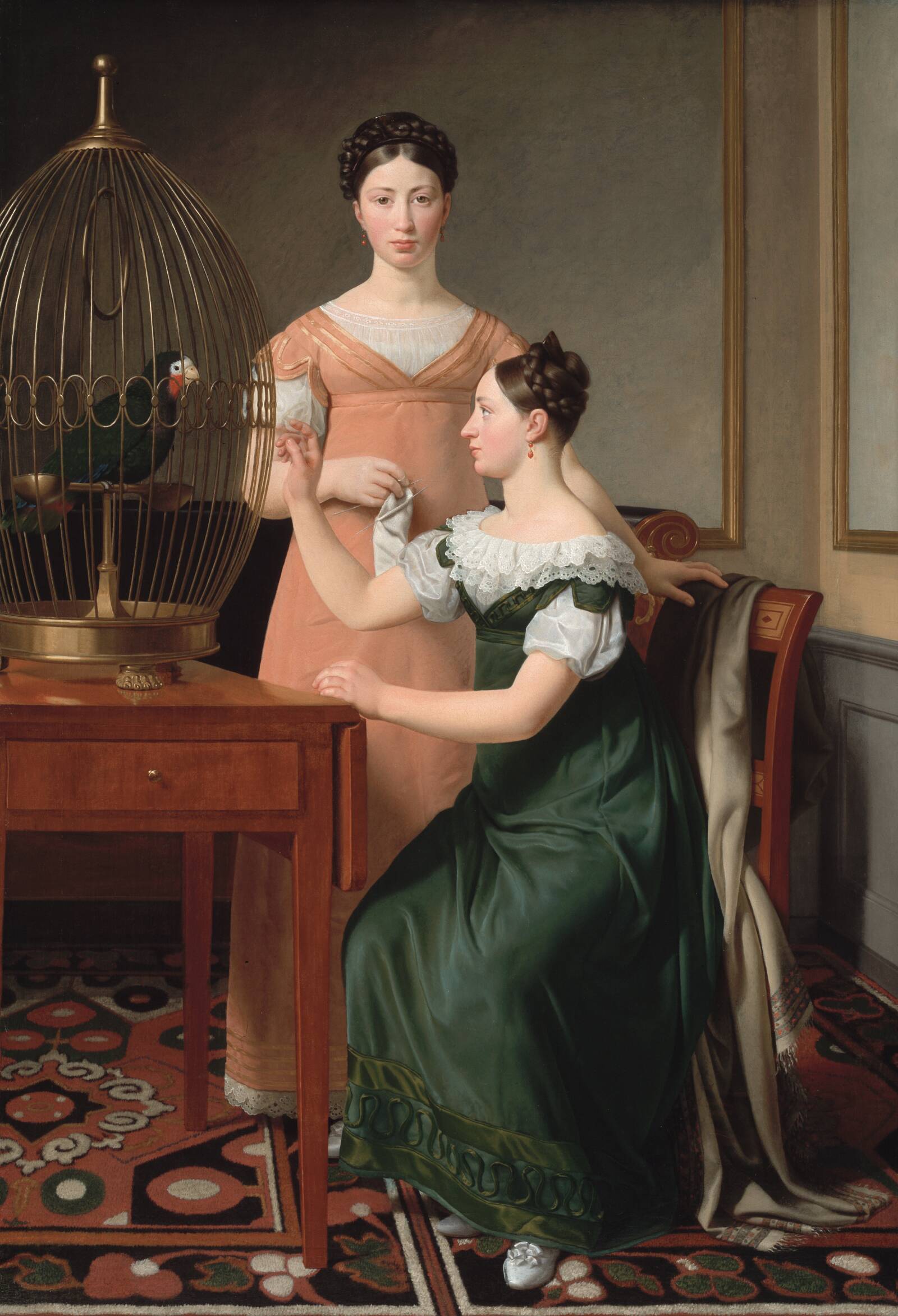
The red dresses in Bella and Hanna, the Eldest Daughters of M. L. Nathanson make the sisters look related before their faces do. Their poses differ, but the repeated colour brings them together. A caged parrot introduces another living presence into the spare room. Its bright plumage competes with the clothing; the bars put a second, smaller interior inside the first.
Their father, the merchant Mendel Levin Nathanson, was an important early patron of Eckersberg. The bird has been read as an allusion to sheltered daughters longing for freedom. Art historian Patrick Kragelund questions that interpretation’s reliance on Dutch symbolism and instead stresses luxury and family prosperity. It is better to keep both proposals visible than to announce that the cage reveals the sisters’ feelings.
The uncertainty is productive. Look at what the two women actually do, how one turns and how much of the room remains unoccupied. The painting can suggest restraint without telling us whether either sitter resented it. A portrait gives a carefully chosen public appearance; the private life behind that appearance is another matter. Eckersberg leaves enough space for our curiosity, but not enough evidence for a confident invented biography.
The harbour assembled from several visits
The imposing ship in The Russian Ship of the Line Asow and a Frigate at Anchor in the Roads of Elsinore looks thoroughly inspected. It was. Eckersberg studied Russian warships in Copenhagen and borrowed technical plans from the naval dockyard. But the finished painting moved the encounter to Elsinore, with Kronborg behind it. Accurate construction did not oblige him to preserve the location of his observations.
That distinction links the vessel to the Roman arches. He gathers reliable pieces and makes a convincing arrangement from them. The rigging rewards close looking, while the relation between the hull and the water steadies the whole scene. One can admire the ship as a complicated object and still notice the much simpler pattern of dark mass, pale sky and horizontal sea.
In A View towards the Swedish Coast from the Ramparts of Kronborg Castle, military and domestic life share the foreground. Soldiers stand near the Danish flag while women attend to laundry. Beyond them lies the Sound. The contrast gives the fortress a lived scale: national territory and washing can occupy the same patch of ground without either ceasing to matter.
Paris: a painting pays a debt of gratitude
A captain raises his hat in A Sloop with Passengers. The Louvre identifies the vessel as Lykkens Prøve, off the Danish coast near Kalvehave. Danish supporters gave the painting to the museum in 1919, thanking France for releasing the portrait of Bella and Hanna from wartime sequestration. Its German owner had died in France after bequeathing the portrait to Copenhagen. Two otherwise unrelated pictures became part of the same diplomatic gesture.
The sloop was recorded in room 862, Richelieu wing, Level 2, on our autumn 2026 check, alongside Seated Nude. The latter has an unusually precise working history: Eckersberg’s diary dates sessions with the model Trine Nielsen from 10 August to 6 September 1839 at the Copenhagen Academy. Behind the quiet image is a named woman and a sequence of working days.
If Copenhagen is within reach, give room 217C time enough for a second circuit. Move from the Roman arches to the ship, then back to the sisters: the differences in subject make his decisions easier to notice. In Paris, check room 862 before visiting and look for the captain’s greeting. Once you know why the picture arrived in France, that small raised hat becomes particularly apt.
På forsiden: Udsigt gennem tre af de nordvestlige buer i Colosseums tredje stokværk — Christoffer Wilhelm Eckersberg. Public domain
Mere at læse
Where to see an artist →Can I see it?
Where to See Moretto da Brescia: A Restless Count and Altarpieces Far from Home
A man surrounded by expensive things seems unable to enjoy any of them. Follow his painter from London to Venice, Milan and Washington, where private unease gives way to public grief.
Can I see it?
Where to See Alexandre Cabanel: Venus, an Emperor and the Stories after the Applause
Napoleon III bought the goddess; Zola disliked her sugary flesh. Cabanel’s other paintings lead from that public triumph into abduction, bereavement and a paradise destroyed twice.
Can I see it?
Where to See Hans Baldung Grien: Death at the Door and the Paintings That Resist It
An hourglass, a false signature and a horse looking over its shoulder: Baldung rarely lets an image remain comfortable. Follow him through Madrid, London, Paris and New York, with a troubling print in Cleveland.