Can I see it?
Where to See Roy Lichtenstein: Whaam!, Drowning Girl and the Pictures Behind Them
Donald Duck catches his own jacket; a pilot destroys a plane. Lichtenstein made familiar printed images difficult to take for granted.
2. november 2026 · 7 min. læsning · ART WIKI’s redaktion
Donald Duck thinks he has caught something enormous. The hook is actually stuck in his own jacket, and Mickey is trying not to laugh. In Look Mickey, Roy Lichtenstein enlarged a small printed joke until it could occupy a museum wall. The mistake is available to everyone except Donald. Looking, and looking wrongly, turns out to be a useful beginning for a painter whose pictures often seem so easy to recognise that we forget to examine them.
Washington: a dog brush helps change the picture
In Washington, Look Mickey belongs to the National Gallery of Art, although our autumn 2026 check recorded it as not on view. Its source was an illustration in the 1960 children's book Donald Duck Lost and Found. Lichtenstein made the painting in 1961, after years of trying cartoon figures inside more gestural images. In 1957 he had projected Mickey onto his son Mitchell's bedroom wall. The sudden conversion to Pop was less sudden than the usual breakthrough story suggests.
Look at Mickey's face and Donald's eyes. Their dots imitate commercial printing, yet Lichtenstein produced them with an unexpectedly domestic implement, a stiff dog-grooming brush dipped in paint. Later methods became more regular. This early solution leaves a useful gap between the appearance of cheap reproduction and the labour of making an individual painting. The joke travelled from a children's book through a brush intended for animal hair before entering the vocabulary of modern art.
London: an explosion that needed gentle handling
Whaam!, in Tate's collection, expands aerial combat across two canvases. A plane fires from the left; the explosion occupies the right. Painted in 1963, it draws on a panel by Irv Novick in DC's All-American Men of War. Naming Novick matters. These images had makers before they became Lichtensteins, and the transformation does not erase that earlier work. Here the separation into two enormous panels makes the passage from firing to destruction something our eyes must cross.
Lichtenstein had himself served in the infantry in Europe during the Second World War. That fact does not settle how to read the painting's cool treatment of combat. It does complicate any assumption that war reached him only through comics. His later success came after years of teaching and other employment, including industrial drawing and furniture design. When his first exhibition of comic paintings at Leo Castelli opened in 1962, it sold out. Familiar imagery had become a commercially effective provocation.
The physical painting proved much less tough than its explosive subject. By 2017, accumulated dirt had dulled its surface, and the different paint types complicated cleaning. Conservators tested methods on specially prepared samples before treating the original. A flexible gel made controlled cleaning possible; the treatment itself took about ninety days. Think of that patient operation when looking at the sudden blast. What appears to happen instantly was painted, preserved and cleaned through painstaking sequences of decisions.

New York: the boyfriend disappears from the frame
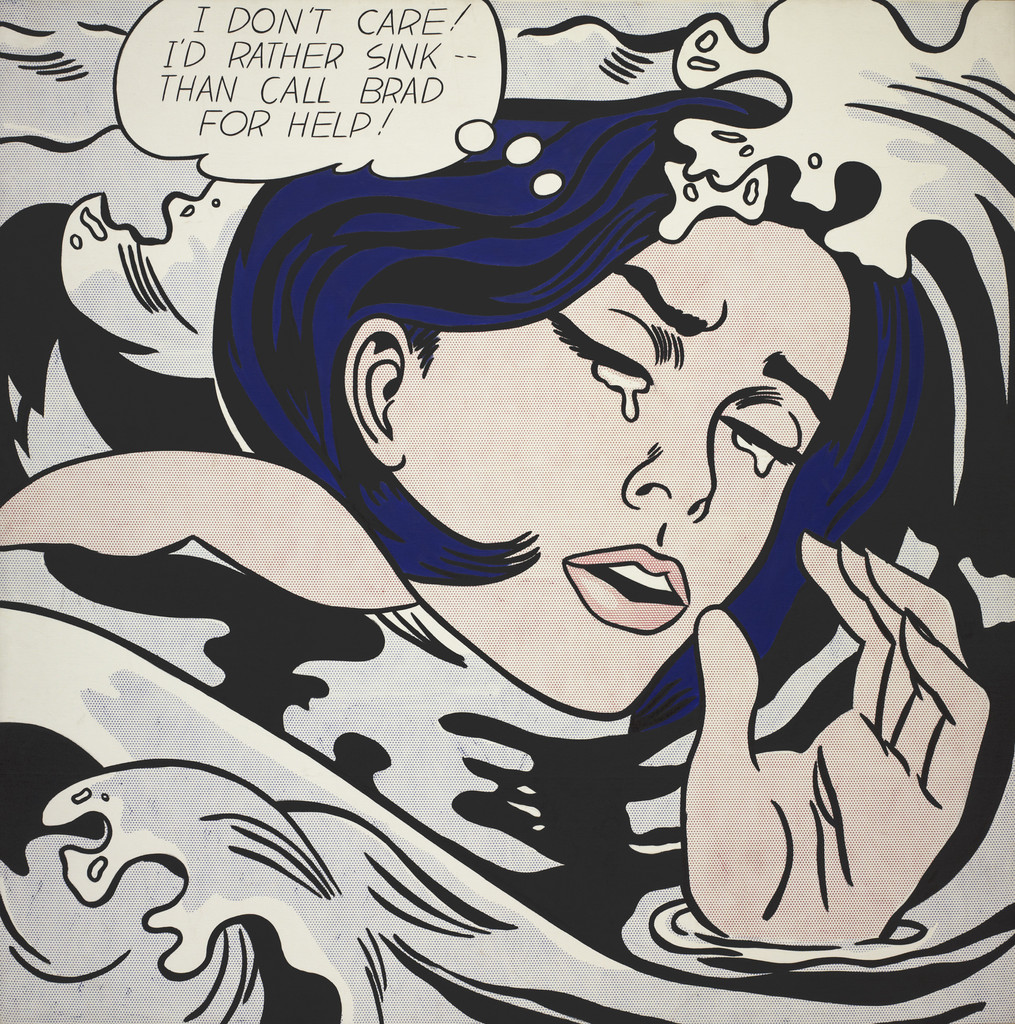
The man missing from Drowning Girl was present in its source. Tony Abruzzo's illustration for Secret Hearts showed him clinging to an overturned boat. Lichtenstein cut him away, shortened the woman's thoughts and changed his name from Mal to Brad. The wave and the woman were left to fill the image. MoMA owns the painting, but our autumn 2026 check recorded it as not on view. Its concentrated drama began with an act of removal.
Beside that imagined crisis, consider MoMA's Girl with Ball, also recorded as not on view at the same check. This time the starting point was a photograph advertising a hotel in Pennsylvania's Pocono Mountains. The raised arms and ball survive, but the body has passed through a cartoon vocabulary of outline and simplified colour. A holiday sales pitch has become something less inviting. The round mouth looks almost manufactured, and the promise of spontaneous enjoyment starts to reveal its rehearsal.
MoMA's discussion of Drowning Girl keeps the question of authorship open. The differences from Abruzzo's page are deliberate, but so are the similarities. It is possible to attend to Lichtenstein's cropping and also ask why one version entered the museum under a single famous name while the source illustrator long remained less visible. The two questions belong together. They make a comparison with the original more useful than a verdict of cleverness or derivation.
The Whitney: a brushstroke gets its portrait painted
A sweeping gesture looks fixed in place in Little Big Painting, held by the Whitney. In 1965 Lichtenstein turned the expressive brushstroke itself into a subject. Thick outlines contain flat colour; even the apparent drips have been designed. The Whitney acquired the work that December, during the year of its making. Our autumn 2026 check recorded it as not on view. The supposedly spontaneous mark had become an image that could be planned, enlarged and collected.
Before buying a ticket for one particular Lichtenstein, confirm that exact painting's availability. Four works discussed here were off display at our recorded checks, and a museum’s ownership does not guarantee a place on its walls. If you do find your chosen canvas, look first from a distance and then close enough to distinguish a painted mark from its printed-looking effect. The change between those two views is part of the pleasure.
På forsiden: Whaam! — Roy Lichtenstein. Eric Koch for Anefo · CC0 · Wikimedia Commons
Mere at læse
Where to see an artist →Can I see it?
Where to See Giambattista Pittoni: A Painted-Out Heaven and a Lost Temple
Someone once painted over God the Father in Pittoni’s Nativity. Following his pictures from London to Venice and Paris means recovering missing figures, lost commissions and even a missing name.
Can I see it?
Where to See Aristide Maillol: The River, the Mediterranean and the Woman with a Parasol
Maillol’s River began as a woman stabbed in the back. The peaceful titles of his sculptures are a poor guide to the lives, commissions and abandoned plans behind them.
Can I see it?
Where to See Henry Fuseli: Shakespeare’s Fairies, Lady Macbeth and a Rejected Witch
One owner found Fuseli’s Night-Hag so intolerable that she gave it to her maid. His paintings still ask an awkward question: how much of another person’s imagination do you want in the room?