Can I see it?
Where to See Gustav Klimt: Hope II, a Defiant Girl and a Forest Nearly Sold
A New York museum almost traded one Klimt for another. The paintings it kept begin a journey through children, collectors and families carrying their pictures into exile.
2. november 2026 · 7 min. læsning · ART WIKI’s redaktion
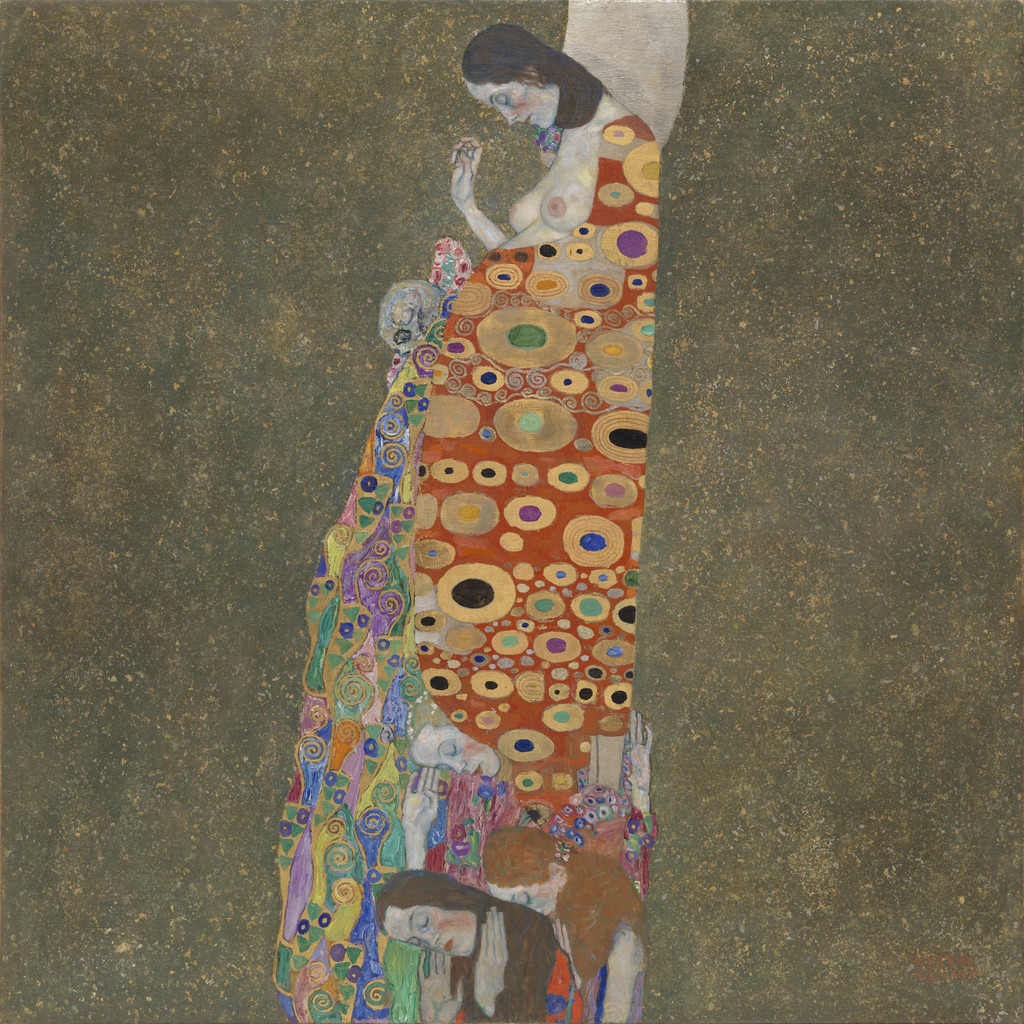
In 1978, the Museum of Modern Art came close to losing its forest. To help buy Hope II, it arranged to sell The Park to the dealer Serge Sabarsky for $500,000. Ronald Lauder would cover the difference. Eventually, enough money was raised to keep both paintings. That abandoned transaction makes an unusually good starting point for a Klimt visit: two pictures once treated as alternatives can now be considered together.
New York: the mother and the forest
The pregnant woman in Hope II lowers her head over her swollen body. A skull interrupts the richly patterned garment; three more women bow below her, their gestures poised somewhere between prayer and mourning. Klimt originally called the picture Vision. Its familiar title came later, connecting it to an earlier painting of pregnancy. Neither name explains away the uneasy coexistence of a coming child and a death's head.
There is real gold and platinum in Hope II, but the face holds attention as strongly as the precious surface. Try following the woman's downward gaze before examining the patterns. The composition keeps bringing the eye back to the vulnerable body inside them. On our autumn 2026 check, the painting was on MoMA's fifth floor, as was The Park.
Klimt had a wonderfully modest tool for making landscapes: a piece of cardboard with a square opening. Looking through it helped him choose a portion of the world. In The Park, the treetops fill almost everything, leaving little room for a conventional view into the distance. Read the square as a decision about what to leave outside. The lower strip of trunks suddenly seems small beneath that enormous accumulation of leaves.
The museum acquired The Park in 1957. An old exhibition label placed it in Venice in 1910, which helps explain the cautious date, 1910 or earlier. This is a useful picture for slowing down after the gold: small marks keep turning into foliage, then back into marks. The nearly sacrificed landscape can hold its own beside the painting that almost displaced it.
The Met: ten days of sitting still
Mäda Primavesi remembered travelling to Vienna every few months and staying for about ten days while Klimt worked on her portrait. She was nine when her parents commissioned it in 1912. When her patience ran out, he gently asked for a little longer. That recollection gives Mäda Primavesi a second life: behind the firm stance are repeated journeys and a child's long acquaintance with an adult's slow work.
Preparatory drawings tested seated and standing positions. In the finished Mäda Primavesi, her feet stand apart, one hand rests on her hip and the other arm disappears behind her. The white dress breaks into flowers against a patterned background. She meets the viewer without a trace of embarrassment. On our autumn 2026 check, the portrait was in the Metropolitan Museum's Gallery 800, together with Serena Pulitzer Lederer.
Painted in 1899, Serena Pulitzer Lederer belongs to an earlier moment in Klimt's portraiture. The flowing white dress almost dissolves into its pale surroundings, leaving the dark hair and face sharply present. Serena and her husband August became important supporters of Klimt. The Nazis impounded this painting in Vienna in 1942; it was returned to their son in Geneva in 1948. The composed figure survived the destruction of the world that had commissioned her.
London: a portrait packed for Australia
For Portrait of Hermine Gallia, now in London's National Gallery, Klimt made more than forty preparatory sketches. He exhibited the still unfinished picture at the Secession in late 1903, between two chairs by Koloman Moser. The arrangement suggests how naturally painting and furniture could belong to the same household conversation. Hermine's pale dress and the shifting outlines around her shoulders reward a close look.
The Gallias later commissioned Josef Hoffmann to furnish their Vienna apartment. Hermine died in 1936. After the Nazi annexation of Austria in 1938, her children escaped to Australia with the portrait and household possessions. Their parents' conversion from Judaism to Christianity had offered no protection. Remembering the furniture beside the painting makes this departure more tangible: a home was being broken up, packed and carried across the world.
Washington: a child appears in August
On 11 August 1917, Klimt wrote to Emilie Flöge about starting a picture of a baby. The following day he began; a day later he thought it half finished, though he was unsure of it. Baby (Cradle) went to an exhibition in Stockholm that September. Photographs show that he subsequently changed it, accounting for the date 1917–18. Speed at the beginning did not mean the image was settled.

In Baby (Cradle), a small face and hand appear at the summit of a mountain of bedding. The National Gallery of Art's provenance records an early sale to Otto and Eugenia Primavesi in 1919, returning us to Mäda's parents. On our autumn 2026 check, the Washington painting was on view in room EU-415-A. A family connection joins the two American cities more intimately than a list of masterpieces could.
Plan separate New York visits for Klimt: MoMA for the two paintings almost separated in 1978, and the Met for the sitters who had to wait for him. Recheck displays before travelling, and leave time to look at a face after looking at its surrounding pattern. The smallest, quietest part of a Klimt often takes longest to register.
På forsiden: Hope, II — Gustav Klimt. © the artist or rights holder
Mere at læse
Where to see an artist →Can I see it?
Where to See Lawrence Alma-Tadema: Spring, Roman Baths and a Pharaoh's Grief
His marble cities look convincing enough to enter. Follow the borrowed monuments, modern flowers and changed commissions that went into building them.
Can I see it?
Where to See George Stubbs: Whistlejacket and the People Behind the Horses
A horse without a rider is only the beginning. London's collections lead from a racing stable to a marriage alliance, a fast carriage and a harvest bought with lottery money.
Can I see it?
Where to See Pompeo Batoni: Grand Tour Portraits, Diana and a Captured Ship
A young Englishman ordered a portrait in Rome and sent it home. French warships intervened; his painted self now belongs to the Prado.