Can I see it?
Where to See Pompeo Batoni: Grand Tour Portraits, Diana and a Captured Ship
A young Englishman ordered a portrait in Rome and sent it home. French warships intervened; his painted self now belongs to the Prado.
2. november 2026 · 7 min. læsning · ART WIKI’s redaktion
The Westmorland was carrying Parmesan, olive oil and crates of art when two French warships captured it in 1779. Bound from Livorno to London, it was taken instead to Málaga. Among the displaced possessions was Francis Basset, 1st Baron de Dunstanville, painted by Pompeo Batoni the previous year. A souvenir intended to announce its owner's Italian education never reached the English house for which it was meant.
Madrid: the traveller who arrived as cargo
Basset holds a plan of Rome in Francis Basset, 1st Baron de Dunstanville. Behind him, St Peter's and Castel Sant'Angelo locate his journey, while fragments of antiquity supply the setting. He had travelled in Italy in 1777–78. Charles III acquired the captured portrait by royal order in 1783; it belongs to the Prado. The map promises control over a city. The painting's voyage tells a less orderly story.
Batoni knew how to give a visitor the appearance of belonging in Rome. Born in Lucca, he left his father's goldsmith's workshop for the city in 1727. He copied ancient sculpture and paintings by Raphael and the Carracci. British collectors noticed those drawings. The objects he had studied became useful companions for men wishing to carry home evidence that they, too, had looked carefully at the ancient world.
In Francis Basset, 1st Baron de Dunstanville, the leaning pose makes a formal commission look like a pause in a walk. It is a convincing fiction. Take away the map and the monuments, and much of the account the sitter wants to give of himself disappears. The portrait travelled as a possession, but it had been made to tell a story about its possessor.
London: a finger on the map
Richard Milles points to the word Grisons on a map in Portrait of Richard Milles. The Swiss canton was probably on his route to Italy. A bust of Marcus Aurelius stands nearby; the red fur-lined cape and silver waistcoat make the traveller difficult to overlook. Later a Member of Parliament for Canterbury, Milles ordered other likenesses from Batoni as well. The National Gallery owns this portrait.
The finger in Portrait of Richard Milles is worth more attention than the sweeping cape. It turns a general claim to cultivation into a particular itinerary. Batoni's clients wanted recognisable faces, but they also wanted the right equipment around them. Here a map and an emperor's bust help the young man make his case without opening his mouth.
A different uncertainty survives in Portrait of John Scott (?) of Banks Fee, dated 1774 and also in the National Gallery. The identification is traditional, not secure, although Scott did visit Rome in the early 1770s. The sitter holds a hat and walking stick, leaning on a stone pedestal in a blue silk coat trimmed with silver. We can inspect what he wore more confidently than we can name him.
Cambridge: a young earl with little time
Charles Compton had just inherited his title when Batoni painted The 7th Earl of Northampton in 1758. He was twenty-one. The portrait, in the Fitzwilliam Museum, gives him books, a bust of Minerva and a hunting dog: learning and activity placed within reach. Five years later he died of tuberculosis while serving as ambassador in Venice. The future that the portrait seems to prepare for was very short.
The familiar props in The 7th Earl of Northampton can make it tempting to dismiss Batoni's portraits as a formula. Look instead at the young man's relation to them. He does not stand apart from the room's furnishings as if waiting to be introduced; he occupies their space with ease. Knowing how little life remained changes the leisurely crossed legs. The picture has given him time that he did not have.
New York: a hunt with a mythological companion
Humphry Morice chose a less upright pose for Portrait of Humphry Morice. He reclines in the Roman countryside among his dogs. Batoni used the same landscape for Diana and Cupid, commissioned by Morice as a companion. The two paintings put a contemporary visitor and an ancient goddess into corresponding worlds. The mythological canvas belongs to the Metropolitan Museum, where our autumn 2026 check placed it in Gallery 627.
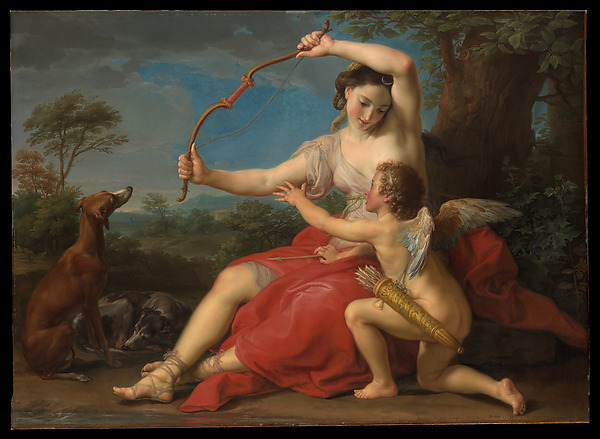
Diana's position in Diana and Cupid draws on a statue of the sleeping Ariadne. Batoni wakes the borrowed figure into a small negotiation: the goddess holds the bow away from Cupid. The raised arm keeps the composition from settling entirely into repose. Think of the absent companion portrait while looking. Morice's commission allowed hunting, leisure and classical learning to meet across the wall, with his own likeness taking half the arrangement.
London again: the face that cannot be preserved
Bartolomeo Talenti, a patron from Batoni's native Lucca, ordered Time orders Old Age to destroy Beauty. A letter of July 1744 refers to the commission; the finished painting is dated 1746. Time points, Old Age reaches towards a young woman's face, and Beauty recoils. The National Gallery owns this unusually direct image of what portraiture tries to postpone.

The confrontation in Time orders Old Age to destroy Beauty makes a hard companion to the travellers' composed appearances. Those portraits let their sitters keep a coat, a pose and a Roman afternoon. Here the face itself is threatened. It is an apt final picture for a route through people so carefully arranging how they would be remembered.
Batoni's travellers make London a good starting point; Cambridge adds the young earl. New York offers the other half of a collector's commission, while Madrid supplies the portrait that went astray. Confirm individual displays before travelling. When time is short, spend it on one sitter's hands and the objects beside them: they often tell you exactly what the portrait was meant to bring home.
På forsiden: Diana and Cupid — Pompeo Batoni. Open Access (CC0)
Mere at læse
Where to see an artist →Can I see it?
Where to See Bramantino: A Crucifixion, a Missing King and a Christ Still in Pain
An angel and a demon kneel beside the same cross. Bramantino's paintings keep familiar stories just strange enough to make you look again.
Can I see it?
Where to See Joos de Momper: Mountains, Hermits and Borrowed Names
The hunters are busy killing a boar; beyond them, an entire country stretches towards the sea. Momper built landscapes big enough to swallow their own stories.
Can I see it?
Where to See Savoldo: Mary Magdalene and the Painter of Uncertain Light
A silver cloak catches the dawn, but the face inside it has become harder to read. Savoldo’s paintings make light visible and leave the story partly in shadow.