Can I see it?
Where to See Paul Klee: Birds, Moving Houses and a Broken Reflection
A handle waits to be turned, a cat thinks about lunch, and a face refuses to stay whole. Five works lead from Klee’s Bauhaus experiments to the year after his flight from Germany.
2. november 2026 · 7 min. læsning · ART WIKI’s redaktion
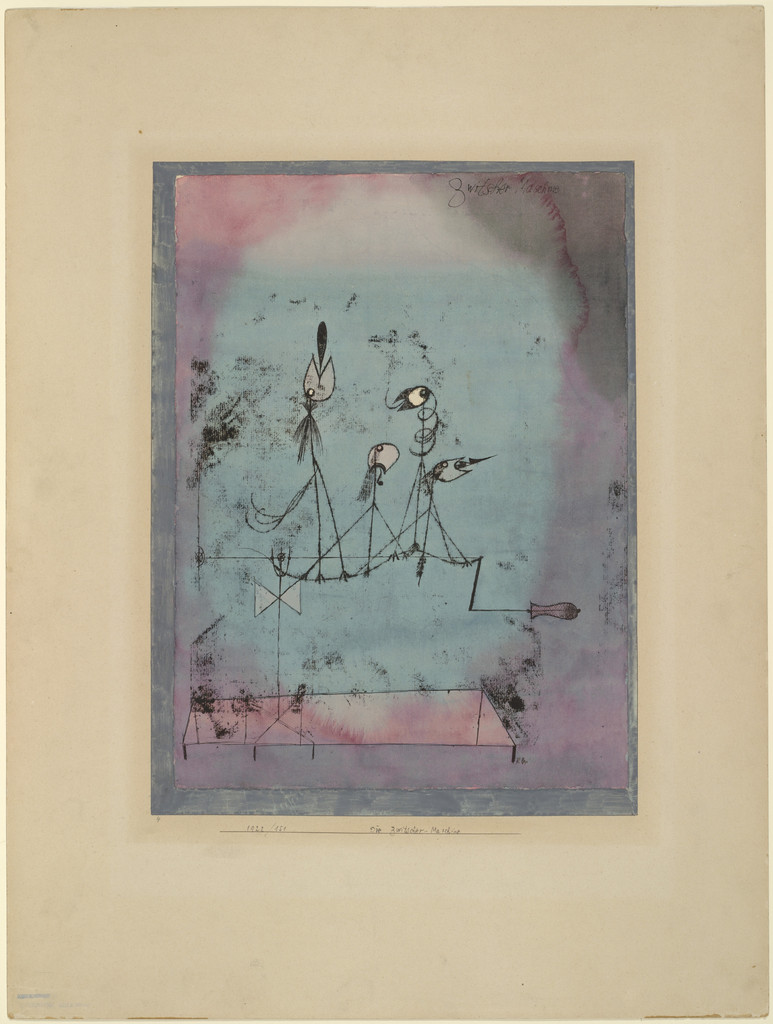
Four birds are attached to a crank. Turn it in your imagination and try to decide what happens next: a concert, a malfunction, an escape? Paul Klee leaves the mechanism of Twittering Machine just legible enough to tempt you. The creatures seem too individual to perform obediently. Their beaks emit different shapes, almost a score for noises that no musician could quite reproduce. The drawing belongs to New York’s Museum of Modern Art; on our autumn 2026 check, it was not on view.
New York: the machine that left Berlin
The paper travelled through a much less fanciful apparatus. Berlin’s Nationalgalerie bought Twittering Machine in 1923. The Nazis confiscated it in 1937. After passing through the dealers Karl Buchholz and Curt Valentin, it entered MoMA in October 1939. That sequence makes the little crank harder to regard as harmless entertainment. It does not prove that Klee intended a political allegory in 1922; the subsequent history belongs to the object, not automatically to its original meaning.
The distinction matters when following Klee across museums. A title can make you laugh before the date or provenance changes the temperature. His years at the Bauhaus, from 1921 to 1931, produced nearly half of his roughly ten thousand works. Teaching colour and form did not turn him into a painter of demonstration charts. Here an apparent technical diagram gives instructions for something impossible. Before looking for a message, ask where your hand would go, and then follow the line from the handle towards the birds.
MoMA’s Cat and Bird has no moving parts. Its small bird sits inside the cat’s forehead, a thought rather than an animal caught in a real room. The heart-shaped nose gives desire another diagram. The painting was already on loan to MoMA in 1930, long before it became a gift in 1975. By our autumn 2026 check it, too, was not on view. In New York, familiarity with an image can easily become a mistaken expectation of finding it on the wall.
Madrid: a house loses its footing
During his first months of teaching at the Bauhaus, Klee painted Rotating House, now in the Thyssen-Bornemisza collection. Roofs and walls spread around an imagined pivot, refusing to settle into a single street view. He put thin paint onto loosely attached cheesecloth; the rough fabric helps the earthy colours suggest sand and cement. The physical surface behaves rather like a sample of building material while the architecture declines to obey gravity.
A useful experiment is to choose one building and mentally stand beside it. Then shift to its neighbour. Your imagined ground keeps changing, even though the picture itself remains still. That is a different demand from identifying a house in a landscape. Klee makes the spectator do the turning. The small scale rewards a slow approach: first the whole arrangement, then the uneven edges where cloth and paper refuse to become an invisible support. A reproduction can flatten precisely the feature worth travelling to inspect.
Philadelphia: something has been hidden under black
The darkness of Fish Magic, in the Philadelphia Museum of Art, was put over colour. Klee scratched into that dark layer to bring forms back into view. At the centre he attached a square of muslin. A diagonal line suggests that this little curtain might be lifted to expose the clock tower beneath. The painting therefore contains a second, miniature performance of concealment and discovery within the larger painted surface.
Start with that square rather than trying to decode every creature. An actual piece of fabric is pretending to be a curtain, surrounded by things made visible through the removal of paint. The two operations run in opposite directions: one adds a covering, the other takes a covering away. Neither requires a dictionary of symbols. Ask what your eyes would lose if the cloth vanished, then what they would gain if the entire dark layer could be scraped off. The picture keeps those two possible revelations apart.

Chicago: three faces after an exile
In June 1934 Paul and Lily Klee moved into a three-room apartment at Kistlerweg 6 in Bern. He made the living room his studio. They had left Germany the previous December after his suspension from teaching in Düsseldorf. Nearly three thousand late works would emerge from these modest rooms. The apartment survived largely unchanged until renovation in 2005, when windows and door fittings were saved for a reconstruction. The setting was domestic; the rupture that brought him there was political.
Chicago’s In the Magic Mirror dates from 1934. A wandering vertical line produces competing faces, looking sideways and out towards us; beneath them sits a black heart. It can be read through the dislocation of exile, though there is no need to treat every bend as a coded confession. On our autumn 2026 check the Art Institute recorded it on view in the Research Center Franke Reading Room. Because that is a named reading room, ask specifically about access when planning the visit.
Choose the work that leaves you with a question you can test in front of it: the fabric in Madrid or Philadelphia, the uncertain face in Chicago. For New York, check the two individual records before buying a ticket for Klee alone. Carrying one unresolved question into a museum is more useful than carrying a list of images you already recognise.
På forsiden: Twittering Machine (Die Zwitscher-Maschine) — Paul Klee. © the artist or rights holder
Mere at læse
Where to see an artist →Can I see it?
Where to See Eugène Boudin: A Princess on the Beach and the Working Coast
The skirts attract attention, but watch what the wind does to them. Boudin’s coast stretches from fashionable society to grounded boats, with an unexpected detour through a kitchen.
Can I see it?
Where to See Gilbert Stuart: Washington’s Face and the Skater Who Came First
Before he painted the face on the dollar, Stuart made a London sensation out of a man on skates. His portraits follow a career built on introductions, conversation and paintings their owners struggled to obtain.
Can I see it?
Where to See Jacopo de’ Barbari: Pacioli’s Geometry and a Hawk on a Perch
A fly interrupts a signature, a hawk watches from a wall, and a Madonna carries a complaint about envy. Following Jacopo means looking closely at evidence, including the evidence that refuses to settle.