Can I see it?
Where to See Eugène Boudin: A Princess on the Beach and the Working Coast
The skirts attract attention, but watch what the wind does to them. Boudin’s coast stretches from fashionable society to grounded boats, with an unexpected detour through a kitchen.
2. november 2026 · 7 min. læsning · ART WIKI’s redaktion
Pauline Metternich could command attention on a beach almost as readily as at court. The Austrian ambassador’s wife was a friend of Empress Eugénie and a leader of Paris fashion. In Princess Pauline Metternich on the Beach, Eugène Boudin gives her a small rectangle of cardboard and lets the coastal breeze get to work on her skirts. Her social position survives; the dress, for a moment, seems to have an agenda of its own.
New York and Washington: who gets to sit on the sand?
The Met’s portrait, painted about 1865–67, was recorded in Gallery 821 on our autumn 2026 check. Its modest size makes an amusing setting for someone so conspicuous. The Goncourt brothers complained that the princess appeared everywhere, from children’s parties to the casino. Their irritation belongs to the same world Boudin was finding a market in. In an 1863 letter, he acknowledged that other people saw money to be made from his little women on the beach. Fashion could pay for weather painting.
That commercial success should not make you mistake every figure by the sea for a holidaymaker. Washington’s Women on the Beach at Berck puts headscarves and baskets in place of the princess’s extravagant silhouette. Ailsa Mellon Bruce bought it in February 1947; it reached the National Gallery of Art in 1970. On our autumn 2026 check it was in M-082. The women gather in a loose line, some sitting, others standing, with the sea barely distinguishable from the pale sky.
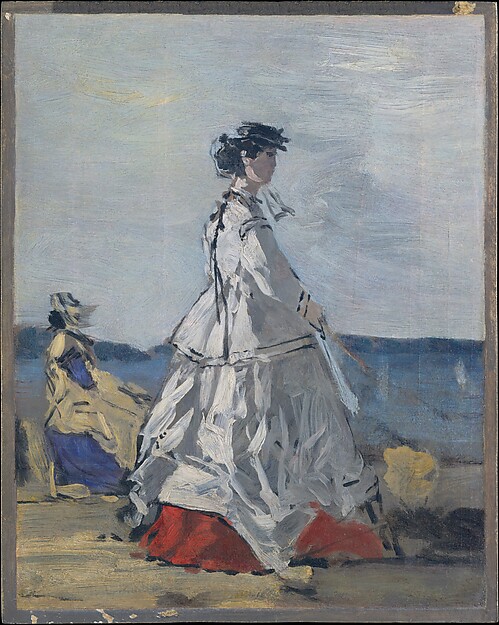
Compare the attention given to clothing in these two pictures. With Pauline, dress almost supplies a public identity. At Berck, repeated white head coverings make the group readable before individual features emerge. You can notice that difference without inventing a biography for each woman. Boudin’s abbreviated marks leave people partly anonymous, and the temptation to fill in their lives is one of the pleasures, and hazards, of looking at his coast.
Le Havre: the bequest that multiplied
Boudin’s plans for Le Havre were modest. He intended to give the museum one painting and let friends choose another one or two. In 1900 his brother Louis, advised by the executor Gustave Cahen, gave 240 works. Later gifts kept extending the collection. Entrance of the Harbour of Trouville came through the merchant Charles-Auguste Marande’s bequest in 1936. The MuMa collection is therefore also a record of people deciding that more of Boudin should remain in public hands than he had initially specified.
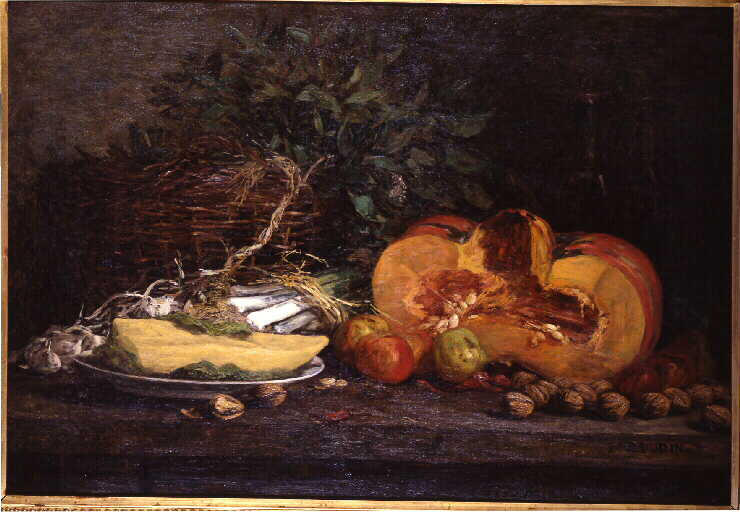
Among its surprises is Still Life with a Pumpkin, painted around 1854–58. In 1851 Le Havre had funded three years of study in Paris. Boudin registered as a Louvre copyist and learnt from Chardin’s still lifes. Here the cut pumpkin keeps its irregular knife marks; leeks and a mound of butter occupy the left side. The subject brings him indoors, but it also gives you a different way to examine his touch. Try looking at the cut surface before searching for any resemblance to a cloud or wave.
London and Cleveland: when the boats stop moving
In 1893 Boudin complained that he had seen no sailing boats at Trouville for two months. Their disappearance, he feared, would make seascapes monotonous. London’s National Gallery owns The Entrance to Trouville Harbour, painted five years earlier. At low tide, vessels rest on the sand beside the mouth of the Touques. The quiet river and restless clouds occupy different kinds of time. His lament gives the apparent calm a date: this was a coast already changing around him.
Cleveland’s View of Bordeaux, from the Quai des Chartrons came out of another encounter with a port. The collector Arthur Bourges first invited Boudin to Bordeaux in 1873. In this 1874 painting, altered lines among the rigging of the little vessel on the left show that he adjusted the design while working. Look for the place where one proposed line gives way to another. The picture preserves a decision in progress, rather than just the appearance of a finished harbour.
The same museum’s The Dock of Deauville, dated 1891, lets pale paint rub across the darker masts and rigging. A line that ought to define a solid object partly disappears into the light around it. Both Cleveland paintings were not on view at our autumn 2026 check. They remain useful companions to the London picture when planning a visit, but their individual records need checking before you travel specifically to see them.
Barcelona: leave the waterfront for a moment
Lluís Garriga Roig’s 1940 bequest brought another Trouville to Barcelona’s Museu Nacional d’Art de Catalunya; Parc Cordier in Trouville entered the museum in 1953. In this 1880s view, small figures measure the landscape beneath a low horizon. The name of a park replaces the familiar port or beach, and light still does much of the organising. After so many masts, it is worth asking how little of that structure Boudin needs to keep a view together.
Let your first encounter be with either the socially charged little portrait in New York or the group at Berck in Washington, then confirm their display records before setting out. If you are going to Le Havre, leave room for the pumpkin. Knowing Boudin only through sea air would mean missing the knife marks.
På forsiden: Princess Pauline Metternich (1836–1921) on the Beach — Eugène Boudin. Open Access (CC0)
Mere at læse
Where to see an artist →Can I see it?
Where to See Gilbert Stuart: Washington’s Face and the Skater Who Came First
Before he painted the face on the dollar, Stuart made a London sensation out of a man on skates. His portraits follow a career built on introductions, conversation and paintings their owners struggled to obtain.
Can I see it?
Where to See Jacopo de’ Barbari: Pacioli’s Geometry and a Hawk on a Perch
A fly interrupts a signature, a hawk watches from a wall, and a Madonna carries a complaint about envy. Following Jacopo means looking closely at evidence, including the evidence that refuses to settle.
Can I see it?
Where to See Willem van de Velde the Younger: The Cannon Shot and the Coming Storm
The gun is firing, but no battle follows. Between Amsterdam and London, van de Velde’s ships reveal ceremonies, near collisions and the family business that crossed to the other side of a naval war.