Can I see it?
Where to See Frans Hals: The Laughing Cavalier and the Faces Behind the Names
The Laughing Cavalier does not quite laugh, and the man with the skull is not Hamlet. Hals makes people seem immediately familiar; finding out who they are takes longer.
2. november 2026 · 7 min. læsning · ART WIKI’s redaktion
An upturned moustache, a hand on a hip and a pair of watchful eyes: the man in The Laughing Cavalier seems to have recognised us before we have recognised him. His name remains uncertain. The Wallace Collection dates his misleading nickname to around 1888, more than two centuries after Hals painted him in 1624. He is neither laughing nor demonstrably a cavalier. A tour of Hals can begin with that mismatch between a face we feel we know and the little we actually know about its owner.
London: read the sleeve, then distrust the label
The embroidery of The Laughing Cavalier gives you something more specific than a personality to examine. Arrows, knots and other emblems belong to the pleasures and troubles of love. They have prompted the suggestion of a betrothal portrait; symbols associated with Mercury have also encouraged a possible identification with a merchant. Neither proposal supplies a secure name. At the Wallace, let the decorated sleeve hold your attention for a while. The wearer has paid to be seen in clothes capable of supporting several conversations at once.

The National Gallery's Young Man holding a Skull has had its own mistaken identity. Earlier viewers saw Hamlet with Yorick, but the museum finds no evidence for performances or a Dutch translation of Shakespeare's play in Hals's lifetime. A longer Netherlandish tradition of young people holding skulls accounts for the subject. The hand reaches towards us while the eyes look elsewhere. Follow that interrupted exchange: you are addressed by a gesture but denied the reassurance of a meeting gaze.
Amsterdam: a hand moves onto a shoulder
Hals changed his mind while painting Portrait of a Married Couple, probably Isaac Massa and Beatrix van der Laen. Technical examination found that the woman's hand resting on the man's shoulder was a later adjustment. What looks like an unplanned moment of affection was worked out on the canvas. The Rijksmuseum preserves both the picture and a cautious identification of the sitters. Their names have changed before: in the nineteenth century they were taken for Hals and his wife. You do not need to settle the names to notice the hand.

A different sort of greeting comes from The Merry Drinker, recorded in room 2.30, the Gallery of Honour, on our autumn 2026 check. He appears ready to raise a glass to us. The Rijksmuseum's technical account catches Hals scratching a few moustache hairs into the paint and leaving runs of thinned colour in a sleeve. These are small, physical actions behind the impression of an animated person. Look between face and glass; then inspect the sleeve. The picture works at the speed of a toast, but its material evidence rewards slower attention.
The Hague: a laugh without a biography
One white stroke makes the bridge of a nose in Laughing Boy, in the Mauritshuis collection. His hair is disordered and his teeth are visible. The museum calls this a tronie, a study of a face or expression, rather than a commissioned likeness. That distinction frees you from searching for the boy's family. Hals is trying to preserve something too brief to hold comfortably for a sitting. Think of the difficulty of keeping a smile alive after someone has asked you to repeat it.
Compare the boy's open mouth with the controlled amusement of The Laughing Cavalier. The difference is more useful than a competition over which figure looks happier. One image leaves a man recognisable in his expensive clothes; the other makes a passing expression its main subject. Hals can make both encounters feel sudden. The effect does not tell us that either picture was dashed off in a single sitting, any more than a natural-looking hand on a shoulder tells us it was there in the first design.
Paris: a neckline changes, a musician arrives late
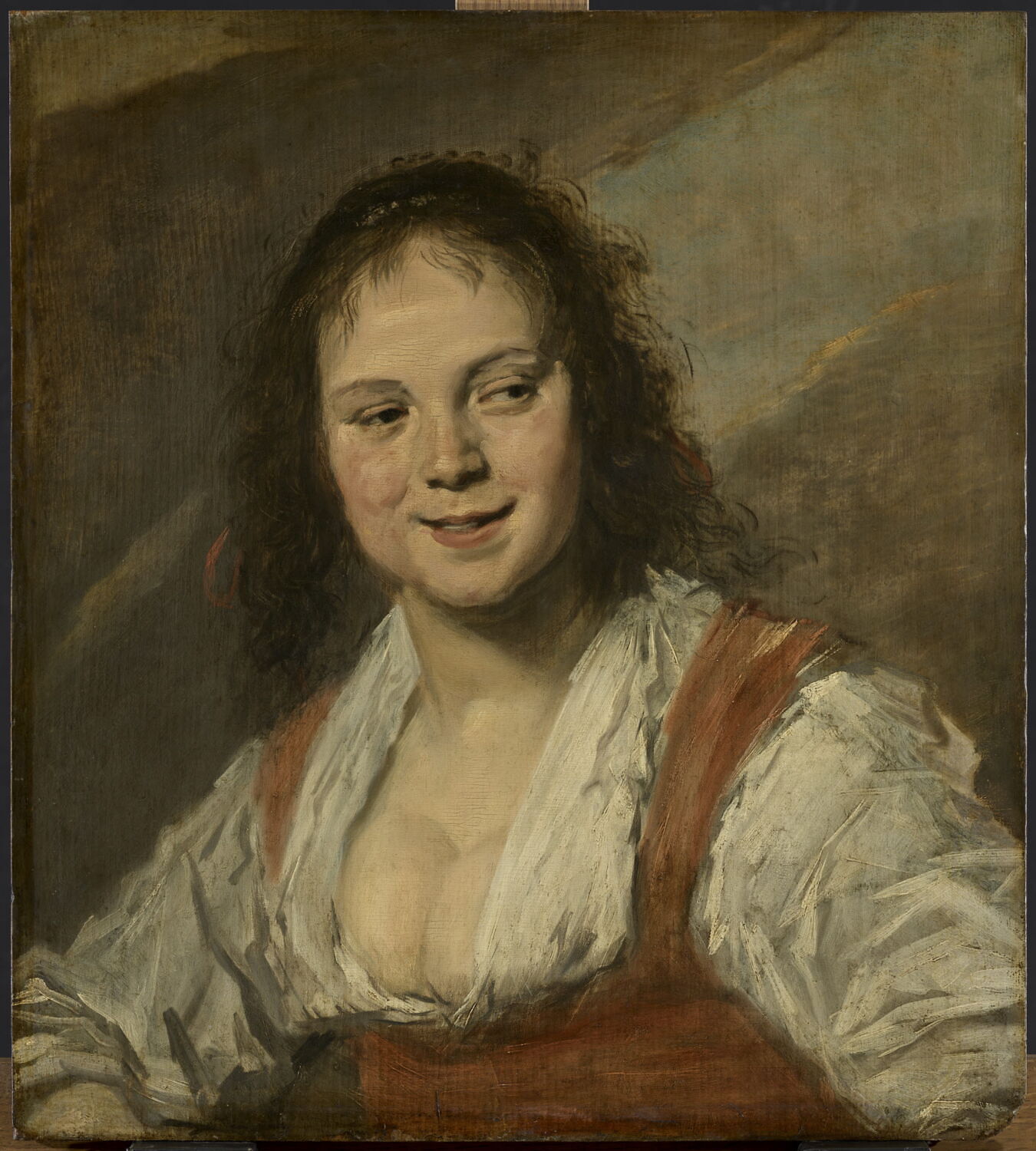
Raking light reveals an earlier, higher neckline beneath The Gypsy Girl in the Louvre. Hals made the clothing more revealing as he worked. The familiar title arrived with the painting's entry into the museum in 1869; it is no proof of the woman's ethnicity. The Louvre reads her costume as that of a courtesan. Keep that interpretation attached to the museum rather than turning it into a recovered biography. The alteration is firmer evidence: it records a decision Hals actually made on the panel.
A different route brought Jester with a Lute into the Louvre. Gustave de Rothschild bought it in 1873; it remained in the family until its acceptance in payment of taxes in 1984. The striped costume connects the player with theatre, while the instrument allows associations with hearing and the brevity of music. On our autumn 2026 check, both Louvre paintings were in room 846, Richelieu, level 2. A long collecting history ends in a very immediate encounter with somebody apparently occupied by a tune.
For one concentrated visit, choose the two London collections or the two Louvre pictures. Amsterdam and The Hague make a useful comparison between affection, drinking and laughter. Confirm availability in the individual records before going. Once there, cover the title on your phone for a moment and describe only what the mouth and eyes are doing. Read the name afterwards; you may find that Hals has already suggested a different story.
På forsiden: Laughing Cavalier — Frans Hals. Frans Hals · Public domain · Wikimedia Commons
Mere at læse
Where to see an artist →Can I see it?
Where to See Jusepe de Ribera: Jacob's Dream, Saint Philip and a Boy with a Crutch
A royal inventory forgot the name of Ribera's martyr but still recognised a man being tormented. His paintings make bodies legible before their stories, whether they are suffering, sleeping or asking for help.
Can I see it?
Where to See Bronzino: Eleonora's Dress, Venus's Secrets and an Altarpiece Sent to France
Bronzino's paintings served people who understood the value of appearances. A duchess's chapel picture could become a diplomatic gift; a necklace could carry a promise that was dangerous to explain.
Can I see it?
Where to See Fragonard: The Swing, a Hidden Face and a Rejected Romance
A courtier wanted a bishop to push his mistress on a swing. Fragonard's pictures begin with such requests, then escape the people who ordered them.