
Can I see it?
Where to See Jusepe de Ribera: Jacob's Dream, Saint Philip and a Boy with a Crutch
A royal inventory forgot the name of Ribera's martyr but still recognised a man being tormented. His paintings make bodies legible before their stories, whether they are suffering, sleeping or asking for help.
2. november 2026 · 7 min. læsning · ART WIKI’s redaktion
By 1666, someone cataloguing the royal collection in Madrid could describe The Martyrdom of Saint Philip only as a person being tormented. The painting was less than thirty years old. Its saint's identity had slipped away even though it hung in an important audience room. That failure says something about Ribera's directness. You can miss the name, the legend and the patron's intentions, yet still understand what the ropes are doing to an elderly man's body.
Madrid: an execution and an almost invisible ladder
In the Prado's The Martyrdom of Saint Philip, men raise the apostle towards his cross while spectators watch with different degrees of concern. The Duke of Medina de las Torres may have commissioned it for Philip IV, whose namesake the saint was. That remains a proposal. What needs no documentary argument is the expanse of sky above the labouring figures. It gives the action room to happen in daylight. Ribera has not hidden the machinery of the execution in a dark corner.

A few years of biography are unnecessary to feel the change in Jacob's Dream, also in the Prado. The sleeper rests beside a tree; the ladder connecting earth and heaven is made of light rather than solid rungs. Angels almost disappear into it. Look at Jacob first, then let your eyes find what he cannot see while awake. The picture gives the weight of a resting body more certainty than the shape of a revelation. It asks for the kind of attention a quiet voice needs after somebody has shouted.
Touch becomes unreliable in Isaac and Jacob. Rebecca helps her younger son impersonate his brother Esau with clothes and an animal skin over his arm. Their blind father is to recognise the wrong son and give him the blessing intended for the elder. Ribera's Prado painting turns a family deception into a problem of surfaces. The viewer can understand the trick that the man touching the disguise cannot. After the dream, this is a useful reversal: ordinary sensation offers no guarantee of truth.
Across Madrid: hands that can no longer help
Ribera signed the Thyssen-Bornemisza's Pietà as a Spaniard in 1633, although his career was being made in Italy. Its original patron remains unknown. The dead Christ lies across the composition, gathering the other figures around him; the Virgin's hands make grief visible without changing anything about his condition. Stay with the difference between those hands and Isaac's searching touch. The gesture that might discover, deceive or bless has become a gesture of loss. This second Madrid collection makes room for what comes after the violence.
Naples: Silenus asks for another drink
A reclining body becomes comic in Drunken Silenus, in the Capodimonte collection. The companion of Bacchus stretches out naked while his company supplies more wine. Paris Musées compares his pose to a reclining Venus, an interpretation that makes his ample belly especially difficult to overlook. Ribera had settled in Naples in 1616 and married the painter Bernardino Azzolino's daughter, entering a network of patrons and commissions. Among the religious demands on him, there was room for this undignified way of inhabiting a myth.
Paris: read the paper in the boy's hand
The boy in The Clubfoot carries a written request for alms for the love of God. His crutch and smile reach us before that appeal does. The Louvre records a succession of owners beginning with the Vandeneyden family in Naples; the picture reached the museum through Louis La Caze's bequest in 1869. A request made by a poor child has travelled through wealthy collections. That distance between subject and ownership is part of the encounter, not something the smile neatly resolves.
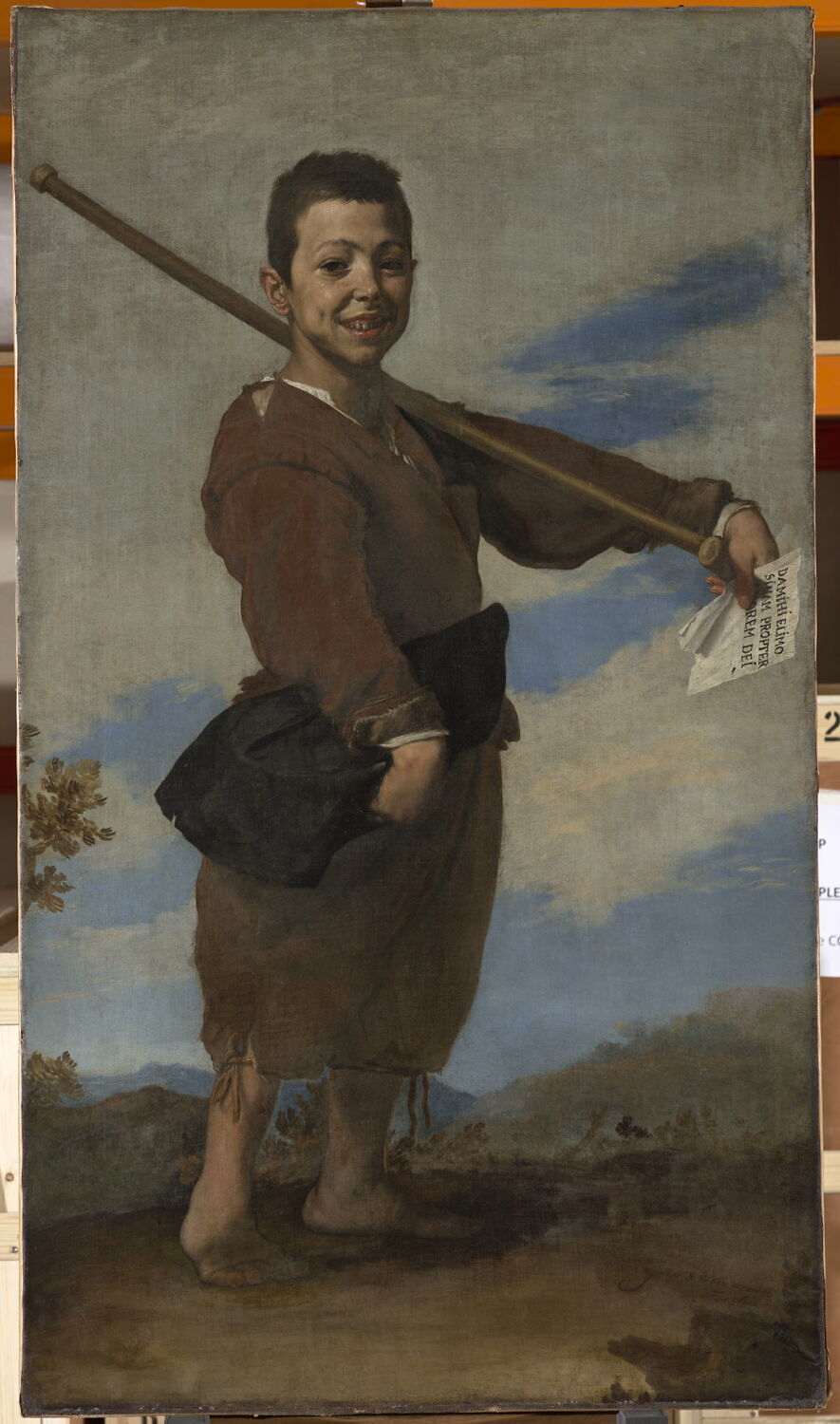
At the autumn 2026 check, The Clubfoot was in Louvre room 718, Denon, level 1. Give yourself enough distance to take in the standing figure before examining the face. The conventional title encourages you to look at one part of the body first. Try reversing that order. Attend to the whole person, the space around him and the way he holds his belongings. A medical diagnosis is neither necessary nor secure enough to supply the meaning of the painting.
Washington and Los Angeles: a knife and an unreadable book
An executioner appears to hesitate in The Martyrdom of Saint Bartholomew, owned by Washington's National Gallery of Art. The museum reads his expression as possible doubt, perhaps even the beginning of conversion. His knife and sharpener remain present. At our autumn 2026 check, the painting was in M-029. The pause matters because it is not a reprieve: the spectator has time to look from the saint's raised face to the person who will hurt him, and wonder what that look might accomplish.
The Getty's Euclid holds out a book containing geometrical diagrams and invented lettering. His worn clothes and dirty fingers make learning look like a life consuming its owner's resources. The text will not reward translation, but the diagrams explain the mathematician's identity. The autumn 2026 record placed him in E201, in the East Pavilion. Here Ribera lets the hands offer something rather than suffer something: a page to study. Keep the book and its bearer together in your attention; the argument depends on both.
Madrid gives the widest range within a compact plan: choose the Prado's dream and family deception, then the Thyssen's mourning scene. Check the linked records before setting out. If your visit centres on a martyrdom, leave time afterwards for a less crowded picture. Ribera's quieter bodies deserve a chance to stay in the memory too, particularly the sleeper who has no idea how much is happening above him.
På forsiden: Jacob’s Dream — Jusepe de Ribera. Jusepe de Ribera · Public domain · Wikimedia Commons
Mere at læse
Where to see an artist →Can I see it?
Where to See Bronzino: Eleonora's Dress, Venus's Secrets and an Altarpiece Sent to France
Bronzino's paintings served people who understood the value of appearances. A duchess's chapel picture could become a diplomatic gift; a necklace could carry a promise that was dangerous to explain.
Can I see it?
Where to See Fragonard: The Swing, a Hidden Face and a Rejected Romance
A courtier wanted a bishop to push his mistress on a swing. Fragonard's pictures begin with such requests, then escape the people who ordered them.
Can I see it?
Where to See Sorolla: Madrid's Beaches, a Family Bedroom and a Boat in Paris
The sunlight in Sorolla's paintings falls on working bodies as well as holidaymakers. Follow it from the Prado's fishing boat to the bed of his wife and newborn daughter.