Can I see it?
Where to See Lucas Cranach: The Fountain of Youth and Venus with a Warning
Cranach can make a moral lesson look like an invitation to misbehave. His women emerge young from a bath, his Cupid steals honey, and the warning often arrives after the pleasure.
2. november 2026 · 7 min. læsning · ART WIKI’s redaktion
Old women arrive in carts and on stretchers. Young women leave the water and prepare for a party. Between them, a rectangular pool performs the impossible with the efficiency of a well-run establishment. Lucas Cranach the Elder painted The Fountain of Youth in 1546; it belongs to Berlin's Gemäldegalerie. Before accepting the promise of rejuvenation, notice who actually has to undergo the treatment. Only women enter the bath. Men are already waiting on the other side.
Berlin: a cure with very particular terms
The journey across The Fountain of Youth can be followed almost like a street scene. Some arrivals hesitate at the edge, others need help undressing, and a doctor examines a patient before she goes in. At the far side, a tent provides new clothes. Then come dancing and a meal. The change in the country around the pool, from stony ground to greenery, helps the fantasy along. Cranach has imagined the practical arrangements as carefully as the miracle.
Venus and Cupid stand on the fountain. Their presence makes love part of the mechanism, rather than an incidental reward after bathing. Yet the arrangement is also a joke with an unequal distribution of effort. Women must be carried to the pool, undress and transform; the men can await the results in their fine clothes. Take the scene slowly from left to right. Its many small incidents make the bargain harder to overlook than the title alone would suggest.

London: Cupid discovers the cost of sweetness
A stolen honeycomb has become a painful possession in Cupid Complaining to Venus, in the National Gallery collection. Bees sting the child who normally wounds other people with his arrows. The story comes from a Greek poem attributed to Theocritus. Cupid complains that such small creatures can hurt so much; his mother points out the comparison with his own activities. The Latin verses painted in the sky make the moral explicit. Pleasure has consequences, including for the god who distributes it.
Venus does not look like an archaeological reconstruction of an ancient goddess. Her feathered velvet hat and jewellery belong to the Saxon court where Cranach worked. She turns towards us while her son complains beside her. That division of attention gives the painting its teasing quality: the lesson concerns the hazards of desire, but the person delivering it is busy attracting a new audience. Cranach's court appointment began in 1505. He knew how contemporary finery could interrupt a story supposedly set in antiquity.

Copenhagen: the game beneath the dark cloud
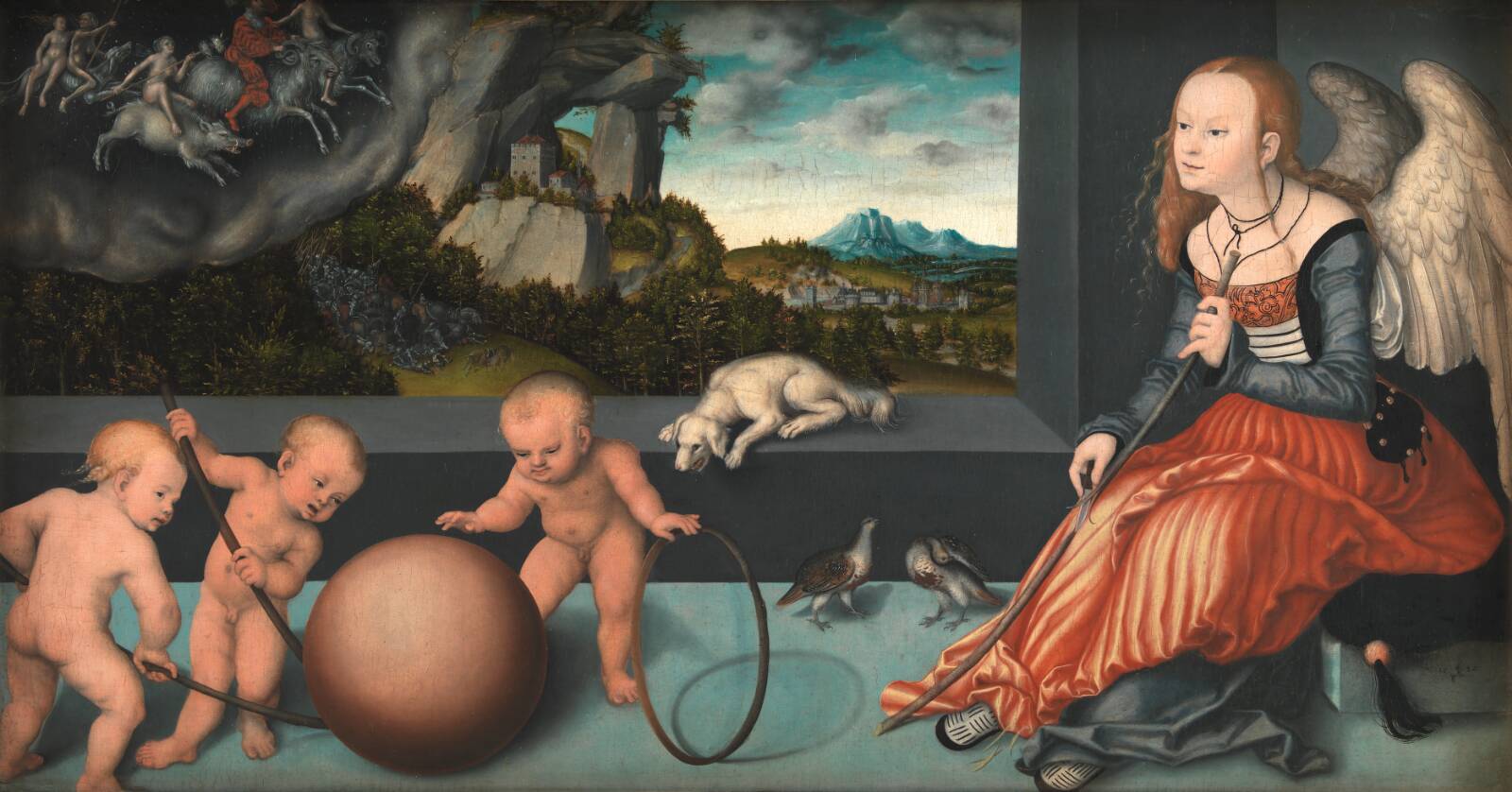
Three boys try to drive a large ball through a hoop in Melancholy. Nearby, a winged woman shaves a stick, perhaps preparing another hoop. The activity could be domestic and harmless, until the sky begins to demand attention. Figures ride through a dark cloud above the landscape. The picture belongs to Denmark's National Gallery, SMK, and was in room 201A on our autumn 2026 check. Its width encourages the eye to move between the children's concentration and the woman's separate occupation.
The winged figure recalls Dürer's earlier treatment of melancholy, but Cranach has built a scene with its own distractions. The cloud's riders have been connected with witchcraft and the period's ideas about the melancholic temperament. It would be misleading to turn that old category directly into a modern diagnosis. The painting puts play uncomfortably close to thought, with threatening fantasy never far away. The panel was recorded at Gottorp in 1710 and transferred to Copenhagen in 1759. Its questions survived the move.
New York: a ring supplies a possible name
Two letters on a signet ring may identify the sitter in Lukas Spielhausen. LS suggests the lawyer who was serving the Saxon state by 1531; the identification remains tentative. His striped black-and-yellow clothes belong to the dress of senior electoral courtiers. At the Metropolitan Museum of Art, where the portrait was in gallery 612 on our autumn 2026 check, the eye can get wonderfully sidetracked by his beard and moustache. Their outward spread answers the tight bundle of hair above.
A coat of arms supplies another clue in The Martyrdom of Saint Barbara, in gallery 607 on the same autumn check. It points to the Rem family, merchants in Augsburg, as patrons. Barbara kneels before her father, who raises a sword to kill her for refusing to abandon Christianity. The episode belongs to her legend. Her costly clothes make the violence harder to detach from the world of prosperous patrons: the kneeling woman could have dressed for a court occasion, but her father is preparing an execution.
Washington and Paris: belief, then a public collection
Words enter the sky again in The Crucifixion with the Converted Centurion, in Washington's National Gallery of Art. This time they are German. Christ commends his spirit to the Father; the mounted centurion recognises him as God's son. The rider wears contemporary armour and raises his hand towards the cross. On our autumn 2026 check, the panel was in M-035-A. The storm-darkened sky leaves the pale horse and the three crosses with very little competition.
Thousands of people helped bring The Three Graces into the Louvre. Its 2010 appeal ultimately drew 7,200 donors and €1,260,000. This was a very different kind of patronage from the Saxon court or an Augsburg merchant family. Ownership still does not guarantee an encounter: on our autumn 2026 check, the painting was not on view. If it is your reason for visiting Paris, establish its availability before arranging the trip.
For a first encounter, Berlin gives you a whole crowd to follow; Copenhagen offers a single puzzling room. Choose whichever kind of looking appeals, and verify the display before travelling. With Cranach, read the little inscriptions and inspect the objects people hold. A ring, a hoop or a stolen honeycomb can change the entire conversation.
På forsiden: Ungdommen springvand — Lucas Cranach. Lucas Cranach the Elder · Public domain · Wikimedia Commons
Mere at læse
Where to see an artist →Can I see it?
Where to See Pieter de Hooch: Delft Courtyards and the Lives Behind Open Doors
A doorway can reveal the next room without explaining what happens there. De Hooch's houses are full of light, household work and stories that refuse to become quite certain.
Can I see it?
Where to See Parmigianino: The Madonna with the Long Neck and the Mystery of Antea
A five-month commission remained unfinished six years later. Following Parmigianino from Florence to London and Naples means meeting paintings whose beauty has outlived their deadlines, destinations and supposed identities.
Can I see it?
Where to See John Constable: The Hay Wain, Salisbury and the Landscapes He Kept
The Hay Wain found no buyer at its first London exhibition. Its journey to a French gold medal is one way into Constable; a horse he bought back and a rainbow painted after bereavement offer others.