Can I see it?
Where to See Marc Chagall: Flying Lovers, Vitebsk and White Crucifixion
Chagall could turn a birthday kiss into flight and a wooden house into an argument with himself. Follow the paintings from remembered village life to the refugees gathered around a cross.
2. november 2026 · 7 min. læsning · ART WIKI’s redaktion
To kiss Bella, the man in Birthday bends his neck at an impossible angle. His body has left the floor. Chagall painted this domestic flight in 1915, the year of their marriage, giving an ordinary room rules of its own. The picture belongs to New York's Museum of Modern Art, though our autumn 2026 check recorded it as not on view. Another Chagall there offers a different kind of reunion, between a man and the home he has left.
New York: a white line crosses the distance
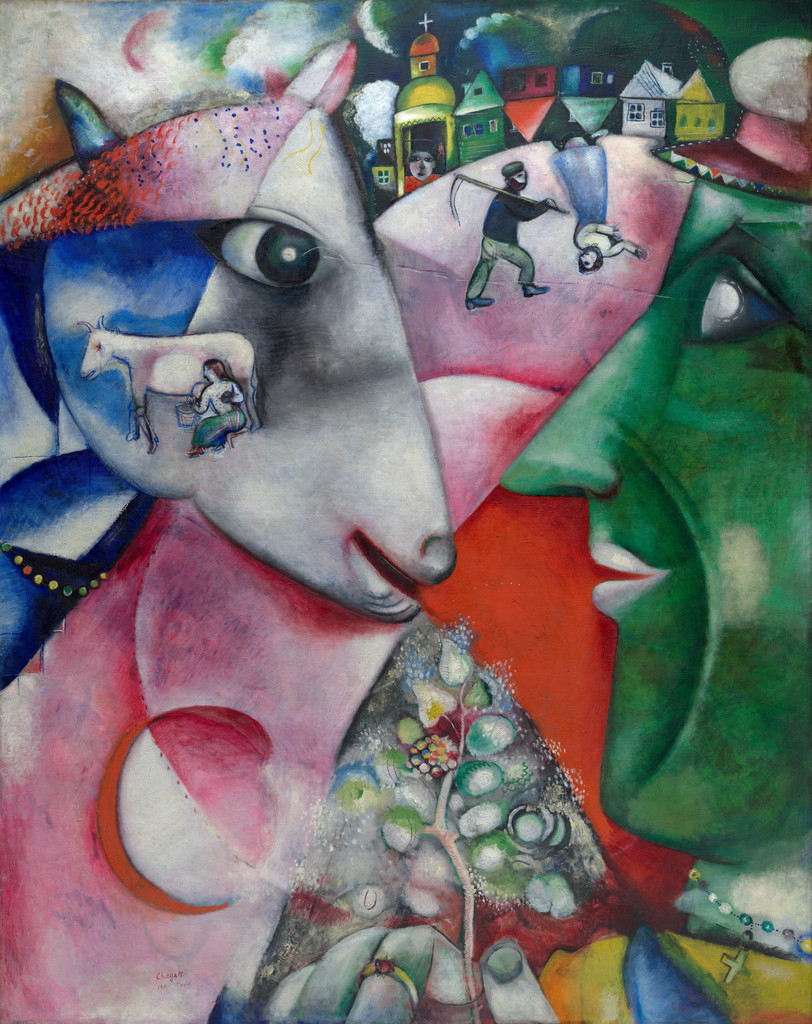
In I and the Village, the pupils of a green-faced man and an animal are connected by a faint white line. Small scenes turn up inside the larger shapes, including a woman milking a cow. Some houses stand upside down. Chagall made the painting in Paris in 1911, drawing on the world of his childhood in what is now Belarus. The new geometry he encountered in France gave him another way to arrange things remembered from elsewhere.
MoMA placed this painting, on our autumn 2026 check, in MoMA's fifth-floor Gallery 503. Start with that almost invisible line before following the circles and diagonals across the canvas. The title was supplied by the poet Blaise Cendrars, a friend in Paris. Looking from one eye to the other makes the connection less abstract than the word memory. A man and an animal have been given the same task: to hold the other's gaze across a divided picture.
The Guggenheim's Paris Through the Window turns towards the new city without becoming a straightforward view. A cat has a human face, a man has two faces, and a train travels upside down. The Eiffel Tower supplies a recognisable landmark among these disturbances. Try following the window frame as if it could keep inside and outside apart. Then find the heart in the blue hand near the lower edge. The room and the city refuse to remain separate territories.
Madrid: the return ticket that could not be used
Chagall went back to Vitebsk in 1914 expecting a short stay. The outbreak of war prevented his return to Paris, and he did not leave Russia until 1922. During those years he married Bella and became involved in the new artistic institutions after the Revolution. The interrupted journey matters when looking at The House in Grey, owned by the Thyssen-Bornemisza. He was painting his home town from within it again, carrying the lessons of Paris with him.
The wooden house sits before the town's taller buildings, including the Assumption Cathedral. At the lower left, a little figure has been interpreted as Chagall himself. Inscriptions complicate that identification. His name appears on the clothing, and the Russian word for fool appears on the fence. Scholars have read the combination as a joke at his own expense. You can look at the grey hut first as a remembered kind of dwelling, then discover that the painter may have written himself into its margin as the local fool.
Saint Petersburg: Bella keeps one hand on earth
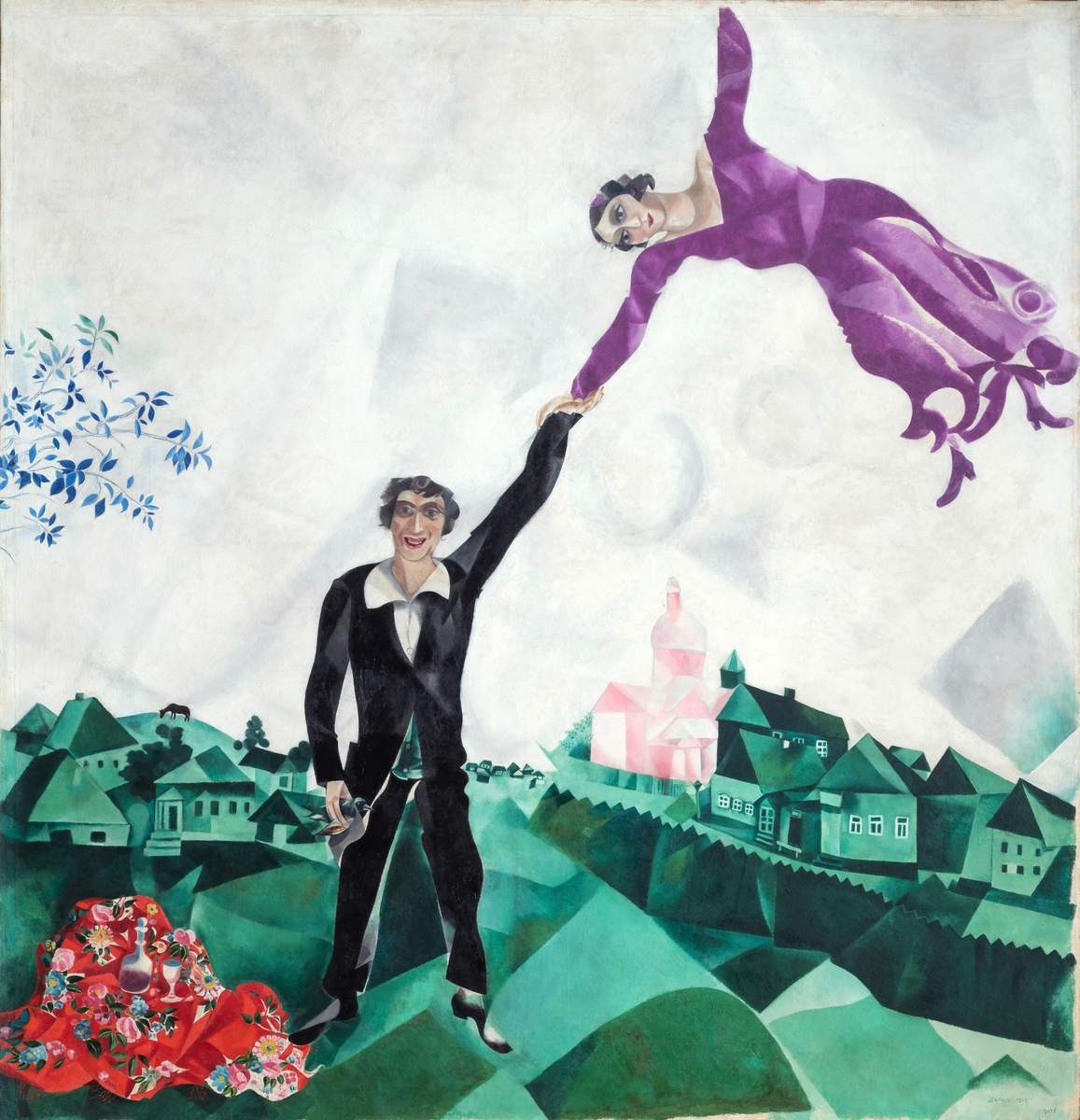
The flying woman in Promenade has not let go of her companion. Chagall stands below, holding a bird in his other hand; a red picnic cloth anchors the lower corner. The Russian Museum owns this 1917 painting, part of a group of double portraits with Bella. Its flight has a compositional job as well as an emotional one. Her body fills the upper right, balancing the spread on the ground. Follow their joined arms and see how much empty sky the gesture can bridge.
Chicago: the cloth around Christ changes the story
By 1938, a different kind of displacement entered White Crucifixion, owned by the Art Institute of Chicago. Christ wears a garment based on a Jewish prayer shawl. Around the cross are persecution and flight, including a burning synagogue. Chagall uses an image familiar to Christian viewers to direct their attention towards Jewish suffering. Some explicitly Nazi details were subsequently painted over. The alteration matters: the canvas itself carries the history of deciding how directly to name the persecutors.
Our autumn 2026 check recorded the Chicago painting as not on view. Together with the unavailable birthday picture, it makes choosing an individual work more useful than simply choosing Chagall's name. For a first trip from this selection, MoMA offers the checked encounter with I and the Village. Recheck the artwork page before leaving, and save time after finding it. First follow the eyes; then let yourself discover the smaller village that has been folded into the larger faces.
På forsiden: Jeg og Landsbyen — Marc Chagall. © the artist or rights holder
Mere at læse
Where to see an artist →Can I see it?
Where to See Mattia Preti: Naples after the Plague and a Concert with the Wrong Name
A widow’s payment, a city’s thanksgiving and a musician’s mistaken attribution lead into Preti’s paintings. Naples is the centre of this route, with quieter encounters in Florence and Saint Petersburg.
Can I see it?
Where to See John Singleton Copley: Paul Revere, a Shark and a Divided Family
A Boston painter sent his younger brother’s portrait across the Atlantic before daring to follow it. His pictures in Boston, Washington and London trace the cost of that crossing.
Can I see it?
Where to See Pierre Bonnard: The White Cat, the Dining Room and the Bath
A cat’s legs took repeated attempts; a sunlit studio took years. Bonnard’s apparently casual glimpses of home were pictures he could not leave alone.