Can I see it?
Where to See Pierre Bonnard: The White Cat, the Dining Room and the Bath
A cat’s legs took repeated attempts; a sunlit studio took years. Bonnard’s apparently casual glimpses of home were pictures he could not leave alone.
2. november 2026 · 7 min. læsning · ART WIKI’s redaktion
The cat has grown too tall. In The White Cat, its back arches above legs that seem stretched beyond feline possibility, while its head sinks into its shoulders. The joke is deliberate. Preparatory drawings and X-rays show that Bonnard repeatedly changed the paws. This small creature in the Musée d’Orsay collection is a useful companion for the larger rooms ahead: nothing here should be mistaken for an unedited glimpse.
Minneapolis: two cats have taken the chairs
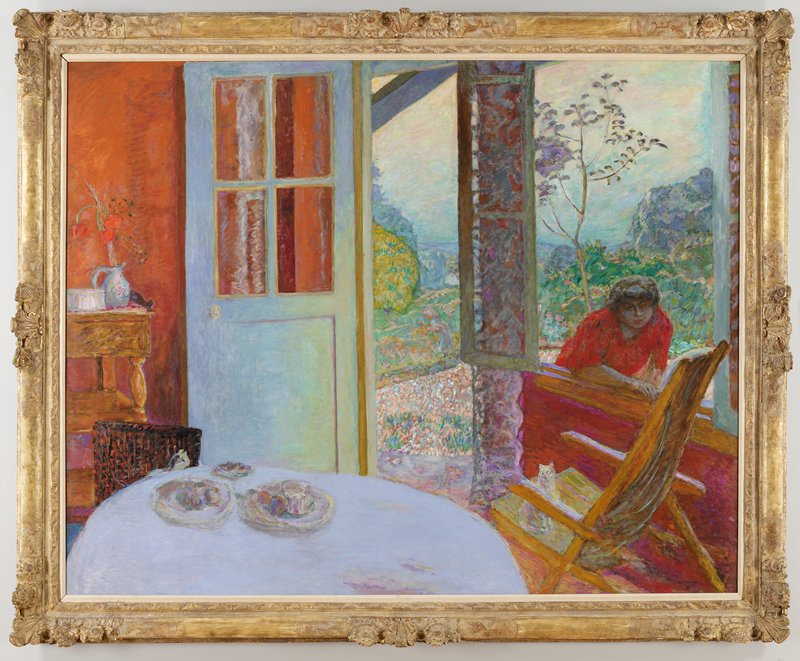
At the Minneapolis Institute of Art, Dining Room in the Country was on view in G355 on our autumn 2026 check. Bonnard painted it in 1913, a year after buying Ma Roulotte, his house at Vernonnet above the Seine. The name means “My Caravan”. A door and window open the dining room to the garden, and Marthe leans on the sill from outside. There are already other occupants inside: two cats, one on either side.
Start with the table, then look towards the greenery. The red-orange room and cooler garden divide the canvas without quite separating it. Light touches the doorframe and cloth; the window brings the garden close enough to seem part of the furnishings. The cats are small, easily missed at first. Finding them changes the scale of the room, which can initially feel almost uninhabited.
This apparent afternoon at home travelled. Bonnard showed the painting at the Salon d’Automne in 1913, where Guillaume Apollinaire noticed it. Three preliminary studies survive. By then Bonnard owned a car and moved frequently, sometimes carrying canvases rolled up. A painting of his dining room need not have been painted in that dining room, or even in the same town. The subject stayed home more reliably than the canvas did.
Paris: a joke with paws, a portrait with fists
The exaggerated animal at Orsay belongs to Bonnard’s early involvement with the Nabis. In 1894, a flat silhouette and an unbalanced arrangement could owe more to Japanese prints than to the rules of a convincing room. Bonnard collected Japanese prints, including images of animals. His cat fills the narrow surface like a decorative sign, with scarcely any depth behind its body.
The same collection owns The Boxer, a self-portrait from 1931. Here the body under examination is Bonnard’s own. The title gives an unexpected occupation to a painter shown bare above the waist. It is a useful interruption to the familiar image of him as a man comfortably occupied with fruit bowls and gardens: the person who made those rooms also turned his scrutiny upon himself.
The portrait’s later history is more violent than its title. It belonged to the Bernheim-Jeune gallery, which was subjected to “Aryanisation” and liquidation during the Occupation. A forced liquidation sale dispersed the picture in 1942. After the war a judgment annulled that sale and ordered restitution or compensation; a settlement followed in 1953. Philippe Meyer’s donation eventually brought the canvas into the national collection. A museum credit line compresses a long dispute.
The bath begins with a rainy-day note
For Nude by the Bath, in the Musée national d’Art moderne collection, begin with the French title, Nu à la baignoire. The 1931 painting shows Marthe standing beside the bath, rather than lying in it. She rubs her back with a bathing strap. Bonnard looks slightly down into the small room, setting the rounded body and bath against the floor’s geometric tiles.
The first idea survives as a pencil sketch in his diary on 17 February 1931, with a note that the weather was rainy. A familiar private gesture became something he could carry back to the studio. The warm body, pale surroundings and discarded clothes needed further drawings before they became a nearly square canvas.

Bonnard’s method depended on such distances between seeing and painting. He made little drawings, then worked from those and from memory. Unstretched canvases could be pinned to a wall, allowing their boundaries to change as he revised them. A room remembered was free to become wider, its furniture less obedient to perspective. The edges were still negotiable.
A window that outgrew its studio
The Studio with Mimosa, also owned by the Musée national d’Art moderne, expands a cramped workroom at Le Cannet into an expanse of yellow blossom. Window bars and the mezzanine railing cross the view. The flowering tree occupies so much of the painting that the room seems to borrow its space from outdoors. Low at the left, a face emerges; it may be Marthe, who died in 1942.
The long making of this canvas is a reason to look slowly at Bonnard. He began it in 1939 and returned to it in Fontainebleau in 1946. A picture of winter blossom could outlast the person whose face perhaps remains inside it. Memory was a working material, not simply a subject.
If Minneapolis is within reach, give the dining room a visit of its own and use G355 as the recorded starting point. For the French collections, ask specifically about your chosen canvas before setting off. Standing before a Bonnard, resist moving on after recognising the room: check the chairs, the corners and the space behind the first thing that caught your eye.
På forsiden: Dining Room in the Country — Pierre Bonnard. © Minneapolis Institute of Art
Mere at læse
Where to see an artist →Can I see it?
Where to See Lorenzo di Credi: A Lost Altarpiece, a Venus and a Woman with a Ring
A little panel bought in 2022 helped put a Renaissance altarpiece back together. Following Lorenzo di Credi means looking past more famous names on old labels.
Can I see it?
Where to See Luis Meléndez: A King Beneath the Oranges
Meléndez wanted a career at court. His bowls, bread and fruit tell the story of what happened instead.
Can I see it?
Where to See Joseph Wright of Derby: The Bird, the Forge and the Hidden Flame
A girl cannot bear to watch the experiment. Wright gives her fear as much room as the scientist's apparatus.