Can I see it?
Where to See Joos de Momper: Mountains, Hermits and Borrowed Names
The hunters are busy killing a boar; beyond them, an entire country stretches towards the sea. Momper built landscapes big enough to swallow their own stories.
2. november 2026 · 7 min. læsning · ART WIKI’s redaktion
A rider crosses a wooden bridge while dogs and horsemen surround a boar. Farther away, boats pass a town and castles occupy the hilltops. In River Landscape with Boar Hunt, at Amsterdam’s Rijksmuseum, you can follow the chase or abandon it for the distance. The painting supplies enough routes for either decision. Even its jagged rocks seem to be pushing you towards another opening, another stretch of water.
Joos de Momper lived in Antwerp, where these mountains would have been conspicuous by their absence. A journey to Italy in the 1580s has often been proposed, although the evidence has been disputed. His family trade is less elusive. He trained with his father, joined Antwerp’s painters’ guild in 1581 and became its dean in 1611. Mountains became his professional identity. A portrait print after Van Dyck actually calls him a painter of mountains.
Amsterdam: someone else painted the hunters
The people in River Landscape with Boar Hunt were painted by Sebastiaan Vrancx. Momper supplied their world. This division of labour explains why following the smallest figures can feel different from studying the landscape around them. The wooden panel entered the Rijksmuseum in 1958 with support from its Jubilee Fund; its nearly two-metre width gives the hunt plenty of room to disappear into the scenery.
Brown foreground, green middle distance, blue horizon. The order sounds mechanical until you watch the colours carry your eye across the panel. Dark rocky sides work like stage scenery, but the stage keeps opening backwards. The hunters need their dogs and weapons; a spectator needs only a line of sight. Try tracing the route that would take a person from the crowded foreground to the distant town. The supposed background may occupy you longer than the action.

Paris: the hermits who changed their painter
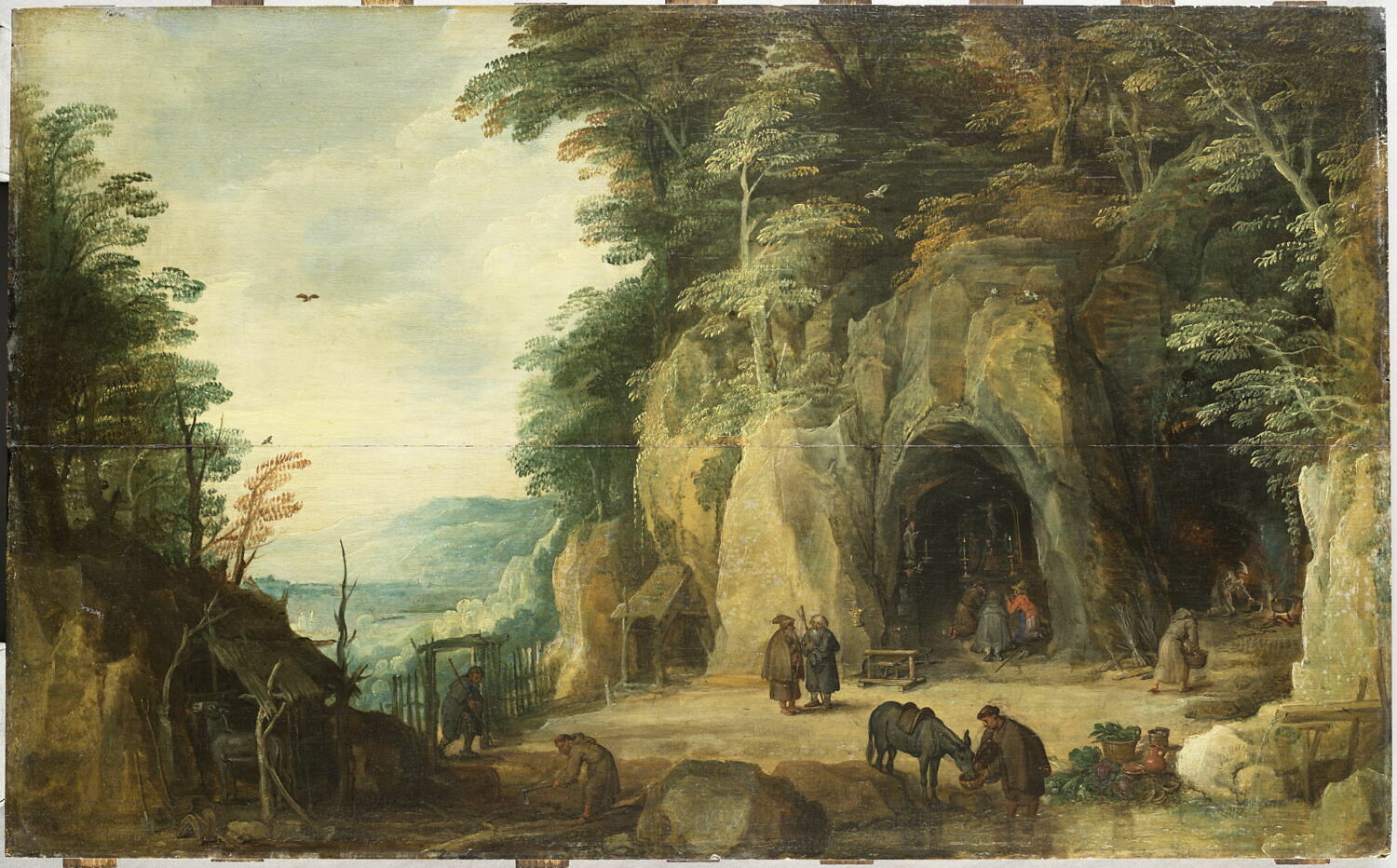
Louis XIV bought Monk’s Hermitage in a Cave from the collector Everhard Jabach in 1671. It was inventoried as Momper, later reassigned to Paul Bril, and sent to Versailles. It returned to the Louvre in 1911 still carrying Bril’s name. Édouard Michel restored it to Momper around 1937. The monks had remained in their cave throughout these changes of address and identity.
On our autumn 2026 check, Monk’s Hermitage in a Cave was in room 807 on level 2 of the Richelieu wing. Who painted its figures remains less settled than who painted the rocks. Jan Brueghel the Elder has been proposed; the attribution is questioned in favour of a follower. That uncertainty concerns a collaborator, rather than Momper’s authorship of the landscape. A little community shelters inside a much larger geological enclosure.
Nearby in the same wing, room 802 held Mountainous Landscape with a Bridge and Four Horsemen on our autumn 2026 check. This painting too once travelled under a different name, that of the Brueghel family, and spent time at Fontainebleau. Louis Demonts recognised Momper in 1922. The human figures have prompted further disagreement, with Frans Francken the Younger and Vrancx among the suggestions. The mountains have proved easier to identify than their inhabitants.
Madrid: a coastline for a royal palace
In Landscape with Sea and Mountains, at the Prado, hunters share the foreground with riders and beggars. The shore curves through successive stretches of distance. The picture was recorded at the Buen Retiro Palace by 1700. Its people have sometimes been attributed to Jan Brueghel the Elder, who often collaborated with Momper. Their different fortunes fit into a landscape that belongs to none of them.
A palace owner could possess the whole view. Within it, the beggar and the mounted traveller experience very different journeys. That difference gives a reason to return to the foreground after following the coast. Momper’s high horizon lets you survey more territory than any one figure could see from the road. The painting offers the spectator an advantage denied to the people moving through it.
Saint-Omer and Saint Petersburg: travellers at ground level
The Alpine Landscape in Saint-Omer’s Musée de l’hôtel Sandelin arrived through Henri Dupuis’s bequest in 1889. Some travellers ride; others walk beside their mules. Wild goats gather near a waterfall, and an isolated little building stands against the blue distance. Here the mountain crossing has the pace of a journey made on foot. A person must negotiate what the eye can skip.
Saint Petersburg holds Rock Landscape with a Waterfall, where riders climb a road while herdsmen sit beside the cascade. Jan Brueghel supplied the figures. The Hermitage record marked it not on view when checked on 29 August 2026, as it did Mountainous Landscape with Figures and a Donkey. Neither should be the sole reason for arranging a museum visit without a fresh check.
Momper’s changing attributions make a compact Louvre itinerary, with two room locations confirmed in autumn 2026. In Amsterdam, allow time for the single river panorama. Start with one rider, follow the road until it disappears, then look up. The landscape opens more slowly after that small delay.
På forsiden: River Landscape with Boar Hunt — Joos de Momper. Public domain
Mere at læse
Where to see an artist →Can I see it?
Where to See Savoldo: Mary Magdalene and the Painter of Uncertain Light
A silver cloak catches the dawn, but the face inside it has become harder to read. Savoldo’s paintings make light visible and leave the story partly in shadow.
Can I see it?
Where to See Jules Bastien-Lepage: Joan of Arc, Haymakers and Village Love
A girl hears saints in an overgrown garden; another sits in a field too tired to move. Bastien-Lepage found the subjects of large paintings close to home.
Can I see it?
Where to See Étienne Dinet: Algerian Lovers and the Paintings That Reached Reims
A search for a beetle took Dinet to Algeria. The journey led to another home, another faith and paintings whose French museum histories are full of unexpected turns.