Frederic Edwin ChurchUSA, 1826–1900
View of Cotopaxi
Kan det ses?
Ja, udstillet nu
Hvor er »View of Cotopaxi« i dag? Art Institute of Chicago, Sal 161, Chicago. Ja, udstillet nu. Kontrolleret 29. september 2026.

Chicago, USA
Åbent nu· til kl. 17.00
Udstillet for publikum.
- Kontrolleret
- Uændret siden
- Kilde
- Museet
Om maleriet
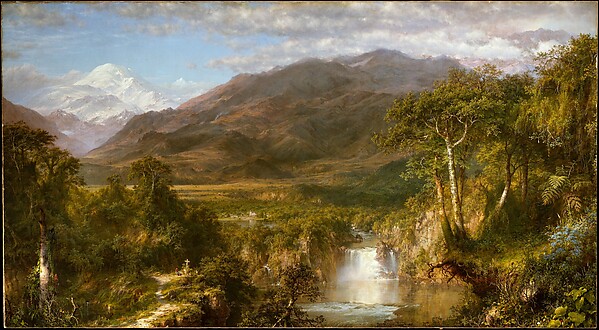
View of Cotopaxi brings together in visual form scientific, religious, political, and cultural ideas in the mid-19th century. Inspired by German naturalist Alexander von Humboldt’s concept of ecological interconnectedness, Frederic Edwin Church traveled to South America to meticulously study the tropical landscape. The artist produced at least ten finished paintings of the Ecuadorian volcano, this one completed in his studio just before his second visit to the region. For Church and other Christian viewers, nature, with all its creative and destructive wonders, was evidence of divine power. The painting likewise reflected an imperialist vision, as US government officials eyed Latin America as a site for territorial expansion and conquest.
Art Institute of ChicagoCC BY 4.0
Oplysninger
- Inventarnummer
- 1919.753
Hvad det viser
I kataloget
Udstillingshistorik
Udstillet · Sal 161
Art Institute of Chicago · 28. sep. 2026 — nu · Kontrolleret
Var udstillet · Sal 171
Art Institute of Chicago · 19. aug. 2026 — 28. sep. 2026 · Kontrolleret
Kilder
- Art Institute of Chicago
- Billede: Art Institute of Chicago — CC0
Imens i livet hos Frederic Edwin Church
Hele livet1854–1856
Canada, New England and Mount Desert Island
Church travelled in Canada and New England; like Cole, he was among the first city dwellers to summer on Mount Desert Island in Maine, now Acadia National Park.
1857
Second South American journey, with Louis Rémy Mignot
Church returned to South America with the painter Louis Rémy Mignot and added to his sketches; the two journeys produced “The Andes of Ecuador”, “Cayambe”, “The Heart of the Andes” and “Cotopaxi”.
1859
A one-picture show: “The Heart of the Andes” in New York
Thousands paid to see the canvas: its huge floor-standing frame served as a window onto the Andes, visitors sat on benches and studied the details through opera glasses, and Church arranged the room so that light from the skylights fell on the picture. It was an instant success; at this exhibition Church met his future wife, Isabel Carnes.
1859
To the icebergs: Newfoundland and Labrador
His friendship with the Arctic explorer Isaac Israel Hayes stirred Church’s interest in the far north, and with his friend the Rev. Louis Legrand Noble he travelled to Newfoundland and Labrador. Noble chronicled the trip in “After Icebergs with a Painter” (1861), published shortly before “The Icebergs” went on display.