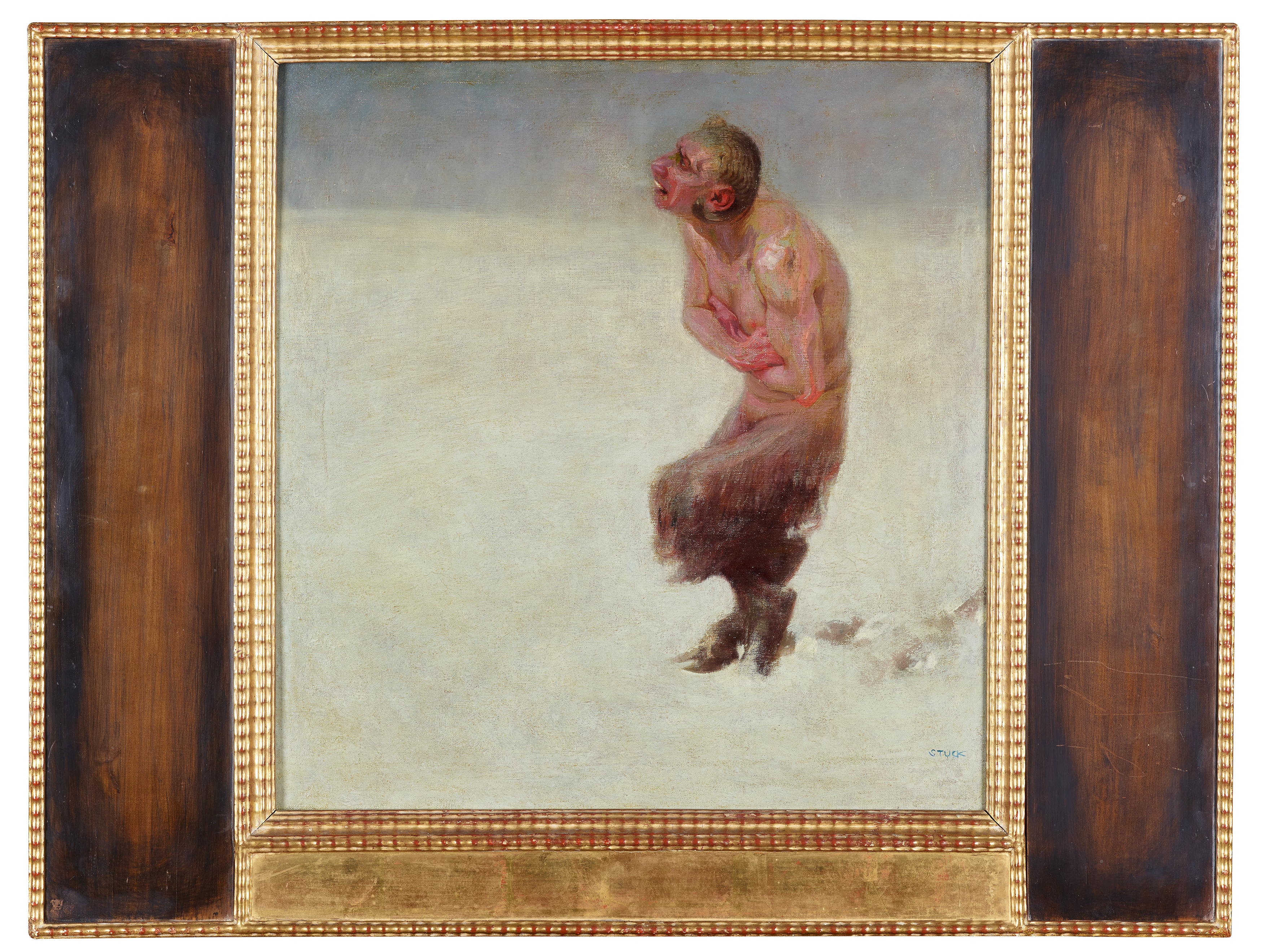
 Franz von StuckTyskland, Østrig, 1863–1928
Verirrt
Må man se det?
Ukendt

Österreichische Galerie Belvedere
Wien, Østrig
Ejeren er kendt; om værket er udstillet i dag, vides ikke.
- Uændret siden
- Kilde
- Museet
Om maleriet
Med museets ord — på tysk
Franz von Stuck ist neben Max Klinger der bedeutendste Maler des Jugendstils in Deutschland. Schon in frühen Jahren wirkt er an der Zeitschrift Jugend mit, die dem neuen Stil den Namen gibt. 1892 ist er Mitbegründer der Münchener Secession, der ersten Reformgruppe im deutschen Sprachraum, die sich der neuen Kunstrichtung verschrieben hat. Berühmt wird Stuck für seine originellen Interpretationen der antiken Mythologie. Im Gemälde Verirrt versetzt er einen Faun, ein Fabelwesen, das den griechischen Erzählungen nach in den warmen Regionen am Mittelmeer zu Hause ist, in eine karge, verschneite Gegend.
Österreichische Galerie Belvedere
Oplysninger
I kataloget
Kilder
- Österreichische Galerie Belvedere
- Billede: Österreichische Galerie Belvedere — CC BY-SA 4.0
Imens i livet hos Franz von Stuck
Hele livet1889
First paintings: gold medal for “The Guardian of Paradise”
He exhibits his first paintings at the Munich Glass Palace and wins a gold medal for “The Guardian of Paradise”.
1892
Co-founder of the Munich Secession
Together with Wilhelm Trübner he founds the Munich Secession; in those years he is also a member of the Munich Society for Original Etching (Verein für Original-Radierung), closely tied to the Secession.
1893
Critical and public success of “The Sin”
The painting “The Sin” (now in the Bavarian State Painting Collections), inspired by Böcklin and now regarded as his best-known work, wins the acclaim of critics and public; other accounts say the great acclaim came as early as 1892.
1893
Gold medal at the World's Columbian Exposition
He is awarded a gold medal for painting at the World's Columbian Exposition in Chicago.
1893
A royal professorship
He is appointed to a royal professorship.