 Franz MarcTyskland, 1880–1916
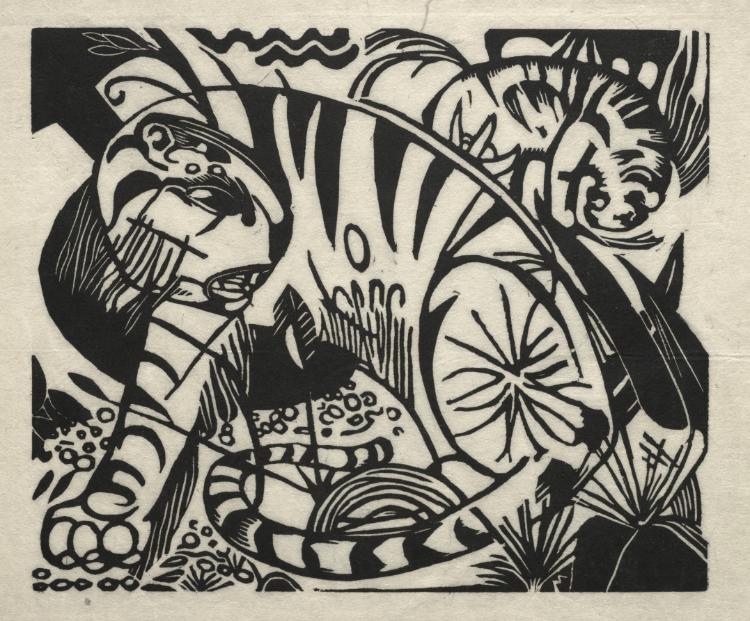
Tiger
Må man se det?
Tager ikke imod for tiden

The Cleveland Museum of Art
Cleveland, USA
Det hører til samlingen, men er ikke udstillet for tiden.
- Kontrolleret
- i forgårs
- Uændret siden
- 19. aug. 2026
- Kilde
- Museets egne samlingsdata
Om værket
Like other members of Der Blaue Reiter in Munich, Franz Marc focused on depicting animals, which symbolized joyous rebirth. Genesis II was made to illustrate the creation story in the book of Genesis; he planned to include it in an illustrated Bible. Here, three horses emerge from a background of chaos and movement. His Tiger is less joyous and more threatening than the bounding horses; with clenched teeth, the tiger leers toward a cowering animal behind it. After enthusiastically enlisting in the German army, Marc died in battle at Verdun, France, on March 4, 1916. His wartime death—and that of fellow artist August Macke—had a profound impact on the Munich Expressionists, whose vision of an earthly paradise quickly dissolved.
The Cleveland Museum of Art
Oplysninger
- Inventarnummer
- 1961.157
I kataloget
Kilder
- The Cleveland Museum of Art: the museum's own open data · hentet for 6 dage siden
- Billede: The Cleveland Museum of Art — Museum open access
Imens i livet hos Franz Marc
Hele livet1910
The second NKVM exhibition at the Thannhauser Galleries
Marc shows works at the second exhibition of the Neue Künstlervereinigung at the Thannhauser Galleries in Munich.
winter 1910 – 1911
Winter 1910–11: the turn to his mature manner
In the view of the writer Morgan Meis, Marc became an artist this very winter: out of earlier confusion comes a unified vision, his animals emerge pure and true from the canvas, and colour becomes the main thing.
December 1911
Leaving the NKVM and founding Der Blaue Reiter
In December 1911 Marc, together with Macke and Kandinsky, breaks away from the Neue Künstlervereinigung and organises his own group, Der Blaue Reiter; he is also credited with founding the journal that became the centre of the circle.
December 1911 – January 1912
The first Blue Rider exhibition
Several of Marc's works are shown at the first Blue Rider exhibition at the Thannhauser Galleries in Munich, which has been called the apex of German Expressionism.
1913
Married: Maria Marc
1914
Called up at the start of the First World War
At the outbreak of war in 1914 Marc, like August Macke, is mobilised and sent to the front; early biographers thought he had volunteered, but conscription was practically impossible to avoid.