Albrecht DürerTyskland, 1471–1528
Melencolia I
Kan det ses?
Ja, udstillet nu
Hvor er »Melencolia I« i dag? National Gallery of Art, 101B Prints & Drawings, Washington, D.C. Ja, udstillet nu. Kontrolleret 29. september 2026.

Lukker snart· til kl. 17.00
Udstillet for publikum.
- Kontrolleret
- Uændret siden
- Kilde
- Museet
Om værket
Melencolia I is a large 1514 engraving by the German Renaissance artist Albrecht Dürer. Its central subject is an enigmatic and gloomy winged female figure thought to be a personification of melancholia. Holding her head in her hand, she stares past the busy scene in front of her. The area is strewn with symbols and tools associated with craft and carpentry, including an hourglass, weighing scales, a hand plane, a claw hammer, and a saw. Other objects relate to alchemy, geometry or numerology. Behind the figure is a structure with an embedded magic square, and a ladder leading beyond the frame. The sky contains a rainbow, a comet or planet, and a bat-like creature bearing the text that has become the print's title.
Læs videre
Dürer's engraving is one of the most well-known extant old master prints, but, despite a vast art-historical literature, it has resisted any definitive interpretation. Dürer may have associated melancholia with creative activity; the woman may be a representation of a Muse, awaiting inspiration but fearful that it will not return. As such, Dürer may have intended the print as a veiled self-portrait. Other art historians see the figure as pondering the nature of beauty or the value of artistic creativity in light of rationalism, or as a purposely obscure work that highlights the limitations of allegorical or symbolic art.
The art historian Erwin Panofsky, whose writing on the print has received the most attention, detailed its possible relation to Renaissance humanists' conception of melancholia. Summarizing its art-historical legacy, he wrote that "the influence of Dürer's Melencolia I—the first representation in which the concept of melancholy was transplanted from the plane of scientific and pseudo-scientific folklore to the level of art—extended all over the European continent and lasted for more than three centuries."
Med museets ord
Although the title indentifies the subject as melancholy, the means by which Dürer demonstrates this emotional state is complex, making Melencolia I the most analyzed and discussed of Dürer’s works. Dürer personifies melancholy as a formidable female—her power originates in her ability to alter a man’s temperament into a melancholic state. Immobilized by her lack of creativity, the winged goddess sits dispiritedly surrounded by the tools and instruments she has lost the inspiration to use. Among intellectuals, melancholy was often associated with introspective, educated people, even genius. Because artists were especially prone to melancholy, this image has been interpreted as Dürer’s spiritual self-portrait, implying that the artist identified with her creative plight.
National Gallery of Art
Oplysninger
- Inventarnummer
- 1949.1.17
Hvad det viser
I kataloget
Udstillingshistorik
Udstillet · 101B Prints & Drawings
National Gallery of Art · 29. sep. 2026 — nu · Kontrolleret
Var udstillet · 101B Prints & Drawings
The Cleveland Museum of Art · 29. sep. 2026 — 29. sep. 2026 · Kontrolleret
Var udstillet · 101B Prints & Drawings
National Gallery of Art · 29. sep. 2026 — 29. sep. 2026 · Kontrolleret
Var udstillet · 101B Prints & Drawings
The Cleveland Museum of Art · 28. sep. 2026 — 29. sep. 2026 · Kontrolleret
Var udstillet · 101B Prints & Drawings
National Gallery of Art · 28. sep. 2026 — 28. sep. 2026 · Kontrolleret
Var udstillet · 101B Prints & Drawings
The Cleveland Museum of Art · 27. sep. 2026 — 28. sep. 2026 · Kontrolleret
Var udstillet · 101B Prints & Drawings
National Gallery of Art · 25. sep. 2026 — 27. sep. 2026 · Kontrolleret
Var udstillet · 101B Prints & Drawings
The Cleveland Museum of Art · 19. aug. 2026 — 25. sep. 2026 · Kontrolleret
Kilder
- The Cleveland Museum of Art
- Billede: National Gallery of Art — Museum open access
Imens i livet hos Albrecht Dürer
Hele livet1507–1528 · Virkested
Nuremberg
1512
Kejser Maximilian I bliver hans vigtigste mæcen
Fra 1512 var kejser Maximilian I Dürers vigtigste mæcen. Til ham skabte Dürer og hans elever »Триумфальная арка«, et vældigt træsnit på 295 × 357 cm, sammensat af aftryk fra 192 blokke og udtænkt efter forbillede i det antikke Roms triumfbuer.
3 January 1512
Privilegium fra Nürnberg mod forfalskninger
Nürnbergs byråd gav Dürer et privilegium på udbredelsen af hans grafiske blade; forfalskere risikerede straf.
1513–1516
Tre år uden maleri
Dürer beklagede, at maleriet sammenlignet med grafikken ikke gav tilstrækkelig betaling for den medgåede tid, og fra 1513 til 1516 malede han ikke et eneste billede.
1514
Moderens død
I det år, hvor »Melankoli« og »Святой Иероним в келье« blev til, døde kunstnerens mor, Barbara Holper.
1515
Livsvarig pension fra kejseren
Den evigt pengetrængende Maximilian kunne ikke betale til tiden og foreslog at fritage kunstneren for byskatter, men Nürnbergs råd satte sig imod. På Dürers anmodning tilkendte kejseren ham en livsvarig pension på 100 gylden om året af de beløb, Nürnberg indbetalte til kejserrigets skatkammer.
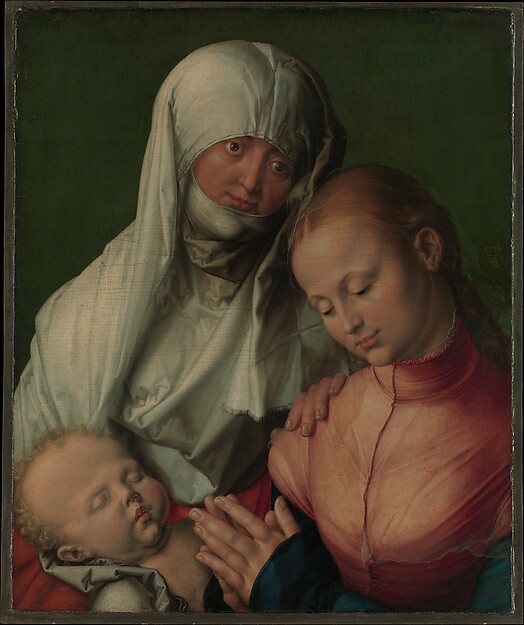
![Madonna and Child [obverse], Albrecht Dürer, c. 1496/1499](https://api.nga.gov/iiif/878db7e6-10ae-4cae-ba5d-6d6f5c413ae8/full/!2400,2400/0/default.jpg)
![Lot and His Daughters [reverse], Albrecht Dürer, c. 1496/1499](https://api.nga.gov/iiif/7565a449-f82a-414b-9bda-c93f55a51b4d/full/!2400,2400/0/default.jpg)