 Jacques CallotFrankrig, 1592–1635
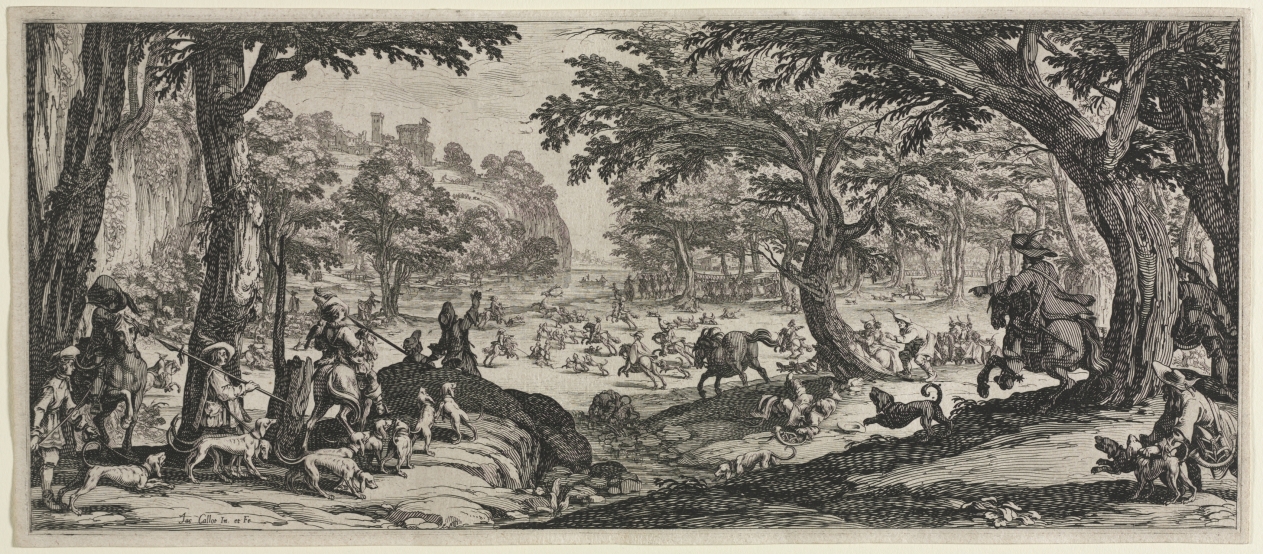
The Large Hunt
Må man se det?
Tager ikke imod for tiden

The Cleveland Museum of Art
Cleveland, USA
Det hører til samlingen, men er ikke udstillet for tiden.
- Kontrolleret
- Uændret siden
- Kilde
- Museets egne samlingsdata
Om værket
Jacques Callot (French, 1592-1635)
The Large Hunt, 1619
Etching
Gift of Margaret Crile Garretson in memory of Hiram Garretson 1970.342
Callot is known for two important inventions in etching. He designed a
slanted, oval-shaped, steel-tipped etching tool called an échoppe which is
used to imitate the tapering and swelling lines of an engraving. He also
developed a hard ground (an acid-resistant coating for etching plates),
composed of mastic and linseed oil, that resisted chipping. Callot's work
was significantly influenced by theater design. His organization of space,
usually into three distinct areas (although there are five in this
case)-foreground, middleground, and background-resembles stage sets of the
time. In fact, this work was probably inspired by a theater screen painted
by Federico Zuccaro in 1565.
Like Jacques Bellange, whose works are featured in galleries 109 and 110,
Read on
Callot was from Lorraine. He was one of the most prolific professional
printmakers of the 1600s. Trained as an engraver, he worked in Nancy,
France, the Low Countries, and in Florence for Grand Duke Cosimo II de'
Medici. His range of subjects was broad-religious scenes, theater and
pageants, court life, beggars, and landscapes.
The Cleveland Museum of Art
Oplysninger
- Inventarnummer
- 1970.342
I kataloget
Kilder
- The Cleveland Museum of Art: the museum's own open data · hentet for 7 dage siden
- Billede: The Cleveland Museum of Art — Museum open access
Imens i livet hos Jacques Callot
Hele livet1611–1621 · Virkested
Florence
1614–1621
At the court of Cosimo II de’ Medici
Under Parigi’s direction Callot works at the court of the Grand Duke of Tuscany Cosimo II de’ Medici in the Uffizi, designing festivals and theatrical performances — later these give him themes for his series of grotesque prints; during his Florentine years he becomes an independent master and often works for the Medici.
1617
Switches to hard ground and repeated biting
From 1617 Callot uses, instead of the soft ground customary until then, the acid-resistant hard ground of Florentine joiners and furniture-makers; it allows the plate to be bitten repeatedly, with parts of the spatial planes successively covered by varnish, and gives broad tonal gradations; he is also credited with the échoppe, an etching needle with a slanted end that produces a swelling line.
1621
Returns to Nancy after the death of Cosimo II
After the death of Grand Duke Cosimo II de’ Medici, Callot responds to Duke Charles IV of Lorraine’s wish to see him at his court and returns to Lorraine, where he is received with flattering honours; staying in Nancy, he sends his prints all over Europe, and Rembrandt becomes a keen collector of them.
1621–1635 · Virkested
Nancy