ART WIKI33.040 udstillet
KortSamlingKunstnereMuseerUdstillingerJournal
Log ind

ART WIKI

Hvor mesterværket hænger, og hvornår man bliver lukket ind.

Samlinger: Art Institute of Chicago, Det Russiske Museum, Eremitagen, Getty Villa, Harvard Art Museums, Hirshhorn Museum and Sculpture Garden, J. Paul Getty Museum, Louvre, Metropolitan Museum of Art, Minneapolis Institute of Art, Museum of Modern Art, National Gallery of Art, National Museum of Asian Art, National Portrait Gallery (Smithsonian), Pusjkinmuseet, Rijksmuseum Amsterdam, Smithsonian American Art Museum, Statens Museum for Kunst, The Cleveland Museum of Art, Tretjakovgalleriet, Victoria and Albert Museum, Whitney Museum of American Art, Ruslands statskatalog over museumsfonden (274 museer), Europeana (19 museer), Wikidata (6 museer), Paris Musées (12 museer) og Joconde, det franske kulturministeriums museumsdatabase (495 museer). Billederne tilhører deres rettighedshavere.

Afsnit

  • Kort
  • Søgning
  • Samling
  • Mesterværker
  • Udstillet nu
  • Kunstnere

Mere

  • Museer & gallerier
  • Udstillinger
  • Journal
  • Hvor data kommer fra
  • Privatliv & cookies
ForsideKortKatalog
  1. Samling/
  2. Minneapolis Institute of Art/
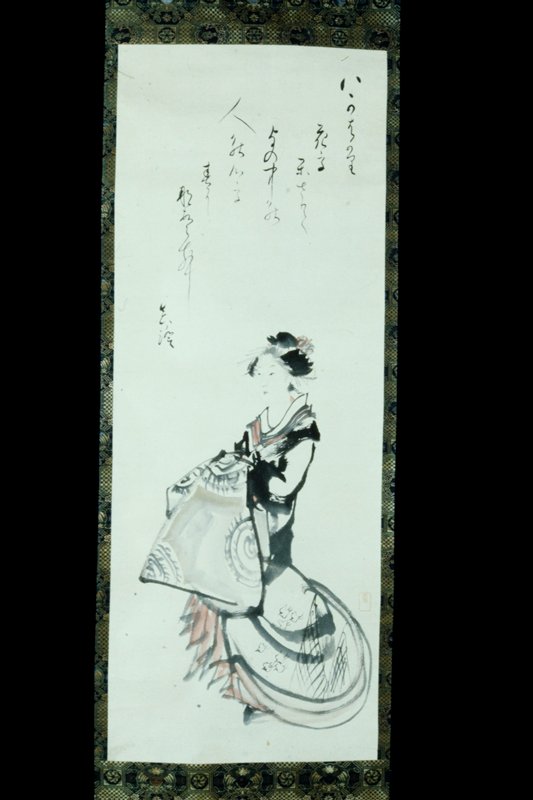
  3. Standing Courtesan
Standing Courtesan, Kitagawa Utamaro, 18th century
Kitagawa Utamaro, portrætKitagawa UtamaroJapan, 1754–1806

Standing Courtesan

18th century · Paintings, Calligraphy · 120 × 45 cm

Må man se det?

Tager ikke imod for tiden

Minneapolis Institute of Art

Minneapolis, USA

Det hører til samlingen, men er ikke udstillet for tiden.

Kontrolleret
for 9 dage siden
Uændret siden
25. sep. 2026
Kilde
Museet
På kortetMuseets side

Oplysninger

Inventarnummer
81.2.12

I kataloget

MalerierTuschJapansk maleriBarok1700-talletNikuhitsu ukiyo-e, Ukiyo-e, KitagawaJapan

Kilder

  • Minneapolis Institute of Art
  • Billede: Minneapolis Institute of Art — public domain

Imens i livet hos Kitagawa Utamaro

Hele livet
  1. 1753/1754

    Born

  2. 1775

    Meeting the publisher Tsutaya Jūzaburō

    By some accounts, in 1775 Utamaro meets the publisher Tsutaya Jūzaburō, who had an enormous influence on his work: many of his finest albums, illustrated books and series of single-sheet prints came out of their long collaboration. His first known work for Tsutaya, however, dates only from 1783.

  3. autumn 1782

    A banquet for his new name, Utamaro

    In the autumn of 1782, it is believed, Utamaro hosts a lavish banquet whose guests include the artists Kiyonaga, Kitao Shigemasa and Katsukawa Shunshō and the writers Ōta Nanpo and Hōseidō Kisanji. It is here that he is thought to have announced his new art name, handing out, as custom required, a specially made print, a self-portrait bowing deeply before a screen bearing his guests' names. By other accounts, he has used the pseudonym since 1781.

  4. c. 1783 – 1788

    Years in the publisher Tsutaya's house

    Probably from 1783, Utamaro lives for about five years in the house of Tsutaya Jūzaburō and becomes one of the principal artists of the Tsutaya firm. Evidence of his prints from these years is sporadic: he mostly illustrates books of kyōka, “crazy verse”, a parody of the classical waka form.

  5. c. 1791

    Giving up book prints for half-length portraits of beauties

    Around 1791 Utamaro gives up designing prints for books and concentrates on single portraits of women shown half-length, rather than the group scenes favoured by other ukiyo-e artists. He was the first in Japanese woodblock printing to use half-length compositions for women's portraits; none of his work from 1790–1792 has survived.

  6. 1797

    The death of his friend and patron Tsutaya Jūzaburō

    In 1797 Utamaro's long-time friend and supporter, the publisher Tsutaya Jūzaburō, dies; the artist is apparently very upset by the loss, and some commentators feel that his work never reached its former heights afterwards. He later lives in Kyūemon-chō, then Bakuro-chō, and finally near the Benkei Bridge.
Mere af Kitagawa Utamaro

Alle værker
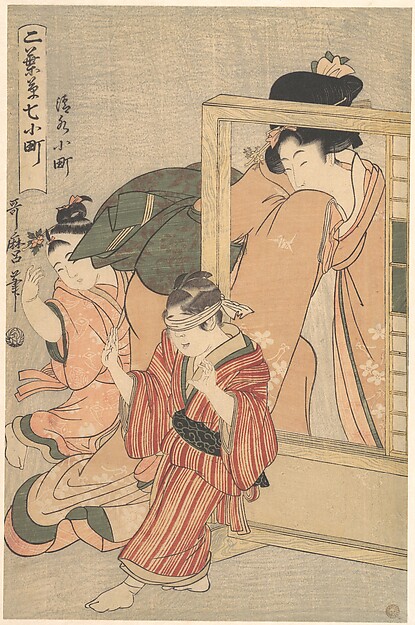
Kiyomizu Komachi, from the series Futabagusa nana Komachi, Kitagawa Utamaro, 1790s

Kiyomizu Komachi, from the series Futabagusa nana Komachi

1790s · Metropolitan Museum of Art

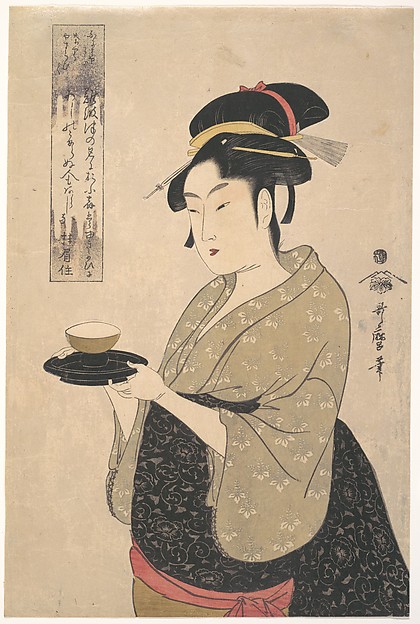
Okita of the Naniwa-ya Teahouse, Kitagawa Utamaro, ca. 1793

Okita of the Naniwa-ya Teahouse

ca. 1793 · Metropolitan Museum of Art

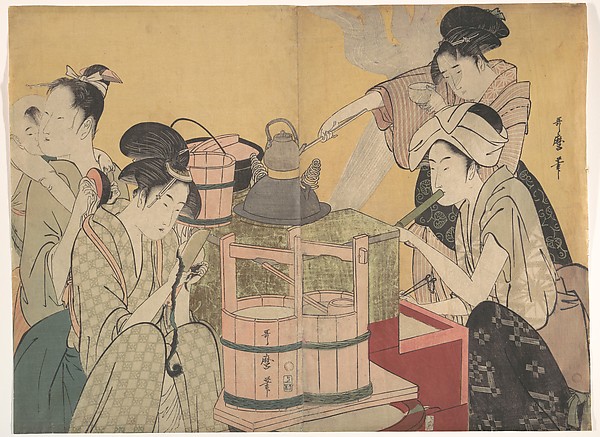
Kitchen Scene, Kitagawa Utamaro, ca. 1794–95

Kitchen Scene

ca. 1794–95 · Metropolitan Museum of Art

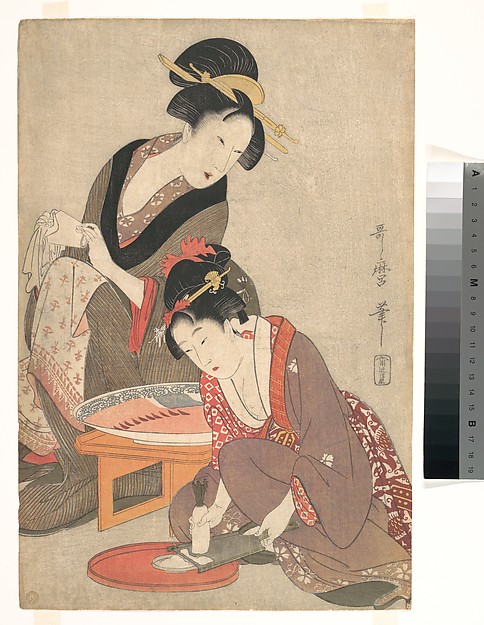
Women Grating Radish for Sashimi, Kitagawa Utamaro, ca. 1798–99

Women Grating Radish for Sashimi

ca. 1798–99 · Metropolitan Museum of Art

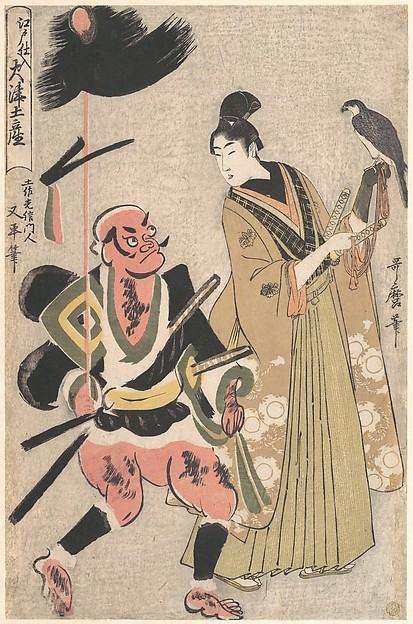
Foot-Soldier with a Spear and Hawk-Handler (Yari-mochi yakko to taka shō), from the series Souvenir Paintings from Ōtsu, Stocked in Edo (Edo Shi-ire Ōtsu Miyage), Kitagawa Utamaro, ca. 1802–3

Foot-Soldier with a Spear and Hawk-Handler (Yari-mochi yakko to taka shō), from the series Souvenir Paintings from Ōtsu, Stocked in Edo (Edo Shi-ire Ōtsu Miyage)

ca. 1802–3 · Metropolitan Museum of Art

Enjoying the Cool in a Garden, Kitagawa Utamaro, c. 1788/90

Enjoying the Cool in a Garden

c. 1788/90 · Art Institute of Chicago

House cleaning in preparation for the New Year, Kitagawa Utamaro, late 1790s

House cleaning in preparation for the New Year

late 1790s · Art Institute of Chicago

Seiro niwaka onna geisha no bu : Asazumabune Ogiuri Uta....., Kitagawa Utamaro, 1793

Seiro niwaka onna geisha no bu : Asazumabune Ogiuri Uta.....

1793 · Art Institute of Chicago

Naboer på Minneapolis Institute of Art

Museets side
Olive Trees, Vincent van Gogh, 1889

Vincent van Gogh

Olive Trees, 1889

Grainstack, Sun in the Mist, Claude Monet, 1891

Claude Monet

Grainstack, Sun in the Mist, 1891

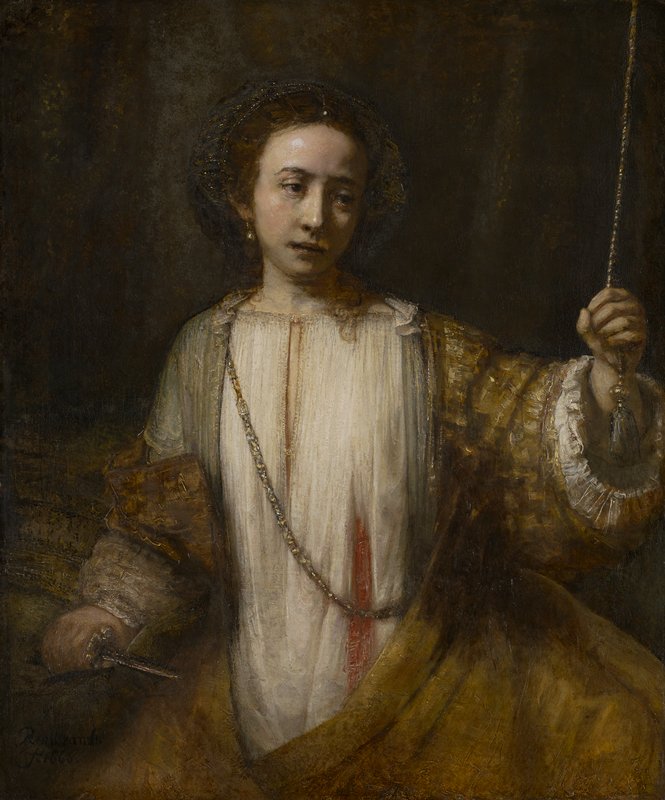
Lucretia, Rembrandt van Rijn, 1666

Rembrandt van Rijn

Lucretia, 1666

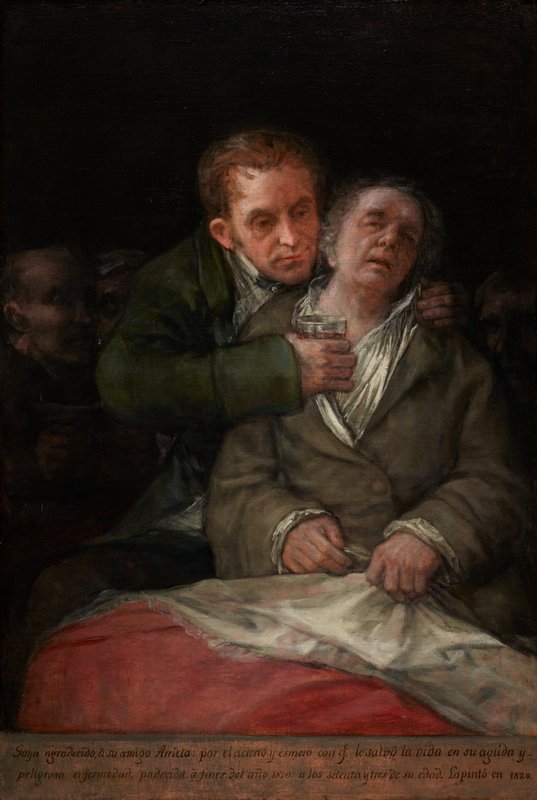
Self-Portrait with Dr. Arrieta, Francisco José de Goya y Lucientes, 1820

Francisco de Goya

Self-Portrait with Dr. Arrieta, 1820

Study for Improvisation V, Vassily Kandinsky, 1910

Vasily Kandinsky

Study for Improvisation V, 1910

Tahitian Landscape, Paul Gauguin, 1891

Paul Gauguin

Tahitian Landscape, 1891

Chestnut Trees at Jas de Bouffan, Paul Cézanne, c. 1885–86

Paul Cézanne

Chestnut Trees at Jas de Bouffan, c. 1885–86

The Union of England and Scotland (Charles I as the Prince of Wales), Peter Paul Rubens, 1633–34

Peter Paul Rubens

The Union of England and Scotland (Charles I as the Prince of Wales), 1633–34