 Caspar David FriedrichTyskland, 1774–1840
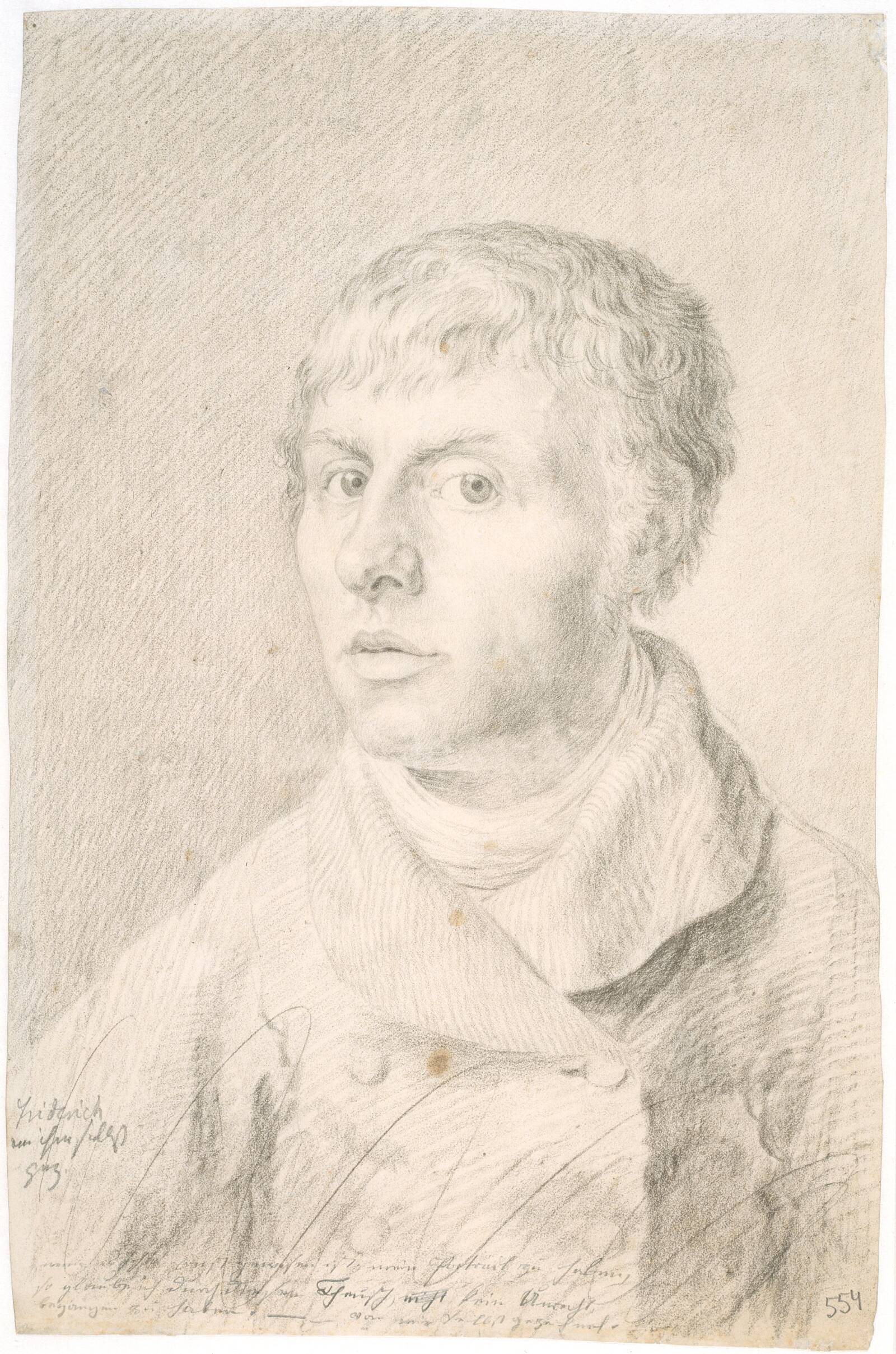
Selvportræt
Kan det ses?
Ikke udstillet lige nu
Hvor er »Selvportræt« i dag? Samling: Statens Museum for Kunst, København. Ikke udstillet lige nu. Kontrolleret 29. september 2026.

København, Danmark
Det hører til samlingen, men er ikke udstillet for tiden.
- Kontrolleret
- Uændret siden
- Kilde
- Museet
Oplysninger
- Inventarnummer
- KKSgb5006
I kataloget
Kilder
- Statens Museum for Kunst
- Billede: Statens Museum for Kunst — public domain
Imens i livet hos Caspar David Friedrich
Hele livet1794–1798
Copenhagen: casts, life drawing and Dutch landscape painters
At the prestigious Copenhagen Academy Friedrich begins by copying casts of antique sculpture before moving on to drawing from life, and the Royal Picture Gallery opens up to him 17th-century Dutch landscape painting. His teachers Lorentzen and Juel, inspired by Sturm und Drang, stand at a midpoint between the budding Romantic aesthetic and the waning neoclassical ideal.
after 1798
The Dresden Romantics: Tieck, Novalis, Kleist, Runge
Friedrich grows close to a circle of Romantics that includes Ludwig Tieck, Novalis, Heinrich von Kleist and Philipp Otto Runge, and he is also a friend of the natural philosopher and painter Carl Gustav Carus. Together with Runge he is regarded as the foremost representative of early German Romanticism and the leader of the Dresden Romantics.
1798 · Virkested
Dresden
1798–1804
Etchings and woodcuts
In Dresden Friedrich experiments with etching and makes designs for woodcuts that his furniture-maker brother cuts: by 1804 he has produced 18 etchings and four woodcuts, apparently in small numbers and distributed only to friends. His main media remain ink, watercolour and sepia, and he does not work extensively in oils until his reputation is more established.
from 1801
Trips in search of motifs from 1801
From 1801 Friedrich makes frequent trips in search of motifs to the Baltic coast, Bohemia, the Krkonoše and the Harz Mountains. He makes his studies almost exclusively in pencil, with topographical notes, while the subtle atmospheric effects that become his trademark are painted later from memory.