 Caspar David FriedrichTyskland, 1774–1840
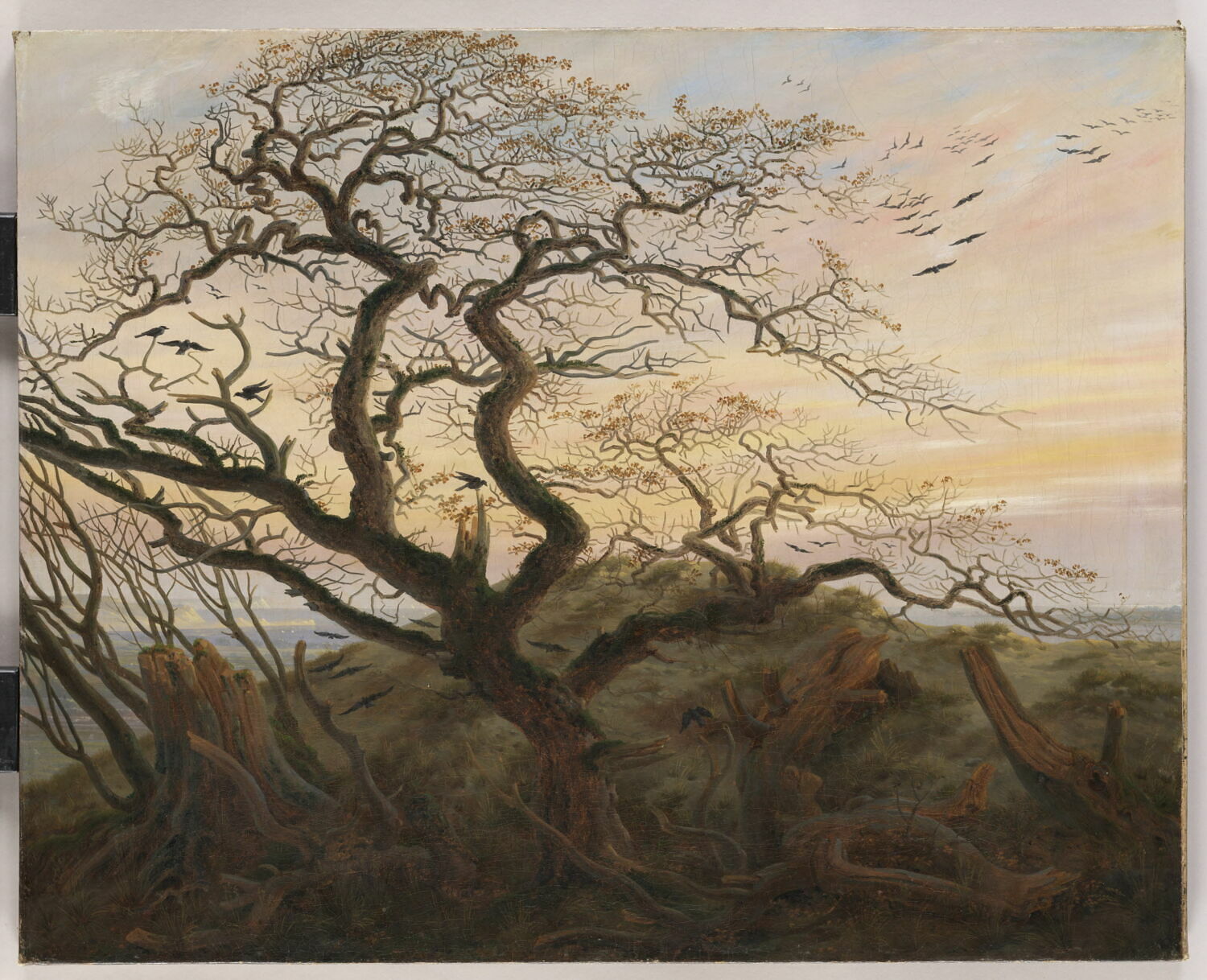
Kragernes træ
L'arbre aux corbeaux
Må man se det?
Ja, det tager imod

Udstillet for publikum.
- Kontrolleret
- Uændret siden
- Kilde
- Museet
Om maleriet
The Tree of Crows (also known as Raven Tree) is an oil painting by the German Romantic artist Caspar David Friedrich, from 1822. Acquired by the Louvre in 1975 (the institution's first acquisition of a work by the artist, followed by Seaside by Moonlight in 2000), it has been called one of Friedrich's "most compelling paintings." The painting depicts a twisted oak tree, bare but for a few dead leaves, seen against an evening sky. An inscription on the back of the canvas refers to the hill at the painting's center as a Hünengrab, or dolmen, a prehistoric burial ground. In the distance can be seen the ocean, and Cape Arkona's chalk cliffs, a favorite subject of Friedrich's. Two crows are perched on the oak, while a flock (also known, more correctly, as a "murder") descends toward it. In the darkened foreground are a hacked trunk and the upright stump of another oak.
Læs videre
The oak is based on a drawing dated 3 May 1809, to which Friedrich added branches at the left and elongated others so as to stretch its forms across the picture plane; the tree in the painting has the overall shape of a rhombus, its web of contorted branches taking on a dramatic presence. Contrasted with the serene layers of chromatic clouds, the tree's forms have been likened to "many flailing arms." The foreground may be seen as representing death, with the distant sky offering consoling beauty and the promise of redemption afterlife.
A single dominant oak was also the subject of two later vertical compositions painted by Friedrich. In those paintings, the trees appear to stand in resignation, whereas that of The Tree of Crows seems animated by desperation.
Oplysninger
- Inventarnummer
- RF 1975 20
I kataloget
Kilder
- Louvre
- Billede: Louvre — © 2022 GrandPalaisRmn (musée du Louvre) / Franck Raux
Imens i livet hos Caspar David Friedrich
Hele livet1820
Grand Duke Nikolai Pavlovich in his studio
At the behest of his wife Alexandra Feodorovna, Grand Duke Nikolai Pavlovich visits Friedrich’s studio and returns to Saint Petersburg with a number of paintings, beginning a patronage that continues for many years.
by 1820
A recluse, “the most solitary of the solitary”
By 1820 Friedrich is living as a recluse, described by friends as the most solitary of the solitary.
1820
The birth of his daughter Emma
The Friedrichs’ first child, a daughter named Emma, is born; they will have three children. The third, Gustav Adolf, is named after the Swedish king Gustavus Adolphus and becomes a notable painter in his own right.
1821
Meets Zhukovsky
In 1821 the Romantic poet Vasily Zhukovsky, an admirer of his work, visits Friedrich’s studio: he buys several paintings and keeps them all his life. The friendship that begins lasts until the artist’s death, and thanks to Zhukovsky Friedrich becomes popular in Russia — today Russian museums hold 17 of his paintings, 15 of them in the Hermitage.
23. december 1824
Son born: Adolf Friedrich
1824–1826
Depression and darker motifs
A new bout of depression — earlier ones came in 1799, 1803–1805, around 1813 and in 1816 — brings vultures, owls, graveyards and ruins into his work. From 1826 these motifs become a permanent feature of his output, and his colours grow darker and more muted.