Henry MooreEngland, 1898–1986
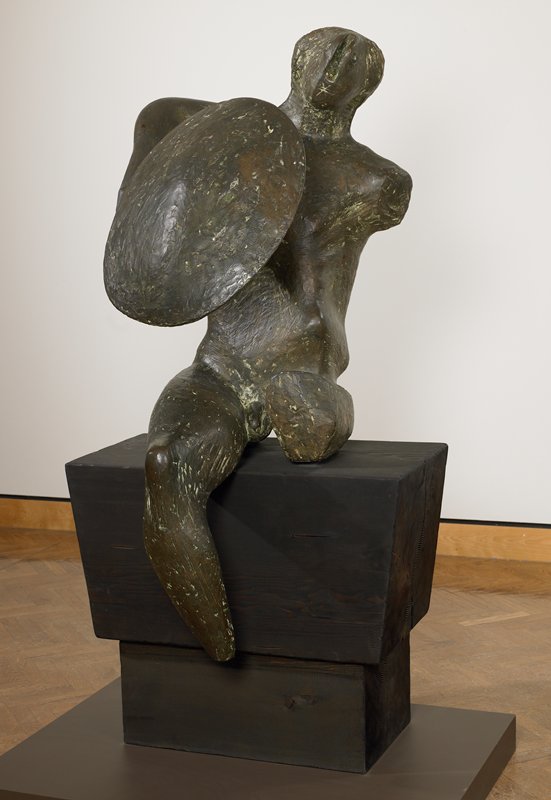
Seated Woman
Må man se det?
Ja, det tager imod
J. Paul Getty Museum
Los Angeles, USA
SalMuseum West Pavilion, The Fran and Ray Stark Sculpture Terrace
Udstillet for publikum. Hvem der står inde for det, står nedenfor.
- Kontrolleret
- Uændret siden
- Kilde
- Museets egne samlingsdata
Om skulpturen
Although willfully distorted, this large bronze form remains instantly identifiable as a seated woman. The figure's lower half has been reduced to a bulbous mass that rests atop a minimally articulated stool. The top half is more contorted, yet plainly recognizable as a female torso. The woman's head turns distractedly to one side and, though lacking in anatomical specificity, achieves a surprising degree of expression. The creation of this sculpture reveals the lengthy gestation period that sometimes accompanied Henry Moore's work. In the late 1950s, he made a *maquette* or small plaster model of this seated figure. Once he had achieved the desired shape, one of Moore's studio assistants then carved a plaster mold of the *maquette* to be sent to a foundry for casting in bronze. But Moore, unsatisfied with the large mold, chose not to have it cast and continued to refine the plaster. It remained in his studio for many years and was finally cast in 1975--more than two decades after the original design was conceived.
J. Paul Getty Museum
Oplysninger
- Inventarnummer
- 2005.117.3
I kataloget
Kilder
- J. Paul Getty Museum: museets åbne data · hentet i forgårs
- Billede: J. Paul Getty Museum — ; In Copyright
Imens i livet hos Henry Moore
Hele livet1940–1986
A bomb in Hampstead: the move to Hoglands
In September 1940 bomb shrapnel hit the Moores’ Hampstead home and they left London for Hoglands, a farmhouse in the hamlet of Perry Green near Much Hadham in Hertfordshire. It remained Moore’s home and workshop for the rest of his life; though he grew wealthy he never felt the need to move to larger premises.
11. juli 1959 – 11. oktober 1959
Exhibition: Documenta II
28. juni 1964 – 6. oktober 1964
Exhibition: Documenta III
1971–1974
A gift to Toronto: the Henry Moore Sculpture Centre
In 1974 the Henry Moore Sculpture Centre opened at the Art Gallery of Ontario in Toronto, the world’s largest public collection of Moore’s work, most of it donated by him between 1971 and 1974.
summer 1972
An exhibition at the Forte di Belvedere, Florence
In the summer of 1972 a major retrospective of Moore’s work was held in the grounds of the Forte di Belvedere overlooking Florence, one of several large shows held around the world in the last three decades of his life.
1972–1977
The Henry Moore Trust and Foundation
As his wealth grew Moore worried about his legacy, and with the help of his daughter Mary set up the Henry Moore Trust in 1972 to protect his estate from death duties. By 1977 he was paying nearly a million pounds a year in income tax and established the Henry Moore Foundation as a charity, with Irina and Mary as trustees, to encourage public appreciation of the visual arts and especially of his own work.