 Francisco de ZurbaránSpanien, 1598–1664
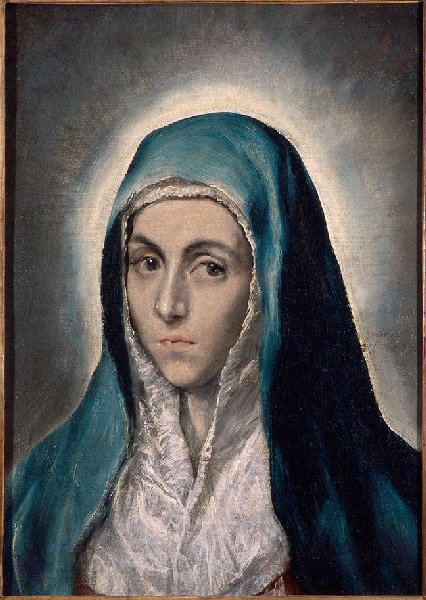
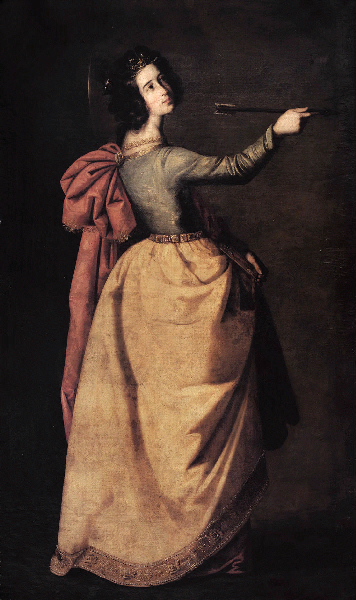
Sainte Ursule
Kan det ses?
Ukendt
Hvor er »Sainte Ursule« i dag? Samling: Musée des Beaux-Arts de Strasbourg, Strasbourg. Ukendt.
Strasbourg, Frankrig
Ejeren er kendt; om værket er udstillet i dag, vides ikke.
- Uændret siden
- Kilde
- Museet
Oplysninger
- Inventarnummer
- MBA 288 ; 44.R.103 (N° récolement)
Hvad det viser
I kataloget
Kilder
- Musée des Beaux-Arts de Strasbourg
- Billede: Musée des Beaux-Arts de Strasbourg — © Service photographique des Musées de Strasbourg, © PLISSON; Ministère de la Culture (France), base Joconde
Imens i livet hos Francisco de Zurbarán
Hele livet1614–1658 · Virkested
Seville
1634
Madrid: the “Labours of Hercules” for the Buen Retiro
In 1634 Zurbarán travels to Madrid, where for the newly built Buen Retiro palace he departs from religious subjects: he paints a cycle of ten canvases of the deeds of Hercules (now in the Prado) and the historical composition “The Defence of Cádiz”. Studying the work of Italian painters and meeting other leading masters in the capital enriches his art.
late 1630s
The workshop produces for export to South America
From the late 1630s Zurbarán’s workshop produces many paintings for export to South America. “Jacob and His Twelve Sons” seems to have been aimed at the South American market too, but the originals were acquired for Auckland Castle in England.
May 1639
The death of his wife Beatriz de Morales
In May 1639 Zurbarán’s second wife, Beatriz de Morales, dies.
after 1640
His austere style gives way to Murillo’s
After 1640 Zurbarán’s austere, harsh, hard-edged style is unfavourably compared to the sentimental religiosity of Murillo, and his reputation declines.