 Isaac Levitan1860–1900
Пасека
Må man se det?
Ukendt: museet holder tæt

Tretjakovgalleriet
Moskva, Rusland
Ejeren er kendt. Om det er udstillet i dag, siger museet ikke, og at gætte har vi ikke lært.
- Kilde
- Museets egne samlingsdata
About the painting
In the museum's own words — the original
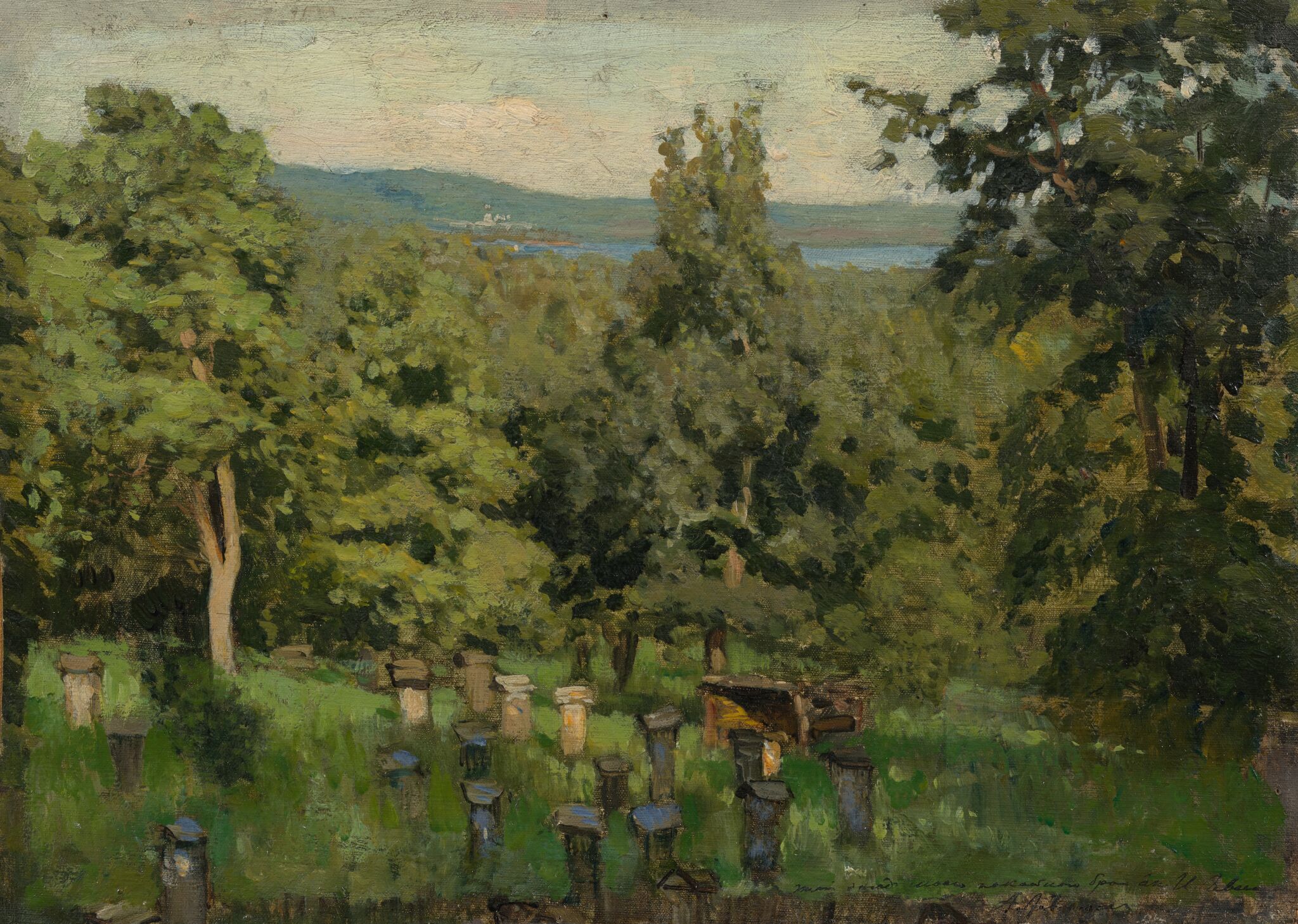
Этюд «Пасека» был написан Исааком Левитаном для картины «Разлив на Суре» (1887, частное собрание, Москва). В мае-июне 1887 года художник совершил свою первую поездку на Волгу. Обосновался он в городке Васильсурск Нижегородской губернии, примечательном своей пристанью на правом берегу Волги при впадении в нее одного из самых больших притоков, многоводной извилистой реки Суры. Позади Васильсурска находилась гора, по скату и у подошвы которой расположились деревянные дома жителей. Очарованный живописностью ландшафта, особой атмосферой покоя и умиротворенности местечка, Левитан создал множество этюдов.
Read on
На этюде «Пасека» художник изобразил пчелиные ульи среди густой зелени деревьев и кустарников прибрежного лесного массива, освещенного ярким летним солнцем в утреннюю пору. Вдали видны река с левым пологим берегом и спускающимся к нему городком, подернутым серебристо-голубой воздушной пеленой. Пейзаж безлюден, но в нем явственно ощущается присутствие человека. Это достигается мастерской передачей художником жизни природы в погожий летний день, согласованностью зеленых, оливковых, коричневатых и серебристо-голубых красок, выверенностью всех частей замкнутой композиции. Все это создает ощущение уюта и гармонии, близких душе человека, живущего в согласии с окружающим миром. Особую прелесть изображенному виду придают аккуратные пчелиные ульи – свидетельство освоенности пейзажа местными жителями.
Tretjakovgalleriet
Oplysninger
- Inventarnummer
- 9116
Kilder
- Tretjakovgalleriet: the museum's own open data · hentet for 5 dage siden
- Billede: Tretjakovgalleriet — © State Tretyakov Gallery
Imens i livet hos Isaac Levitan
Hele livetmid-1880s
His heart disease sharply worsens
Levitan's material situation improves in the mid-1880s, but a hungry childhood, an unsettled life and hard work tell on his health: his heart disease sharply worsens.
spring 1885
He graduates without the title of artist
In spring 1885, at twenty-four, he graduates from the school but does not receive the title of artist: he is given a diploma as a teacher of penmanship. He has no money.
April 1885
He settles at Maximovka and meets Chekhov
In April 1885 he settles in the remote village of Maximovka near Babkino, where the Chekhovs are staying at the Kiselyov estate; his acquaintance with Anton Pavlovich Chekhov begins a friendship and rivalry that will last all his life.
1886
The Crimea and an exhibition of fifty landscapes
A trip to the Crimea in 1886 restores his strength; on his return Levitan organises an exhibition of fifty of his landscapes.
spring 1888
He discovers Plyos on the Volga
In spring 1888 he sails by steamer along the Oka to Nizhny Novgorod and on up the Volga with the artist Alexei Stepanov and Sofia Kuvshinnikova; to their own surprise they discover the small, quiet town of Plyos and decide to stay on for a while. The three summer seasons there (1888–1890) prove extremely productive: some two hundred works bring Levitan wide fame.
late 1889 – early 1890
His first trip to Western Europe
He visits France and Italy, wanting to get to know modern painting better as shown at the World Exhibition in Paris — probably above all the Barbizon school and the Impressionists. According to Nesterov, in the West he became convinced that the path he had chosen was the right one.