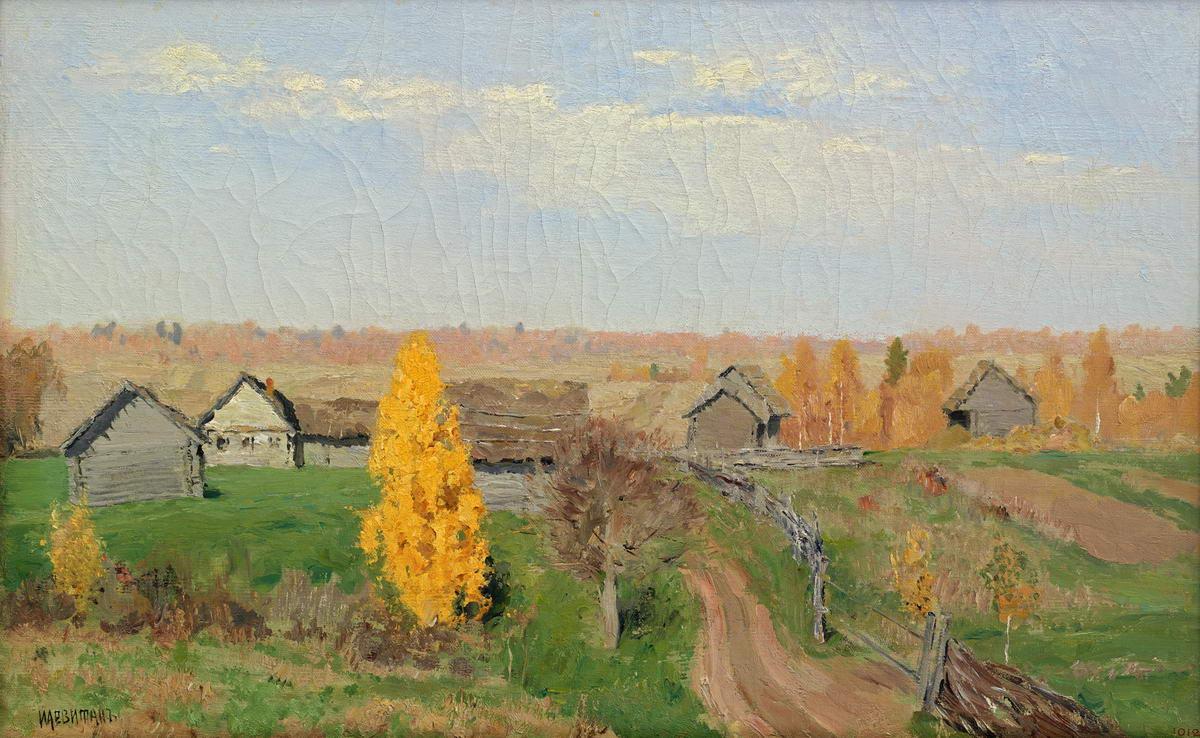
Isaac Levitan1860–1900
Birch grove
Kan det ses?
Ukendt
Hvor er »Birch grove« i dag? Samling: Tretjakovgalleriet, Moskva. Ukendt.

Moskva, Rusland
Ejeren er kendt; om værket er udstillet i dag, vides ikke.
- Kilde
- Museet
Om maleriet
Med museets ord — på russisk
«Левитан показал нам то скромное и сокровенное, что таится в каждом русском пейзаже, – его душу, его очарование» – писал о художнике Михаил Нестеров. Левитану суждено было стать основоположником нового направления в русской пейзажной живописи – «пейзажа-настроения». Созданные им образы природы пронизаны желанием выразить «божественное нечто, разлитое повсюду», – их музыкальные ассоциации колеблются от звонких, пронзительных, мажорных нот до симфоний настоящей скорби и тоски от неотвратимости хода времени, всепоглощающей стихии – как это выразилось в программном его произведении «Над вечным покоем» (1894).
Læs videre
Картина «Березовая роща» является одним из примеров обращения художника к импрессионистическим приемам живописи. Аромат солнечного дня, шелест березовых листьев, прохлада изумрудной травы в тени деревьев – такой удивительной осязательности достигает мастер в этой работе. Вибрирующим мазком кисти мастер передает малейшие цветовые градации в изображении зелени берез, их белоснежных стволов, лучей солнца. «Березовая роща» Левитана представляет собой будто выхваченный случайно «кадр» из жизни природы. Это сообщает полотну жизненность, вовлекая зрителя в дышащее свежим летним воздухом царство природы.
Tretjakovgalleriet
Oplysninger
- Inventarnummer
- 15511
I kataloget
Kilder
- Tretjakovgalleriet
- Billede: Tretjakovgalleriet — Museum open access
Imens i livet hos Isaac Levitan
Hele livet1887
His first trip to the Volga: the river seems dreary
In 1887 he at last fulfils his dream and goes to the Volga, which his teacher Savrasov had painted so movingly (in the early 1880s his sister's illness had prevented the trip). In cold, overcast weather the river disappoints him: it seems to him dreary and dead.
late 1880s – early 1890s
Heads the landscape class at Gunst's school
In the late 1880s and early 1890s he heads the landscape class at the School of Fine Arts of the artist-architect A. O. Gunst.
spring 1888
He discovers Plyos on the Volga
In spring 1888 he sails by steamer along the Oka to Nizhny Novgorod and on up the Volga with the artist Alexei Stepanov and Sofia Kuvshinnikova; to their own surprise they discover the small, quiet town of Plyos and decide to stay on for a while. The three summer seasons there (1888–1890) prove extremely productive: some two hundred works bring Levitan wide fame.
late 1889 – early 1890
His first trip to Western Europe
He visits France and Italy, wanting to get to know modern painting better as shown at the World Exhibition in Paris — probably above all the Barbizon school and the Impressionists. According to Nesterov, in the West he became convinced that the path he had chosen was the right one.
summer 1890
Yuryevets: the idea of “A Quiet Monastery”
In summer 1890 he goes to Yuryevets and, among many landscapes and studies, paints “View of the Krivoozersky Monastery”; this is how the idea of “A Quiet Monastery” is born. The picture made a strong impression on Chekhov.
March 1891
Admitted to the Peredvizhniki Association
In March 1891 he becomes a member of the Association of Travelling Art Exhibitions.