
 John CageUSA, 1912–1992
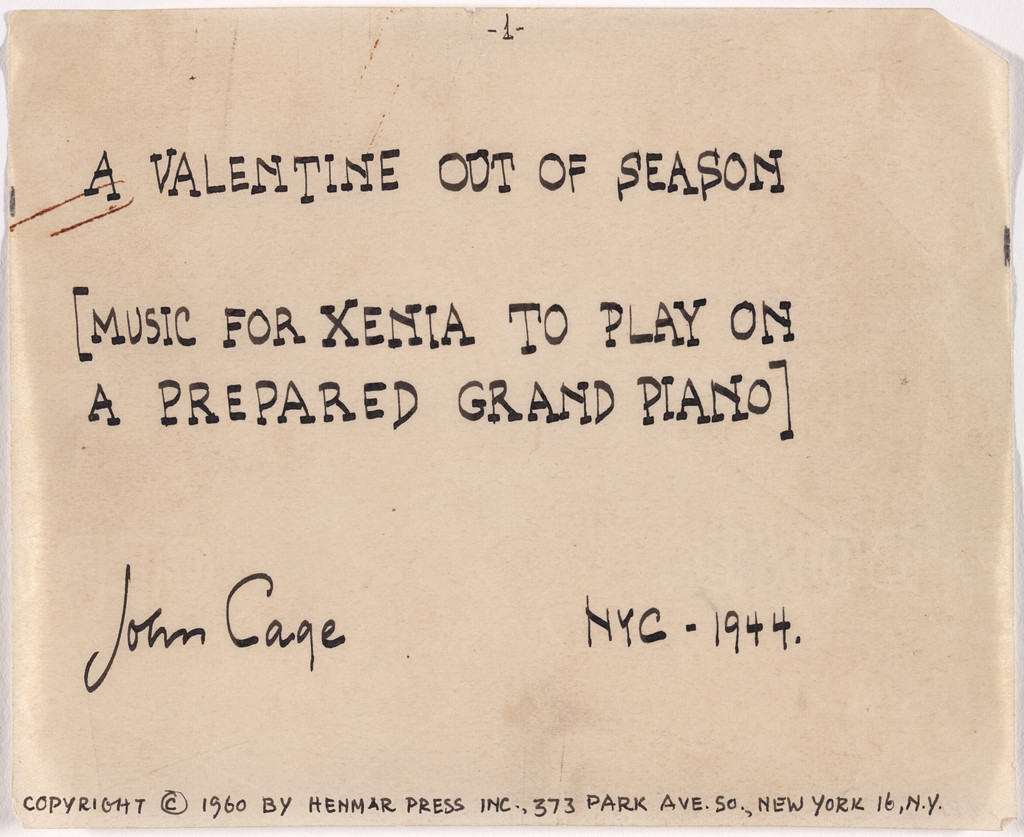
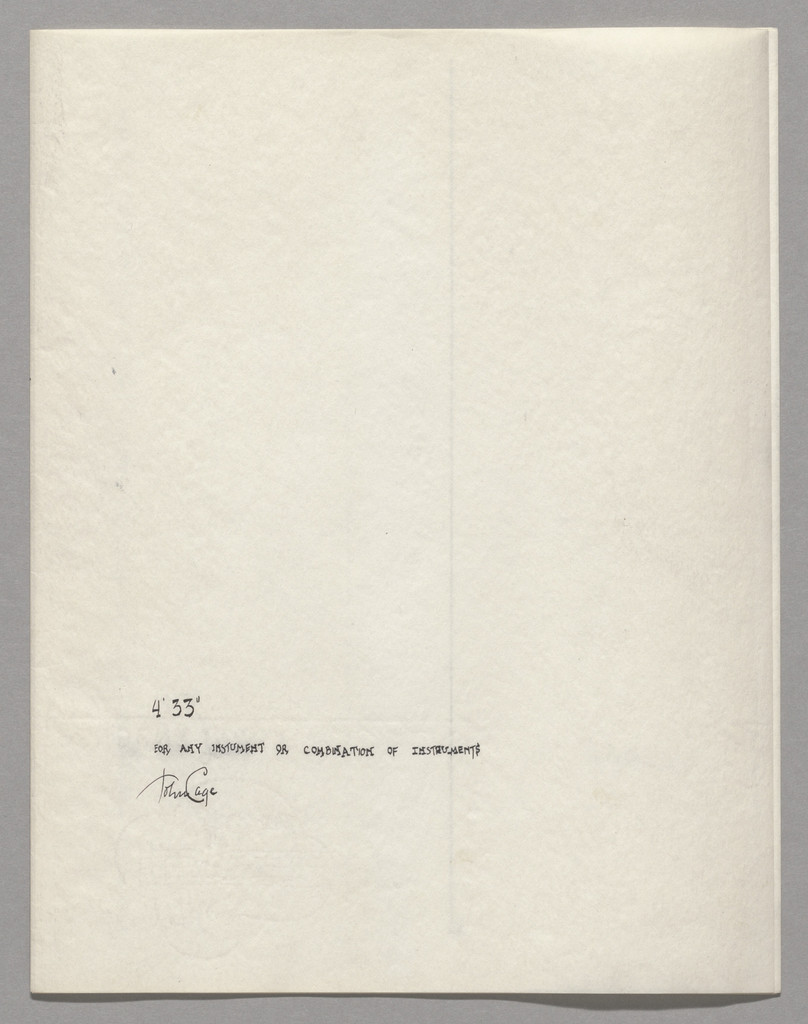
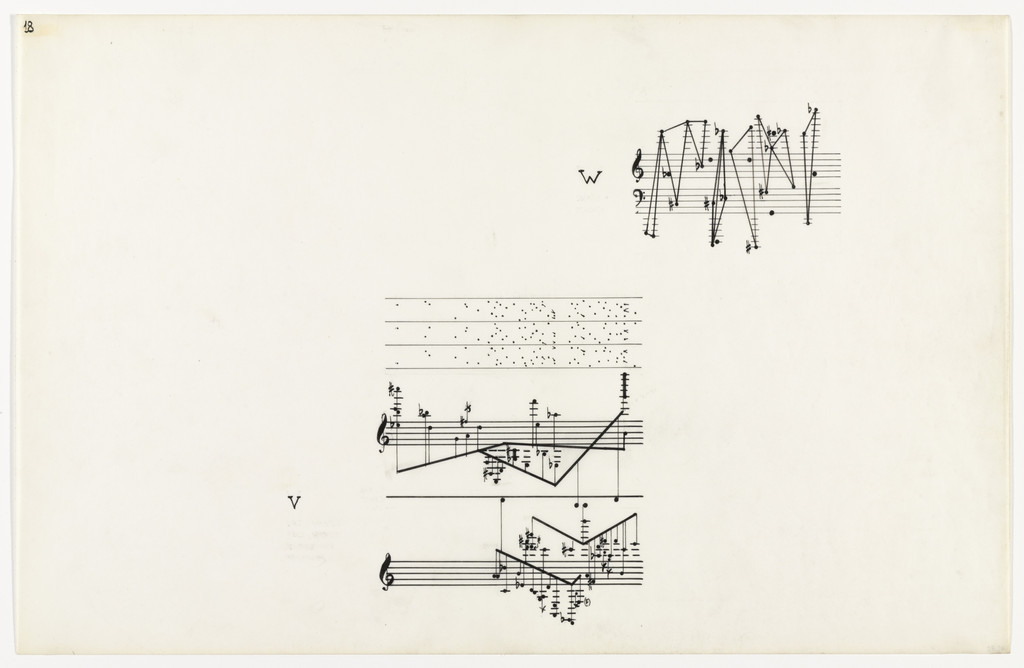
Music Walk (Notation Plan)
Må man se det?
Tager ikke imod for tiden

National Gallery of Art
Washington, D.C., USA
Det hører til samlingen, men er ikke udstillet for tiden.
- Kontrolleret
- for 18 timer siden
- Uændret siden
- 19. aug. 2026
- Kilde
- Museets egne samlingsdata
Oplysninger
- Inventarnummer
- 1991.241.42
What it shows
I kataloget
Kilder
- National Gallery of Art: the museum's own open data · hentet for 5 dage siden
- Billede: National Gallery of Art — © the artist or rights holder
Imens i livet hos John Cage
Hele livet1950s
Chance wrecks his reputation
The adoption of chance procedures has disastrous consequences for Cage's reputation: the press, which used to react favourably to his percussion and prepared-piano music, ignores his new works, and many valuable friendships and connections are lost. Boulez, who used to promote Cage's work in Europe, opposes his particular use of chance, as do other composers who came to prominence in the 1950s, such as Stockhausen.
1956–1961
The New School class and Fluxus
From 1956 to 1961 Cage teaches classes in experimental composition at The New School in New York (from 1956 to 1958 he also works as an art director and designer of typography); most of his students are visual artists with little or no musical background: Jackson Mac Low, Allan Kaprow, Al Hansen, George Brecht, Ben Patterson, Dick Higgins. The classes influence the formation of Fluxus; Cage met Kaprow, who coined the term “happenings”, on a mushroom hunt with George Segal and invited him to join his class.
1957
The lecture “Experimental Music”
In his 1957 lecture “Experimental Music” Cage describes music as “a purposeless play” — an affirmation of life, not an attempt to bring order out of chaos or to suggest improvements in creation, but simply a way of waking up to the very life we are living.
1960
Wesleyan University and Norman O. Brown
From the 1950s until his death Cage collaborates with the music department of Wesleyan University in Middletown, where the philosopher, poet and classicist Norman O. Brown befriends him — an association fruitful to both. In 1960 Cage is appointed a fellow on the faculty of the Center for Advanced Studies and starts teaching classes in experimental music.
October 1960
Cologne: Paik cuts Cage's tie
In October 1960 Mary Bauermeister's Cologne studio hosts a joint concert by Cage and the video artist Nam June Paik, Cage's friend and mentee; in the course of his performance of “Etude for Piano” Paik cuts off Cage's tie and pours a bottle of shampoo over the heads of Cage and Tudor.
from 1960 until the early 1970s
Arthritis: Cage stops performing in public
Arthritis troubles Cage from 1960, and by the early 1970s his hands are painfully swollen, so that he can no longer perform — “Cheap Imitation” is the last work he plays in public — and manuscripts for publication, previously done in his calligraphic script, now have to be completed by assistants. On top of this, David Tudor leaves performing for composition in the early 1970s, and Cage, for the first time in two decades, has to rely on other performers — Grete Sultan, Paul Zukofsky, Margaret Leng Tan and many others.





![Scenes from the Passion of Christ: The Descent into Limbo [right panel], Andrea Vanni, 1380s](https://api.nga.gov/iiif/4205a539-eadd-4486-89a7-3cff9c1ba428/full/!2400,2400/0/default.jpg)


