 Ai WeiweiKina, 1957
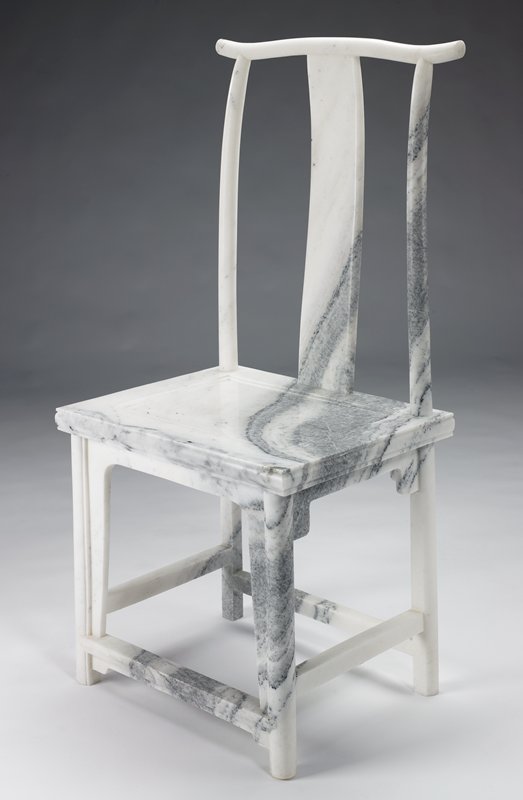
Marble Chair
Må man se det?
Ja, det tager imod

Minneapolis Institute of Art
SalG373Minneapolis, USA
Udstillet for publikum. Hvem der står inde for det, står nedenfor.
- Kontrolleret
- i forgårs
- Uændret siden
- 25. sep. 2026
- Kilde
- Museets egne samlingsdata
About the sculpture
Ai Weiwei persistently questions the conventions and traditions of his Chinese heritage, and his work often draws upon personal experience. Marble Chair is a conceptual, sculptural response to the systematic destruction of Chinese culture that began during the Cultural Revolution (1966–76). Hewn from a single block of marble to resemble a traditional yoke‑back chair, Marble Chair is a small-scale monument to one of the few objects Ai’s family was allowed to keep when they were sent into exile. Ai’s collaborations with highly skilled artisans, in this case marble carvers, are a means of elevating and conserving traditional skills. As a superb piece of craftsmanship, Marble Chair is also a poignant symbol of China’s position as the world’s largest manufacturing center.
Minneapolis Institute of Art
Oplysninger
- Inventarnummer
- 2010.24
I kataloget
Kilder
- Minneapolis Institute of Art: the museum's own open data · hentet for 5 dage siden
- Billede: Minneapolis Institute of Art — Copyright © Ai Weiwei 2008
Imens i livet hos Ai Weiwei
Hele livet16. juni 2007 – 23. september 2007
Exhibition: documenta 12
2009
The “So Sorry” exhibition at Haus der Kunst
In 2009 Ai’s exhibition “So Sorry” was held at the Haus der Kunst museum in Munich; the documentary “So Sorry” (2011) made by his studio takes its name from it.
20 March 2009
Launches the “Citizens’ Investigation”
To find the names of the schoolchildren who died in the earthquake because of substandard school buildings, Ai recruited volunteers online and on 20 March 2009 posted a blog entry calling for a “Citizens’ Investigation”. By 14 April 2009 the list held 5,385 names.
August 2009
Beaten by the police in Chengdu
Ai went to Chengdu to testify at the trial of Tan Zuoren, a fellow investigator of the schoolchildren’s deaths in the earthquake; the police beat him badly.
14 September 2009
Emergency brain surgery in Munich
After the beating in Chengdu Ai travelled to Munich to prepare his exhibition at Haus der Kunst; in a Munich hospital he was diagnosed with internal bleeding, and the doctor arranged emergency brain surgery. The cerebral haemorrhage is believed to be linked to the police attack.
October 2010
“Sunflower Seeds” in Tate Modern’s Turbine Hall
Tate Modern’s Turbine Hall opened an installation of 100 million hand-painted porcelain sunflower seeds, made by 1,600 Chinese workers. Walking on the carpet of seeds was soon stopped because the porcelain dust was a health hazard.