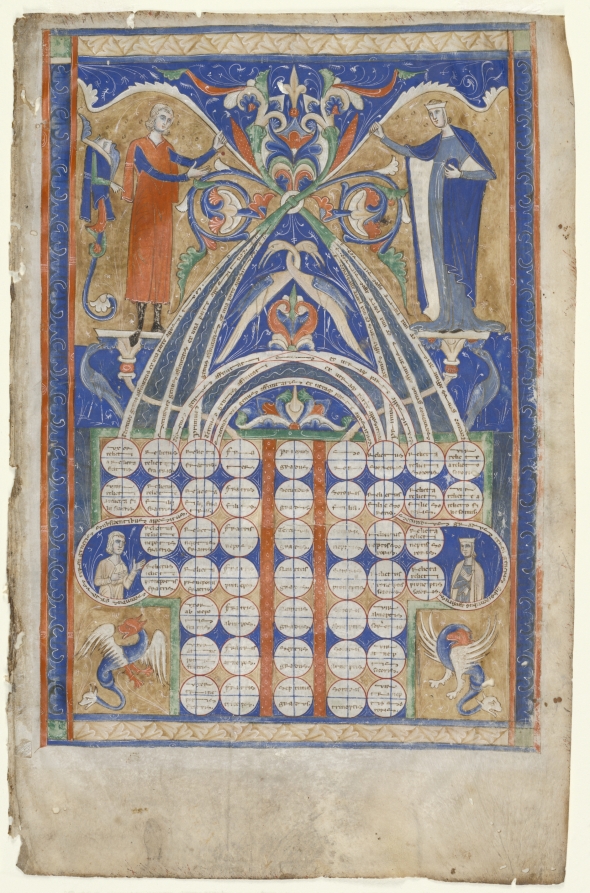
Leaf from Gratian's Decretum: Table of Affinity
Kan det ses?
Ikke udstillet lige nu
Hvor er »Leaf from Gratian's Decretum: Table of Affinity« i dag? Samling: The Cleveland Museum of Art, Cleveland. Ikke udstillet lige nu. Kontrolleret 12. oktober 2026.

Cleveland, USA
Det hører til samlingen, men er ikke udstillet for tiden.
- Kontrolleret
- Uændret siden
- Kilde
- Museet
Om maleriet
These leaves were excised from a copy of the handbook of canon law known simply as the Decretum written by Gratian, an Italian Camaldolese monk, in Bologna around 1130-40. The Decretum was widely copied and consulted throughout the Middle Ages.
These tables were used to determine relationships created by marriage. During the Middle Ages such relationships of "affinity" could be impediments to subsequent marriages if one partner were to die. In the direct line, for example, a man may not marry his mother-in-law or his daughter-in-law, while in the collateral line a man may not marry his uncle's wife or his wife's first cousin or niece. Like Tables of Consanguinity, Tables of Affinity were used by church officials to approve or deny marriages.
The Cleveland Museum of Art
Oplysninger
- Inventarnummer
- 1929.435.1
I kataloget
Kilder
- The Cleveland Museum of Art
- Billede: The Cleveland Museum of Art — Museum open access