 Eugène DelacroixFrankrig, 1798–1863
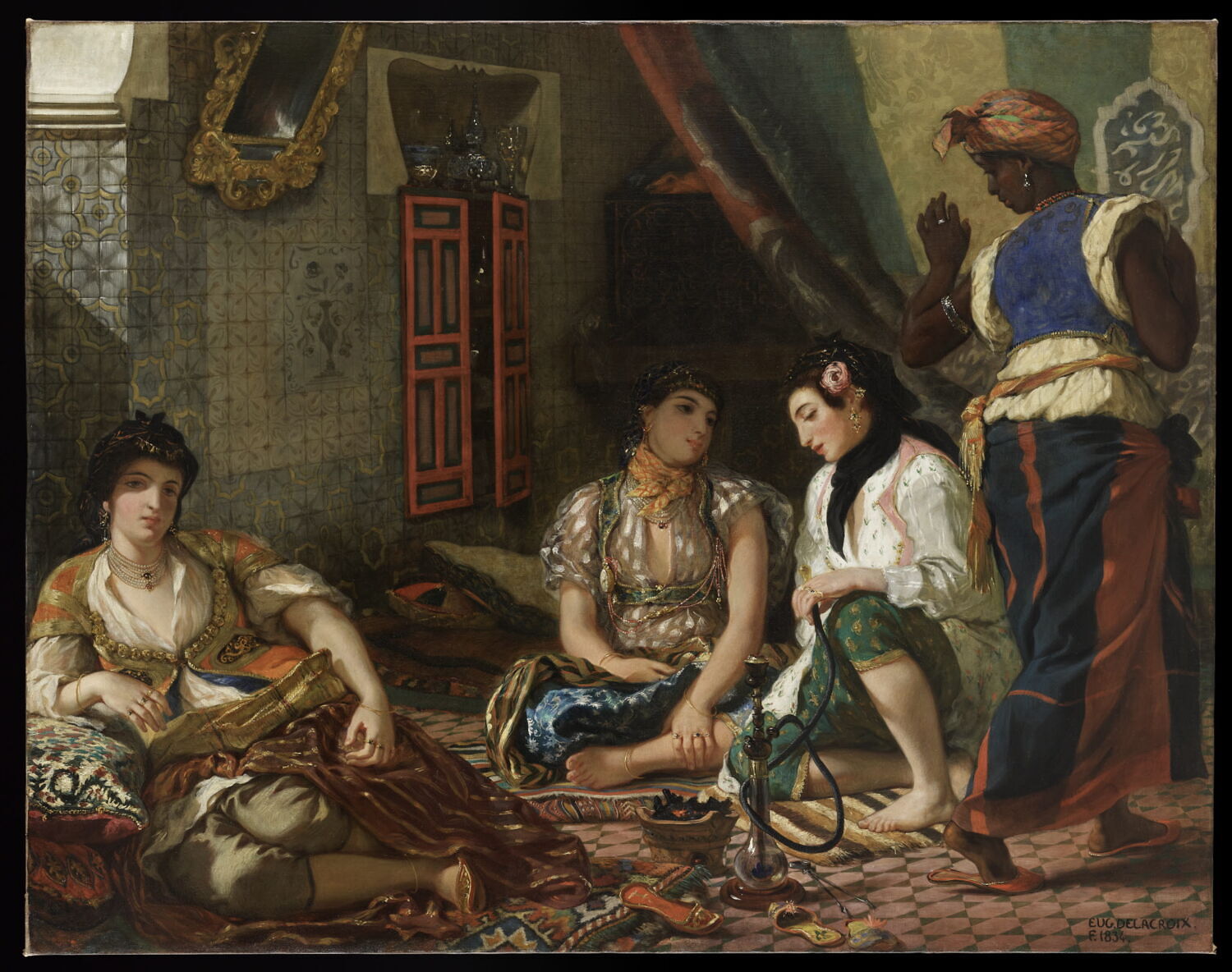
Femmes d'Alger dans leur appartement
Må man se det?
Ja, det tager imod

Udstillet for publikum.
- Kontrolleret
- Uændret siden
- Kilde
- Museet
Om maleriet
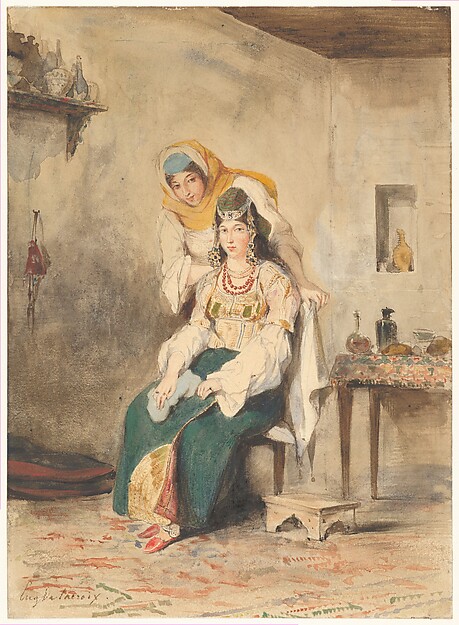
Women of Algiers in Their Apartment (French: Femmes d'Alger dans leur appartement) is the title of two oil on canvas paintings by the French Romantic painter Eugène Delacroix.
Delacroix's first version of Women of Algiers was painted in Paris in 1834 and is located in the Louvre, Paris, France. The second work, painted fifteen years later between 1847 and 1849, is located at the Musée Fabre, Montpellier, France. The two works both depict the same scene of four women together in an enclosed room. Despite the similar setting, the two paintings evoke completely different moods through the depiction of the women. Delacroix's earlier 1834 work captures the separation between the women and the viewer. The second painting instead invites the viewer into the scene through the warm inviting gaze of the women.
Læs videre
Women of Algiers, along with Delacroix's other Orientalist paintings, has inspired many artists of later generations. In 1888 both Vincent van Gogh and Paul Gauguin travelled to Montpellier to view Delacroix's 1849 version of Women of Algiers. The painting served as a source of inspiration to the later impressionists, and a series of 15 paintings and numerous drawings by Pablo Picasso in 1954.
Paul Cézanne described Delacroix's intoxicating colour plays as "All this luminous colour... It seems to me that it enters the eye like a glass of wine running into your gullet and it makes you drunk straight away".
Oplysninger
- Inventarnummer
- INV 3824
I kataloget
Kilder
- Louvre
- Billede: Louvre — © 2021 GrandPalaisRmn (musée du Louvre) / Franck Raux
Imens i livet hos Eugène Delacroix
Hele livet1832
Journey to Spain and North Africa
As part of the diplomatic mission of Charles-Edgar de Mornay, Delacroix traveled to Morocco shortly after the French conquest of Algeria. The journey proved a turning point: he made dozens of sketches, and his impressions of North Africa nourished his art for the rest of his life.
1832
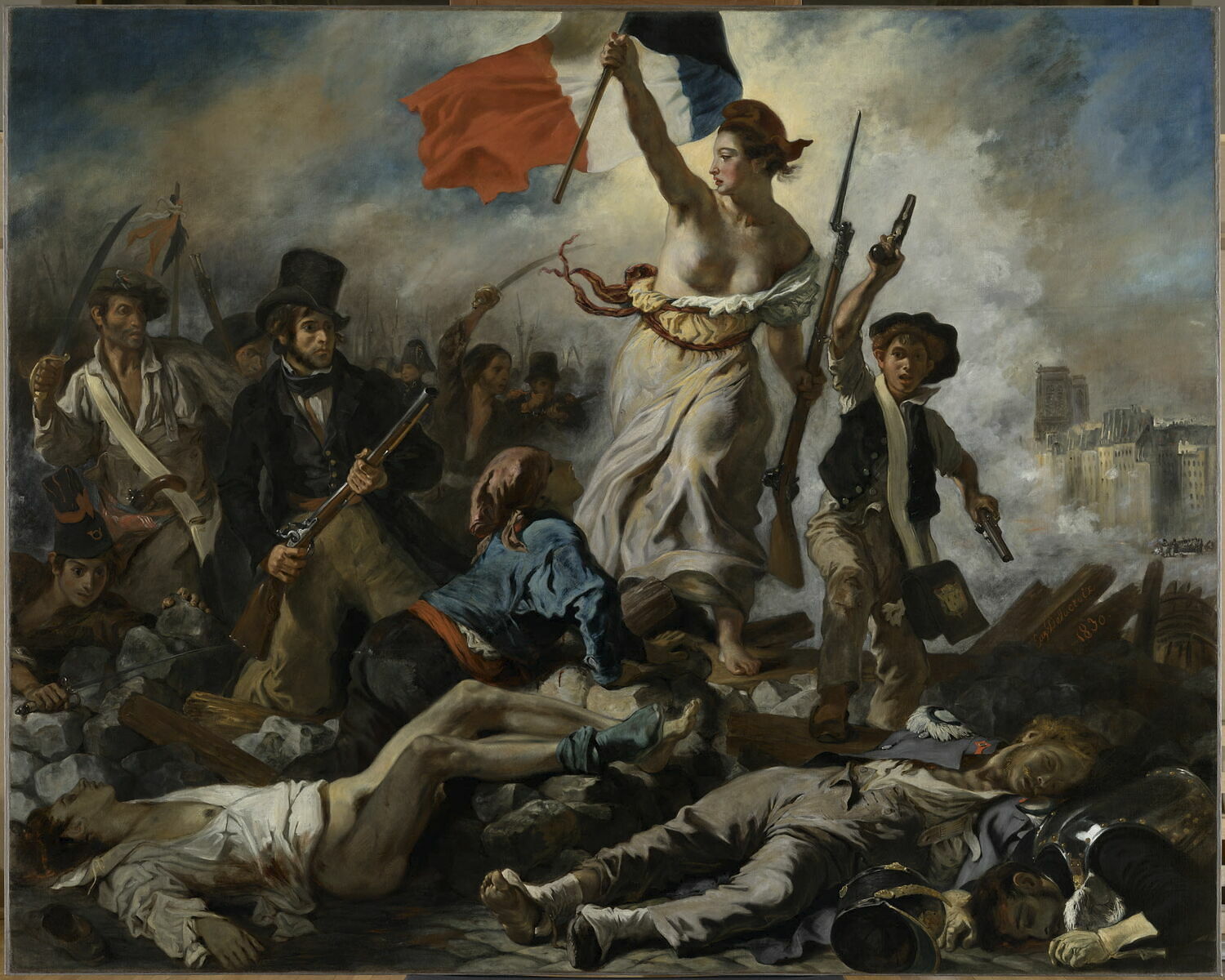
"Liberty" Removed from Public Display
By 1832 officials had deemed the painting's glorification of liberty too provocative and removed it from public display; nevertheless Delacroix continued to receive state commissions.
1833
Beginning of the Friendship with Marie-Élisabeth Blavot-Boulanger
In 1833 Delacroix formed a friendship with the painter Marie-Élisabeth Blavot-Boulanger that lasted the rest of his life.
1833–1837
Decoration of the Salon du Roi in the Palais Bourbon
From 1833 Delacroix received numerous commissions to decorate the public buildings of Paris; the first was his work on the Salon du Roi in the Chamber of Deputies at the Palais Bourbon, completed in 1837.
from 1834
Jeanne-Marie le Guillou Becomes His Housekeeper
From 1834 until the artist's death, the housekeeper Jeanne-Marie le Guillou cared for him devotedly, jealously guarding his private life.
1835
Serious Throat Illness Discovered
In 1835 Delacroix was found to have a serious throat ailment which, alternately subsiding and flaring up, eventually brought him to his grave.